Table of Contents
- Why Response Time Matters for Stranded Truckers
- Average Mobile Truck Repair Arrival Time: The Real Numbers
- What Determines a Mobile Diesel Mechanic’s Arrival Window?
- Emergency Diesel Engine Diagnostics On-Site vs. Towing to a Shop
- Mobile Diesel Repair Roadside Assistance: A Step-by-Step Guide
- The Cost and Safety Reality of Roadside Diesel Repair
- Get Back on the Road Faster with On-Site Repair
- Frequently Asked Questions
Last Updated: September 7, 2026
When a semi-truck fails on a busy interstate, every minute of downtime costs money and raises safety risks. A mobile diesel mechanic emergency response time directly determines how quickly a stranded driver can resume their route. This guide from Mudhollow Diesel Mechanics explains what response times you should expect, what causes delays, and how on-site service compares to towing your rig to a shop.
Why Response Time Matters for Stranded Truckers
A breakdown on the shoulder is more than an inconvenience; it is a financial and safety event. For owner-operators and fleet managers, the gap between the initial call and the mechanic’s arrival represents lost revenue, missed delivery windows, and mounting stress.
Beyond the financial hit, sitting on a highway shoulder exposes you to traffic risks that grow with every passing minute. A responsive mobile diesel mechanic emergency response time is the difference between a brief delay and a lost day of work.
Average Mobile Truck Repair Arrival Time: The Real Numbers
Response times vary widely based on traffic conditions, the time of day, and how far you are from the nearest available service vehicle.
Here is what you can generally expect:
- Immediate dispatch: A call is answered and a technician is assigned within 10 to 15 minutes (fmcsa.dot.gov).
- Travel to your location: The drive time typically ranges from 30 to 75 minutes for a mobile unit within a 50-mile service radius (trucking.org).
- On-site assessment: Once arrived, the mechanic performs diagnostics within 15 to 30 minutes.
- Repair completion: Most common roadside fixes are completed within 1 to 2 hours of arrival.
These figures align with the operational benchmarks used across the towing and mobile repair industry, where Federal Motor Carrier Safety Administration guidance on roadside breakdowns emphasizes minimizing roadside exposure time for safety. The actual mobile truck repair arrival time you experience will hinge on the factors covered in the next section.
What Determines a Mobile Diesel Mechanic’s Arrival Window?
Several variables influence how quickly a technician can reach you. Understanding these helps set realistic expectations and speeds up the entire process.
Your Location and Service Radius
Distance is the primary factor. A service provider operating along a specific corridor, such as the I-80 and I-29 routes in western Iowa, can typically reach any point within their coverage zone faster than a generalist traveling from a distant city. When you call, the dispatcher immediately calculates drive time based on your mile marker and the nearest available truck.
Time of Day and Emergency Demand
A 2:00 AM call on a Tuesday will likely get a faster response than a Friday afternoon rush hour breakdown. Peak breakdown periods, severe weather, and situations where multiple emergencies occur simultaneously can stretch arrival windows. Reputable providers maintain 24/7 dispatch, but they cannot guarantee instant arrival when every unit is already on a call.
Decoding the Emergency Call-Out Fee Structure
Mobile diesel services often structure their emergency response pricing around three components: a base call-out fee, a mileage surcharge, and an after-hours premium. Understanding this structure is key to avoiding surprises.
- Base Call-Out Fee: This is a flat charge to cover the cost of dispatching a fully stocked service truck to your location. It is triggered the moment a technician is assigned, regardless of whether the repair takes 15 minutes or two hours.
- Mileage Surcharge: This is calculated from the service provider’s base location (or the technician’s last job site) to your exact mile marker. The rate is typically applied per mile, and it compensates the provider for fuel, vehicle wear, and the technician’s travel time. A breakdown 10 miles from the shop will have a lower surcharge than one 45 miles away.
- After-Hours Premium: Calls placed outside standard business hours, typically evenings, overnights, weekends, and holidays, carry a premium. This reflects the higher labor costs associated with keeping a technician on call 24/7.
When you call, ask the dispatcher directly: “What is your base call-out fee, what is your per-mile rate, and is there an after-hours premium right now?” If a dispatcher is vague or refuses to break down the charges, that is a red flag.
How Dispatch Prioritization Works
When multiple calls come in simultaneously, providers often use a prioritization system. Calls involving a complete blockage of a traffic lane or a safety hazard will typically be dispatched before a truck that has safely pulled into a wide rest area. If you are safely off the travel lanes, you may wait slightly longer for a technician to first clear a more dangerous situation.
When requesting emergency service, always ask for the total estimated cost including the call-out fee, mileage, and any after-hours premium. A professional dispatcher will give you a firm number before you commit, allowing you to make an informed decision without any guesswork.
Emergency Diesel Engine Diagnostics On-Site vs. Towing to a Shop
The choice between on-site repair and towing comes down to speed, cost, and the nature of the fault. Emergency diesel engine diagnostics on-site allow a technician to identify the issue immediately, often fixing it right there on the shoulder. Towing to a shop adds the cost of the tow itself, plus the time spent waiting for the truck to be unloaded, scheduled into the shop’s queue, and diagnosed.
For many breakdowns, a technician with the right diagnostic tools can resolve the issue on-site. This approach is particularly effective for issues like radiator leaks, turbocharger failures, and electrical gremlins that require computer diagnostics rather than heavy shop equipment.
What a Mobile Tech Can Fix On-Site vs. What Requires a Tow
Our experienced team specializes in rapid roadside repairs and preventive maintenance, ensuring you get back on the road quickly and efficiently. However, it is critical to understand the line between a roadside fix and a shop job.
Common On-Site Repairs:
- Sensor and Actuator Replacements: Failed sensors (e.g., coolant temperature, manifold absolute pressure, NOx sensors) often trigger limp mode. These are typically plug-and-play replacements that a mobile tech can handle in under an hour.
- Air and Fuel System Leaks: Leaking hoses, clamps, and fittings for air intake or fuel return lines can often be repaired on-site with the right parts on the truck.
- Radiator and Cooling System Issues: A leaking radiator hose or a failed fan clutch can be replaced on the shoulder. A cracked radiator end tank might be repairable with specialized sealants and clamps, but a full radiator replacement is often better done in a shop.
- Turbocharger Actuator Failures: A stuck or failed variable geometry turbo (VGT) actuator can be replaced on-site, restoring boost pressure and getting you back on the road.
- Electrical Faults: Wiring chafes, corroded connectors, and failed relays are common culprits for no-start or charging issues. A mobile tech with a multimeter and wiring diagrams can trace and repair these on the spot.
Repairs That Typically Require a Tow:
- In-Frame or Major Engine Overhauls: If a connecting rod has thrown or the block is cracked, no mobile service can fix that on the shoulder.
- Transmission Rebuilds: Internal transmission failures require a shop environment with a lift and specialized tooling.
- Extensive Parts Replacement: If a repair requires removing the cab or dropping the oil pan to access internal components, it is not a roadside job.
- Wheel-End and Brake Rebuilds: While a mobile tech can replace a brake chamber, a full hub and drum rebuild is a shop job.
The Diagnostic Advantage of a Mobile Unit
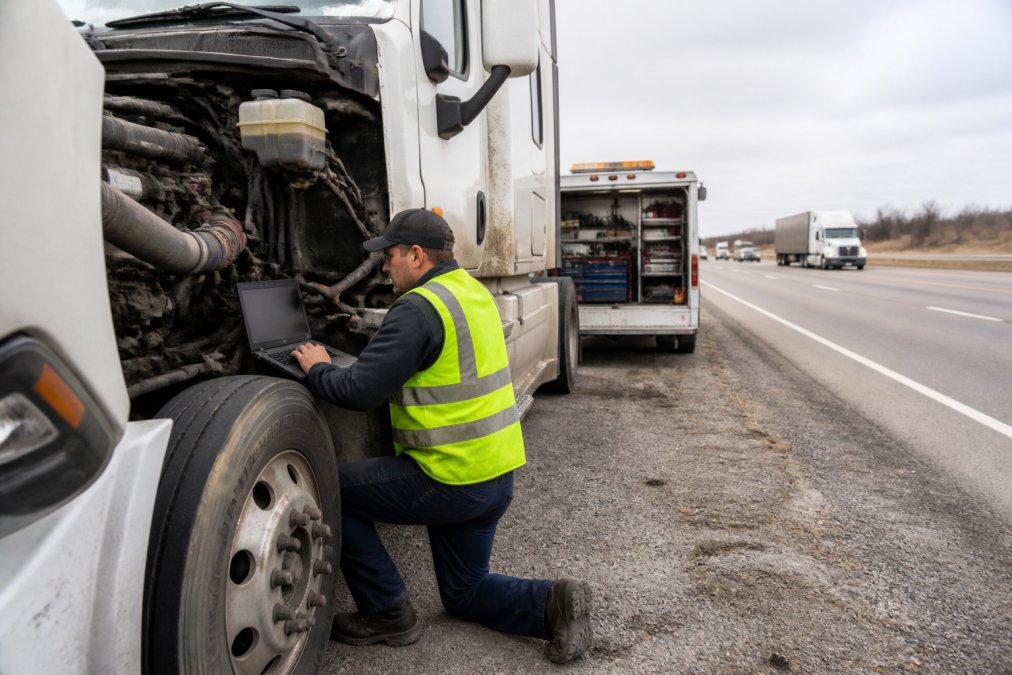
Modern service trucks with computer diagnostics read proprietary fault codes from the engine, transmission, and aftertreatment systems, allowing a technician to perform a deep dive into the data on-site.
For example, a truck in limp mode with a check engine light could be caused by a faulty sensor, a wiring issue, or a more serious mechanical problem. A mobile tech can plug in the diagnostic laptop, read the live data stream, and see exactly what the engine computer is seeing. This level of diagnostic capability means they can often fix a problem that would otherwise require a tow to a shop.
If a mobile technician recommends a tow, ask them to explain exactly why the repair cannot be done on-site. A reputable professional will give you a clear, mechanical reason, such as “the camshaft is broken and requires an engine teardown”, rather than a vague “we don’t have the tools for that here.” This transparency protects you from paying for a temporary patch that fails 50 miles down the road.
Mobile Diesel Repair Roadside Assistance: A Step-by-Step Guide
Knowing what to do in the first minutes after a breakdown can cut significant time off your mobile diesel repair roadside assistance experience.
What to Do Immediately After a Breakdown
Your actions in the first few minutes set the stage for a smooth rescue:
- Get to safety: Move your rig as far onto the shoulder as possible and turn on your hazard lights.
- Set up warning devices: Place reflective triangles behind your truck at the legally required distances to alert approaching traffic.
- Assess the situation: Note any warning lights, unusual sounds, or fluid leaks. Do not open a hot radiator cap.
- Call for help: Contact a mobile diesel service directly rather than a tow company, unless you are certain you need a tow.
Information to Have Ready When You Call
Providing accurate details on the first call accelerates dispatch:
- Your exact location, including highway, direction, and mile marker
- A description of the symptoms or warning lights
- Your truck’s make, model, and engine type
- Whether you are hauling a load and if it requires special handling
Having this information ready ensures the dispatcher can confirm coverage and send a technician equipped with the right parts and diagnostic tools.
The Cost and Safety Reality of Roadside Diesel Repair
Roadside repair can be more cost-effective than towing when you account for the full picture. You save the tow fee and eliminate the downtime of waiting for the shop to fit you into their schedule.
Safety is the other half of the equation. When you choose a mobile service, the technician handles the traffic exposure, not you.
Get Back on the Road Faster with On-Site Repair
A fast mobile diesel mechanic emergency response time is the single biggest factor in minimizing your downtime after a breakdown. By choosing a provider that brings advanced diagnostics and experienced technicians directly to your location, you avoid the expense and delay of towing and shop queues.
The most effective way to reduce your mobile diesel mechanic emergency response time is preparation. Keep the phone number of a reliable mobile service in your cab, know your mile marker, and understand your truck’s symptoms so you can give the dispatcher everything they need on the first call.
Mudhollow Diesel Mechanics delivers rapid, fully equipped mobile diesel repair directly to your location along the I-80 and I-29 corridors in western Iowa. Our modern service trucks carry computer diagnostics and heavy-duty tools, allowing our experienced technicians to resolve most roadside fixes on the spot, whether you are on the shoulder, at a rest stop, or in your own yard. We focus on honest, high-quality repair that minimizes your downtime and keeps your operation moving without the high dealership prices or long wait times.
Frequently Asked Questions
What is the average response time for a mobile diesel mechanic?
Arrival times depend on your location and current dispatch load. For breakdowns on major corridors like I-80 or I-29 within their primary service area, a well-equipped mobile diesel mechanic can often reach you. The best way to get an accurate arrival window is to call and provide your exact mile marker. Ask for a realistic estimate before they dispatch, not a best-case promise.
What factors affect how quickly a mobile diesel mechanic can reach a breakdown?
Your distance from the mechanic’s current location is the biggest factor, which is why choosing a service based near major highway corridors matters. Time of day also plays a role; a 2 AM call on a Tuesday may have a different response time than a Friday afternoon rush. Traffic, weather, and the number of other active emergency calls all shift the arrival window. A professional dispatch will give you an honest update if delays occur.
Does a mobile diesel mechanic provide faster service than a traditional shop?
For many roadside failures, yes. A mobile diesel mechanic eliminates the time spent waiting for a tow truck, the drive to the shop, and the queue of trucks already ahead of you in the service bay. A mobile unit arrives with diagnostic tools and parts on board, meaning many repairs are completed on-site. This direct approach focuses on getting you moving again with minimal downtime.
What information should I have ready when calling for mobile diesel assistance?
Your exact location, including the highway, direction of travel, and nearest mile marker, is essential. Be ready to describe the symptoms: unusual noises, loss of power, warning lights, or a sudden shutdown. Knowing your truck’s make, model, and year helps the technician prepare the right parts and diagnostic equipment. Mention any recent repairs or recurring issues, as this context can speed up the on-site troubleshooting process significantly.
Getting stuck on the roadside tests your patience and your bottom line. You do not have to wait hours for a tow truck to haul you to a distant shop. Call or text Mudhollow Diesel Mechanics now at 712-827-0207, and let our mobile team bring the repair to you.