Table of Contents
- Mobile Truck Repair vs. Towing: The Core Decision
- Average Downtime for Semi-Truck Breakdowns: What Is at Stake
- When Does Mobile Truck Repair Make Sense?
- Situations That Still Require a Tow
- Common Roadside Semi Truck Failures We Fix On-Site
- Mobile Diesel Mechanic Diagnostics: Beyond Basic Fixes
- Cost Transparency: Repair vs. Tow
- The Verdict: Choose Mobile Repair to Minimize Downtime
- Frequently Asked Questions
Last Updated: September 5, 2026
Mobile Truck Repair vs. Towing: The Core Decision
A dead semi on the shoulder of I-80 presents one question before any other: does this need a tow, or can a mobile truck repair service fix it on the spot? The answer determines whether you lose four hours or two days. At Mudhollow Diesel Mechanics, we’ve spent 15+ years responding to breakdowns across western Iowa, and most roadside failures never require a tow truck at all.
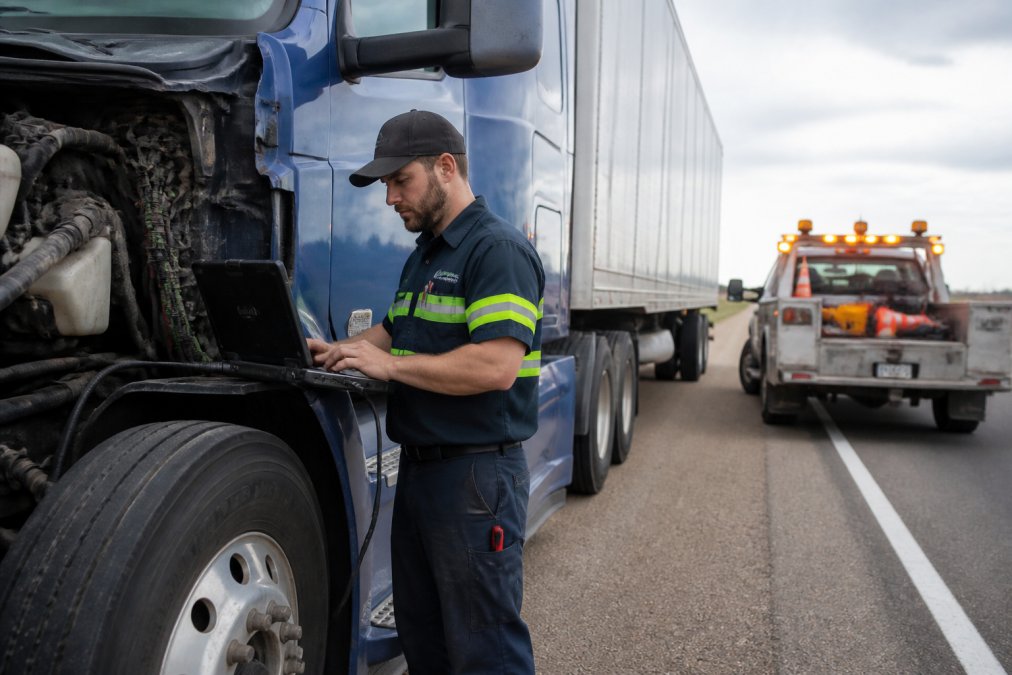
Mobile truck repair dispatches a fully equipped service truck and technician to your location to perform diagnostics and repairs on-site. Towing means hauling your rig to a shop where it waits in line behind other jobs.
Average Downtime for Semi-Truck Breakdowns: What Is at Stake
Every hour a commercial truck sits idle costs money, and the gap between mobile repair and towing is measured in days, not hours (fleetowner.com). When you tow to a shop, your rig joins a queue and repairs often don’t begin until the next business day. A mobile diesel mechanic typically starts work within an hour of arrival (trucking.org).
The structural advantage of mobile repair is consistent: you eliminate the tow itself, the shop intake process, and the scheduling delay. For owner-operators, that difference can mean the margin between a profitable week and a loss.
The real cost of a breakdown isn’t the repair. It’s the compounding downtime of waiting for a tow, waiting for shop intake, and waiting in the repair queue. Mobile repair compresses all three.
When Does Mobile Truck Repair Make Sense?
Mobile truck repair makes sense for the majority of mechanical failures that don’t require a shop environment. Radiator leaks, turbocharger issues, electrical faults, and air brake problems are all addressable on-site with the right tools and diagnostic equipment.
The strongest case for mobile repair is speed. A service truck with computer diagnostics can identify the root cause of a problem that a generalist shop might spend hours chasing.
Situations that favor mobile repair include:
- Electrical gremlins that require computer diagnostics rather than guesswork
- Cooling system failures like radiator leaks that are repairable on-site
- Turbocharger problems where the unit can be replaced roadside
- Air brake issues that need adjustment or component replacement
- Preventive maintenance at your yard or terminal to avoid future breakdowns
Situations That Still Require a Tow
Knowing when to say “no” to a mobile repair is just as important as knowing when to say “yes.” While most mechanical failures are fixable on the shoulder, a handful of situations demand the specialized equipment and controlled environment of a heavy-duty tow.
The Non-Negotiables: When a Tow Is the Only Safe Option
These scenarios are not judgment calls. Attempting a roadside repair in any of the following situations puts you, other motorists, and the technician at risk.
- Major Structural or Frame Damage: If a collision or component failure has compromised the frame rails, suspension mounts, or fifth wheel, the truck’s structural integrity is unknown. Lifting, jacking, or even supporting the vehicle to perform a repair can cause it to collapse. A tow to a shop with a frame rack is the only safe move.
- Catastrophic Engine or Drivetrain Failure: A thrown rod, a cracked block, or a shattered differential carrier are not roadside repairs. These failures often require an engine or transmission replacement, which needs an overhead crane, a clean bay, and specialized tooling. Attempting to patch these on the roadside is a waste of time and money.
- Uncontrolled Fluid Leaks (Fuel or Oil): A minor oil seep is one thing. A ruptured high-pressure fuel line spraying diesel onto a hot turbocharger is a fire hazard. If the leak is active and cannot be isolated, the truck must be towed to prevent an engine fire.
- Brake System Total Failure: If the service brakes are completely inoperative and the spring brakes cannot be safely released or caged, the vehicle cannot be safely stopped. A tow truck with a heavy-duty underlift is the only way to move it.
The Judgment Calls: When Context Dictates the Answer
Beyond the hard rules, there is a gray zone where the right answer depends on your specific situation.
- The Dangerous Parking Spot: You are on a narrow shoulder with a concrete barrier on one side and active traffic inches away. Even if the repair is a simple radiator hose, the risk of a secondary collision while a technician is leaning into the engine bay is unacceptably high. In this case, a short tow to a safe, wide shoulder or a nearby truck stop is the correct move. Once the truck is in a safe location, a mobile mechanic can perform the repair.
- The Load Shift: A shifted load is a cargo problem, not a mechanical one. Unhooking a trailer with a shifted load can cause it to tip. Re-opening the doors to inspect or re-secure the cargo is dangerous. This requires specialized recovery equipment and a controlled environment. Call for a tow and a load-transfer service.
- The 2 AM Parts Problem: It is 2 AM, and the diagnostic points to a failed turbocharger actuator. You have the part on the truck, but the repair requires removing the heat shields and downpipe, a two-hour job in a well-lit shop, but a four-hour ordeal on a dark, windy shoulder with a flashlight. The risk of dropping a bolt into the abyss or rushing the job and creating a new problem is real. In this scenario, a tow to a shop where the repair can be done safely and methodically might be the faster path to a reliable fix.
The Decision Matrix: A Practical Guide
Use this as a quick reference when you are on the side of the road and the adrenaline is up.
| Breakdown Type | Mobile Repair? | Tow Required? | Primary Decision Factor |
|---|---|---|---|
| Radiator or coolant leak (minor, accessible) | Yes | No | Safe parking spot |
| Radiator or coolant leak (major, spraying) | No | Yes | Fire risk and fluid loss |
| Turbocharger failure (oil leak external) | Yes | No | Component accessibility |
| Turbocharger failure (catastrophic, metal in intake) | No | Yes | Risk of engine damage |
| Electrical or sensor fault | Yes | No | Diagnostic capability on truck |
| Air brake component (e.g., failed chamber) | Yes | No | Ability to safely cage brakes |
| Total air brake system failure | No | Yes | Vehicle cannot be stopped |
| Blown engine (internal failure) | No | Yes | Requires shop environment and crane |
| Major accident damage | No | Yes | Structural integrity unknown |
| Dangerous load shift | No | Yes | Cargo safety and recovery equipment |
| Unsafe roadside position (narrow shoulder) | No | Yes (short tow) | Secondary collision risk |
When in doubt, err on the side of safety. A tow to a safe location is never a wasted expense if it prevents an accident or a secondary failure. The goal is to get your truck back to revenue, not to prove a repair can be done on the shoulder.
If you are in a safe location and the failure is mechanical, a mobile repair is almost always the fastest path. But if you are in a dangerous spot or the damage is structural, do not hesitate to call for the hook. Our team can often meet a tow at a safe location to perform the repair there, saving you the shop queue entirely.
Common Roadside Semi Truck Failures We Fix On-Site
The most common roadside semi truck failures are remarkably consistent across fleets and owner-operators. Cooling system leaks, turbocharger failures, and electrical faults account for a significant share of emergency calls.
Radiator failures typically manifest as overheating or visible coolant loss. A mobile mechanic can pressure-test the system, identify the leak point, and replace the radiator on-site. Turbocharger issues often present as loss of power or excessive smoke, and a trained diesel technician can swap the unit roadside.
Electrical diagnostics represent the fastest-growing category of roadside calls. Modern trucks run dozens of sensors and computer modules, and a failure in any one can shut the truck down (nhtsa.gov). Mobile diagnostics using factory-grade software can pinpoint these faults far faster than visual inspection alone.
Calling a tow for a repairable mechanical failure multiplies your downtime and your cost. A shop may not even look at your truck for 24 hours after it arrives. Always confirm whether the failure is tow-worthy before you commit to the hook.
Mobile Diesel Mechanic Diagnostics: Beyond Basic Fixes
Mobile diesel mechanic diagnostics have evolved well beyond the basic roadside fixes of a decade ago. Modern service trucks carry computer diagnostic systems that interface directly with a truck’s engine control module, transmission controller, and ABS system.
The sophistication matters most for electrical problems. A truck that dies randomly or loses power under load can stump even dealership technicians. Mobile diagnostics approach these problems systematically, using data logging and circuit testing to isolate the fault.
This capability changes the economics of breakdowns. A mobile mechanic with proper diagnostics can often resolve in two hours what a shop might spend a full day chasing.
Cost Transparency: Repair vs. Tow
The financial picture of a breakdown is rarely just the line item on the invoice. It is the sum of the tow bill, the shop’s diagnostic fee, the repair labor, the parts markup, and the cost of every hour your truck sits idle.
The Cost Model of a Tow
A tow is a simple transaction with a complex price tag. You are paying for the tow truck’s travel time, the driver’s expertise, and the liability of hauling an 80,000-pound vehicle. The bill typically includes a base fee plus a per-mile rate.
The Cost Model of Mobile Repair
Mobile repair consolidates the financial picture into a single invoice. A service call fee covers the technician’s travel time, and an hourly labor rate covers the diagnostic and repair work performed on-site.
Here is the critical difference: with mobile repair, you pay for the diagnostic and the repair in one visit. With a tow, you pay for the tow, then the shop’s diagnostic time, and then the repair labor.
The Hidden Cost: Downtime
The most significant cost difference is not on the invoice. It is the revenue you lose while your truck is out of service.
| Cost Factor | Tow + Shop Repair | Mobile Repair |
|---|---|---|
| Tow truck bill | Yes (base + per-mile) | No |
| Shop diagnostic fee | Yes (often 1-2 hours of shop labor) | Included in service call |
| Repair labor | Yes (shop hourly rate, often higher than mobile) | Yes (mobile hourly rate) |
| Parts markup | Yes (shop standard markup) | Yes (standard retail) |
| Time to repair start | 4-24+ hours (waiting for shop intake) | 60-90 minutes (technician on-site) |
| Risk of “additional findings” | High (truck is in their bay) | Low (you are present for the diagnosis) |
| Total downtime | 2-5+ days | 2-6 hours for most repairs |
Why the “Higher” Hourly Rate Is Often Cheaper
A common misconception is that a mobile mechanic’s hourly rate is higher than a shop’s rate. While the per-hour number can look higher, the total cost is almost always lower for repairable failures:
- You pay for one visit, not two. The tow is not a separate line item.
- The diagnostic is faster. A mobile technician with sophisticated computer diagnostics is focused solely on your truck. A shop technician is juggling multiple jobs and may not even look at your truck until the next day.
- You avoid the shop queue. Your truck does not sit for 24 hours waiting for a bay to open.
- You control the process. You are standing next to the technician. You see the problem, you approve the repair, and you know exactly what you are paying for before the work begins.
Factors That Affect the Final Bill
Several variables influence the final cost of a mobile repair call.
- Distance: The service call fee typically covers a base radius. Calls beyond that radius incur a per-mile travel charge.
- Time of Day: After-hours, weekend, and holiday calls often carry a premium, similar to a tow company’s after-hours rate.
- Parts Availability: If the failed component is not on the service truck, the technician may need to source it from a local dealer. This adds time and potentially a parts delivery fee.
- Repair Complexity: A simple sensor replacement is a one-hour job. A turbocharger swap is a four-hour job. The labor line item reflects the time required to do the job correctly.
The cheapest option is not the one with the lowest hourly rate. It is the one that gets your truck back to revenue in the shortest time with the fewest surprise charges. For most mechanical failures, mobile repair wins on total cost because it eliminates the tow, the shop queue, and the diagnostic fee.
For a transparent quote on your specific breakdown, contact Mudhollow Diesel Mechanics. We will walk you through the service call fee, the estimated labor time, and the parts cost before we dispatch a technician. No hidden fees, no shop markup games, just a straight answer on what it takes to get you rolling again.
The Verdict: Choose Mobile Repair to Minimize Downtime
The choice between mobile truck repair and towing comes down to one priority: minimizing downtime. If the failure is mechanical and the truck is safely parked, mobile repair is almost always the faster path back to revenue.
Mudhollow Diesel Mechanics provides fully equipped mobile diesel repair across I-80 and I-29 in western Iowa, from mile markers 1 through 100. Our service trucks carry computer diagnostics and heavy-duty tools, and our technicians have 15+ years of experience with the hard-to-solve breakdowns that stump generalist shops. The majority of our customers avoid a tow entirely because we arrive fast and fix the problem on-site.
For fleet managers, we also offer scheduled preventive maintenance at your yard or terminal, catching small issues before they become roadside emergencies. Whether you’re an owner-operator stranded at 2 AM or a fleet manager protecting your schedule, the fastest fix is the one that comes to you.
Frequently Asked Questions
When is a mobile truck repair service a better option than towing?
Mobile truck repair is the better option when the failure can be safely diagnosed and fixed on-site, such as radiator leaks, turbocharger issues, electrical faults, or air system problems. If the truck is mechanically sound enough to be repaired where it sits, a mobile mechanic eliminates the tow bill, the shop wait, and the extra downtime. Towing only becomes necessary for major structural damage, a wreck, or a failure that requires specialized shop equipment the mobile unit cannot carry.
What types of semi-truck failures can be fixed on the side of the road?
Most mechanical failures that do not involve structural damage can be repaired on-site. Common roadside semi truck failures include radiator and cooling system leaks, turbocharger failures, belt and hose breaks, starting and charging issues, and air brake system faults. Sophisticated mobile diesel mechanic diagnostics also handle electrical gremlins and sensor failures that would normally send a truck to a dealership. The key is whether the part is accessible and the repair can be completed safely on the shoulder.
How does mobile diesel repair reduce downtime compared to shop repairs?
A tow to a shop can add hours before the truck is even looked at. Mobile diesel repair cuts that to zero by bringing the mechanic and the diagnostic tools to the truck. The average downtime for semi-truck breakdowns drops significantly because the repair starts the moment the technician arrives, not after the truck is towed, unloaded, and queued behind other shop work. For many roadside failures, the fix is completed in less time than the tow itself would take.
Is it safer to repair a truck on the shoulder or tow it to a shop?
Both options carry risk, but a professional mobile repair team follows strict safety protocols to work on the shoulder. Technicians position the service truck as a barrier, use cones and warning lights, and assess the scene before starting work. If the breakdown location is too dangerous for roadside repair, a reputable mobile mechanic will tell you and recommend a tow instead. The decision depends on shoulder width, visibility, traffic speed, and weather conditions at the breakdown site.
The next time your truck dies on the highway, the question isn’t “tow or repair?” It’s “how fast can a qualified mechanic get here?” Mudhollow Diesel Mechanics answers that question with rapid dispatch, advanced diagnostics, and repairs completed where your truck sits. Skip the tow, skip the shop wait, and get back to hauling. Call or text now at 712-827-0207 to get a technician rolling your way.
This article was written using GrandRanker