Table of Contents
- Why Mobile Fleet Maintenance Reduces Downtime and Protects Warranties
- Mobile Mechanic vs. Traditional Repair Shop: What Fleet Managers Need to Know
- How to Vet a Mobile Mechanic: Certifications, Insurance, and Warranty Compliance
- Fleet Maintenance Documentation Best Practices for Warranty Claims
- On-Site Heavy-Duty Diagnostic Capabilities: What Your Mobile Mechanic Must Have
- Building a Preventative Maintenance Schedule for Mobile Units
- Conclusion
- Frequently Asked Questions
Last Updated: September 15, 2026
Why Mobile Fleet Maintenance Reduces Downtime and Protects Warranties
Learning how to choose a mobile mechanic for fleet warranty maintenance starts with understanding what’s actually at stake: a breakdown on I-80 doesn’t just cost you a repair, it can void the coverage that was supposed to pay for it. A mobile service provider that comes to your truck keeps it out of a shop queue, but the wrong provider can leave you with repair documentation that a warranty administrator won’t accept.
Fleet warranty maintenance is the practice of performing scheduled and emergency repairs in a way that preserves the manufacturer’s or extended warranty coverage on each vehicle. It requires three things working together: qualified technicians, documented service history, and parts that meet warranty compliance standards.
The math favors mobile service. Every hour a commercial vehicle sits waiting on a shop bay is an hour it isn’t earning, and tow costs stack on top of that. Mobile repair eliminates the tow in most cases and shortens repair turnaround time because the technician works on your schedule, at your yard or on the shoulder.
Downtime reduction isn’t just about speed. It’s about keeping the repair inside the warranty system so the next failure doesn’t come out of your pocket.
Mobile Mechanic vs. Traditional Repair Shop: What Fleet Managers Need to Know
A traditional shop wins on lift access, parts inventory, and climate control. A mobile mechanic wins on response time, on-site repair, and keeping your fleet uptime intact without a tow.
For warranty work specifically, the deciding factor is often documentation quality, not tooling. A dealership service department generates warranty-compliant records automatically. A mobile provider has to build that paper trail deliberately, and not all of them do.
| Factor | Mobile Mechanic | Traditional Shop |
|---|---|---|
| Response time | Hours, on-site | Same-day to multi-day queue |
| Tow required | Usually no | Usually yes |
| Documentation control | Varies by provider | Standardized |
| Best for | Roadside failures, scheduled yard service | Major teardown, warranty recall work |
When a Shop Visit Makes More Sense
Some jobs belong in a bay. Internal engine teardown, transmission removal, and structural frame work need a lift and a controlled environment. If a mobile technician diagnoses a failure that requires that level of disassembly, the honest answer is a shop referral, not a roadside attempt. A provider who tells you that upfront is worth more than one who promises everything.
How to Vet a Mobile Mechanic: Certifications, Insurance, and Warranty Compliance
Vetting comes down to three checkpoints: technician credentials, liability insurance, and whether the provider’s paperwork survives a warranty audit. Ask for all three before you hand over a truck.
ASE Certification and Technician Credentials
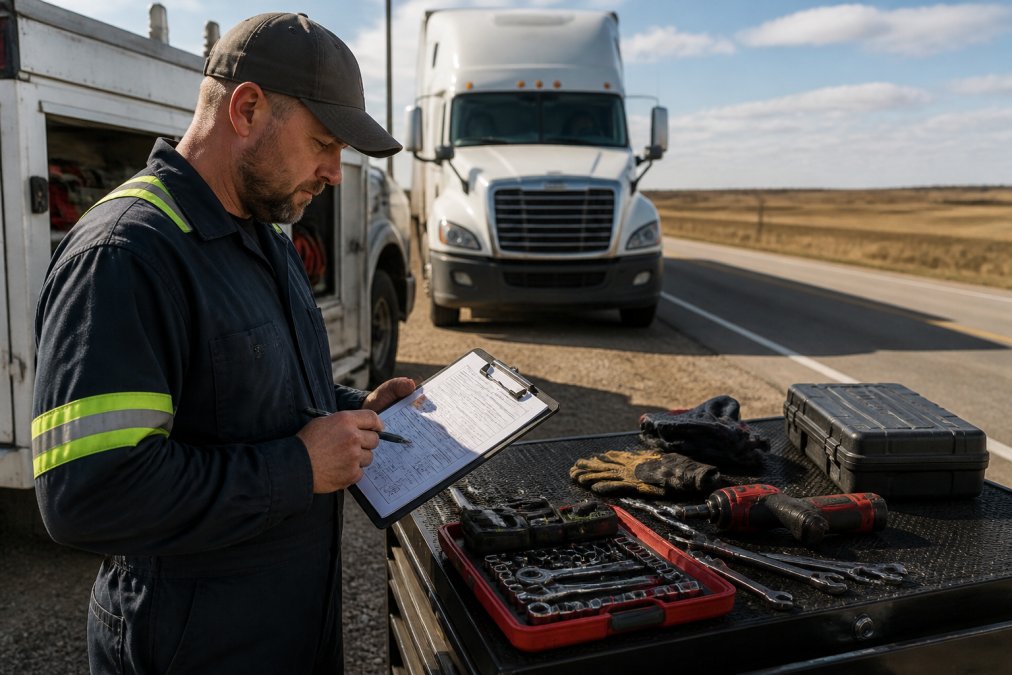
ASE certification is the baseline credential for commercial vehicle repair, and the relevant tests for diesel work fall under the medium-heavy truck series (ASE Certification Test Series). Ask which specific certifications each technician holds, not just whether the company “has ASE techs.” A shop owner can hold a master certification while the person dispatched to your yard holds none.
Technician experience matters as much as the certificate. Fifteen years of roadside diesel work produces a different diagnostic instinct than two years in a dealership bay, particularly on electrical faults that don’t throw a clean code.
Liability Insurance and Warranty Coverage
Request a certificate of insurance showing commercial general liability and garage keeper’s coverage before any work begins (Business Vehicle Insurance). If a technician damages your vehicle or a third party’s property during an on-site repair, you want the provider’s policy responding, not your fleet policy.
Then ask about parts warranty and labor warranty separately. A part covered for twelve months means little if the labor to replace it isn’t covered alongside. Get both terms in writing, including whether the warranty follows the truck or the original purchaser.
A provider who can’t produce a certificate of insurance on request is a liability risk you’re absorbing personally. One damaged turbo or dropped tool can exceed the entire repair invoice.
Fleet Maintenance Documentation Best Practices for Warranty Claims
Fleet maintenance documentation best practices for warranty claims come down to one standard: a third party should be able to reconstruct the repair from your records without asking you a single question. Warranty administrators deny claims for missing detail far more often than for disputed workmanship.
The Warranty Claim Workflow With a Mobile Provider
This is where most fleet managers get surprised. A dealership service department files the warranty claim for you because it is an authorized franchise location. A mobile provider usually is not, which means the claim path runs through you or through an authorized dealer who agrees to process a repair it did not perform.
A common pattern looks like this:
CALL or TEXT NOW:712-827-0207 →
- The mobile technician diagnoses the failure and confirms the component is within the manufacturer’s or extended warranty term.
- The provider documents the failure with codes, photos, and part numbers, then either performs the repair or holds pending authorization.
- You or the provider submits the claim package to the warranty administrator or the covering dealer.
- The administrator reviews documentation and either authorizes reimbursement, requests more detail, or denies.
- If the repair was already completed, you seek reimbursement; if not, you wait for authorization before parts are ordered.
The practical takeaway: ask any mobile provider up front whether they submit warranty claims directly, whether they work with a sponsoring dealer, or whether the claim is entirely your responsibility. Get that answer in writing before the first breakdown, because it determines how much administrative work lands on your desk.
What Belongs in Every Service Log
Build every service log around these fields:
- VIN and current odometer reading at time of service
- Date, location, and description of the reported symptom
- Diagnostic trouble codes pulled, with the code numbers recorded verbatim
- Parts used, including manufacturer part numbers and supplier
- Labor performed, with hours and technician name
- Photos of the failed component before and after replacement
- Whether the repair was pre-authorized or completed pending reimbursement
Fleet Management Software Integration
This is the piece almost no mobile provider advertises, and it is the one that saves the most administrative time. If your fleet runs a maintenance platform, ask whether the provider can deliver work orders in a format you can import, or better, whether they can post directly into your system through an API or a supported integration.
A provider that hands you a PDF invoice forces manual re-entry, and manual re-entry is where VINs get transposed and odometer readings get dropped. Those small errors are exactly what a warranty administrator uses to deny a claim. If direct integration is not available, ask for a structured digital report with fixed fields you can map into your platform without retyping.
Test the integration before you need it. Have the provider send one sample work order through their normal process and try importing it into your fleet platform. If it fails on a routine job, it will fail on a warranty claim.
Repair documentation also protects you on repeat failures. If the same component fails twice, a complete service history is what separates a covered claim from an argument.
On-Site Heavy-Duty Diagnostic Capabilities: What Your Mobile Mechanic Must Have
On-site heavy-duty diagnostic capabilities determine whether a mobile call actually resolves the problem or just confirms it. A service truck carrying hand tools and a code reader handles basic roadside fixes. It won’t touch the faults that strand a modern diesel.
Look for a provider running OEM-level diagnostic software for the major engine platforms, not a generic scan tool that reads emissions codes and little else.
Ask two questions during vetting:
Building a Preventative Maintenance Schedule for Mobile Units
Why the Schedule Is a Warranty Document
Setting Intervals That Hold Up
A workable structure for most mixed fleets:
Deciding What Runs Mobile and What Goes to a Shop
Batch your scheduled maintenance by yard location rather than by individual truck. Dispatching one technician to service four units at the same terminal costs less in downtime than four separate calls, and it produces a cleaner service history per vehicle.
Conclusion
Frequently Asked Questions
Does using a mobile mechanic void my fleet vehicle warranty?
It doesn’t have to, as long as the work follows OEM standards and you keep proper records. The Magnuson-Moss Warranty Act protects you from blanket warranty voiding when third-party repairs are done correctly. Use ASE-certified technicians, document every service with parts numbers and labor details, and retain records. If a warranty claim is denied, that documentation is your evidence that the repair met the manufacturer’s requirements.
What documentation do I need from a mobile mechanic for warranty claims?
Get a service report listing the technician’s name and ASE certification number, the date and location of service, parts used with OEM or equivalent part numbers, labor performed, and diagnostic readings. Photograph the work area before and after if possible. These records prove the repair met warranty compliance standards. For fleet maintenance documentation best practices, store everything digitally and back it up so you can retrieve it months later when a claim arises.
How do I verify a mobile mechanic’s certifications for heavy-duty diesel repair?
Ask for their ASE certification numbers and verify them through the ASE website. Check for specific heavy-duty diesel certifications, not just general automotive. Also confirm liability insurance coverage and ask about their diagnostic tool capabilities. A legitimate on-site heavy-duty diagnostic setup includes OEM-level software for your fleet’s engine makes. Ask for references from other fleet managers and confirm they carry parts and labor warranties.
How can I ensure my mobile mechanic follows OEM maintenance standards?
Provide your mechanic with the OEM service schedule for each vehicle in your fleet. Require them to document that each step was completed and note any deviations. Ask them to use OEM or OEM-equivalent parts and record part numbers. Schedule regular reviews of their service logs against your preventative maintenance schedule. A good mobile service provider will welcome this oversight because it protects both parties if a warranty claim comes up later.