Table of Contents
- Step 1: Verify Credentials and Experience Before You Call
- Step 2: Check Reviews, Reputation, and Service Radius
- Step 3: The Mobile Diesel Diagnostic Tools Your Mechanic Must Carry
- Step 4: Benefits of Mobile Diesel Repair vs Towing for Your Breakdown
- Step 5: Critical Questions to Ask a Mobile Diesel Mechanic Before Hiring
- Step 6: Understand Costs, Insurance, and Warranty Coverage
- Red Flags: When to Walk Away From a Mobile Diesel Mechanic
- Conclusion: Your Roadside Repair Checklist
- Frequently Asked Questions
Last Updated: September 11, 2026
Step 1: Verify Credentials and Experience Before You Call
Knowing how to find a reliable mobile diesel mechanic starts with one question: can this person actually fix a heavy-duty engine on the shoulder of a highway? At Mudhollow Diesel Mechanics, our 15+ years of experienced technicians answer that question for owner-operators, fleet managers, and RV owners across western Iowa, and the answer almost always comes down to credentials and real-world experience.
A mobile diesel mechanic is a technician who performs heavy-duty engine, electrical, and aftertreatment repairs at your location rather than in a shop. That distinction matters because roadside work demands different skills than bay work: no lift, no parts counter, no second set of hands unless they brought one.
Start your vetting with these checks:
- ASE certification. The National Institute for Automotive Service Excellence certifies medium-heavy truck technicians, and you can verify any technician’s status through the ASE certification lookup. Ask for the certification number, not just the claim.
- Diesel-specific experience. Fifteen years on semis is not the same as fifteen years on pickup trucks. Ask what percentage of their work is commercial vehicle repair.
- Diagnostic capability, not just parts swapping. A mechanic who only replaces what the fault code names will miss root causes.
The most common mistake is hiring on price alone. A cheap roadside fix that misdiagnoses the problem means you pay twice: once for the wrong repair and again for the correct one, plus the downtime in between.
Step 2: Check Reviews, Reputation, and Service Radius
Reputation research takes ten minutes and saves hours of regret. Read customer reviews on Google and Facebook, but read them critically: look for patterns across multiple reviews rather than one glowing or angry outlier. A trustworthy mechanic will have a repair history you can trace through repeat customers and fleet accounts.
Service radius matters just as much as reputation. Ask directly: how far will you travel, and what’s your typical response time? A shop that covers I-80 and I-29 in western Iowa (mile markers 1-100) will reach you faster than one dispatching from three counties away. If you break down near the Missouri border, confirm coverage before you commit.
Step 3: The Mobile Diesel Diagnostic Tools Your Mechanic Must Carry
The right mobile diesel diagnostic tools separate a real repair from a guess. Modern heavy-duty engines run on computerized controls, and aftertreatment systems, fuel systems, and electrical faults all require factory-level scan tools to diagnose correctly. A generic OBD-II code reader that works on a pickup will not read proprietary fault codes on a Cummins X15, a Detroit DD15, a PACCAR MX-13, or a Volvo/Mack D13. That single fact explains most misdiagnosed roadside breakdowns.
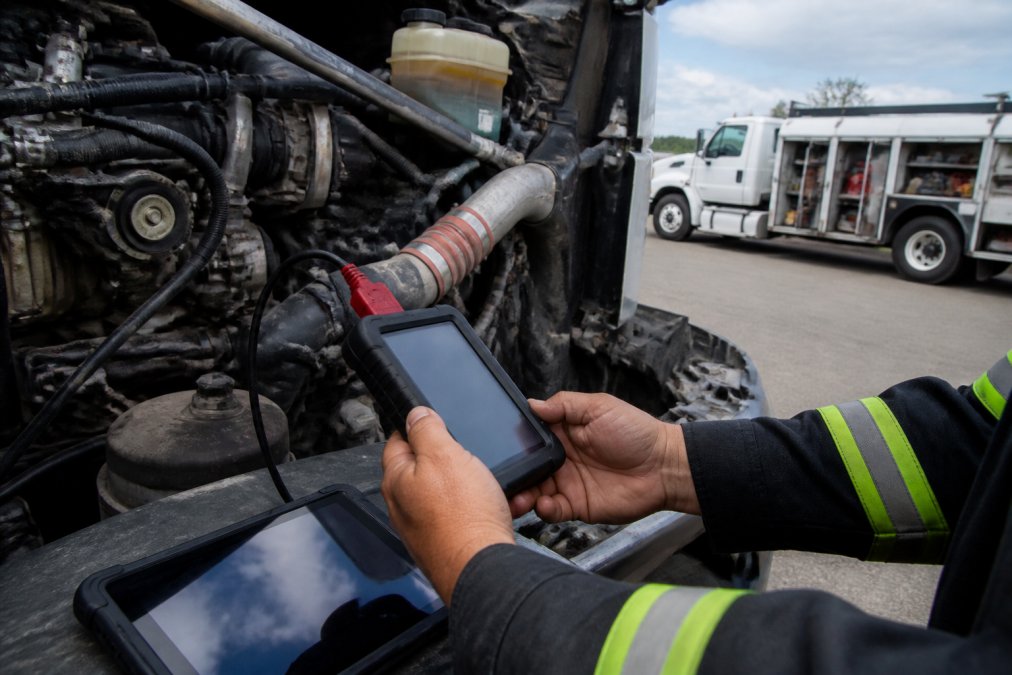
What each tool class actually does, and the fault it catches
- OEM-level diagnostic software (Cummins INSITE, Detroit DiagnosticLink, PACCAR ESA, Volvo/Mack Tech Tool). Reads proprietary fault codes, runs bidirectional tests (injector cutout, DPF regen, turbo actuator sweep), and pulls freeze-frame data. Without it, a mechanic is guessing at root cause on aftertreatment and fuel faults.
- Digital multimeter and oscilloscope. Traces voltage drops, shorts, and intermittent signals that a code reader cannot see. Essential for the no-start and derate complaints that plague electrical systems on high-mileage trucks.
- Load testers and battery/charging analyzers. Confirms whether a no-crank is a battery, alternator, starter, or cable problem before parts are thrown at it.
- Aftertreatment and DEF testing equipment. Measures NOx sensor function, DEF quality (refractometer), and DPF differential pressure. Aftertreatment faults are among the most common and most expensive to misdiagnose.
- Fuel system pressure test kits. Verifies low-pressure and high-pressure fuel delivery on common-rail systems where a weak lift pump mimics an injector failure.
- Hydraulic and air system gauges. Diagnoses brake, suspension, and steering complaints that strand a truck at the shoulder.
- A working parts inventory. Common failure items, sensors, relays, belts, hoses, clamps, fuses, so the first trip is the only trip.
How to verify the equipment before dispatch (the gap most guides skip)
You do not need to be a technician to screen a mobile mechanic’s tooling. Ask three questions on the phone:
- “Which OEM software platforms do you run?” A real mobile diesel operation will name Cummins, Detroit, PACCAR, and Volvo/Mack without hesitation.
- “Can you run a forced DPF regen and a bidirectional injector test on-site?” If the answer is no, they cannot resolve aftertreatment or fuel faults at the roadside.
- “What scan tool brand is in the truck?” Brand names like Snap-on, Autel, or Texa paired with OEM software signal a serious investment; “whatever the code reader says” signals the opposite.
A mechanic who shows up with only a generic code reader will default to a parts-cannon approach, replacing sensors and components until the light goes out. That approach costs you the part, the labor, and the downtime, and it often leaves the root cause untouched.
The EPA regulations on heavy-duty diesel emissions mean aftertreatment faults are common and expensive to misdiagnose, and the FMCSA commercial vehicle safety guidance ties many of those faults directly to out-of-service violations. Sophisticated mobile diagnostics are not a luxury, they are the difference between a repair that clears the fault and one that clears your schedule.
Step 4: Benefits of Mobile Diesel Repair vs Towing for Your Breakdown
The benefits of mobile diesel repair vs towing come down to three things: time, money, and risk. A tow to the nearest shop can mean hours of waiting, a hookup fee, and days in a queue behind other trucks. On-site repair skips all three.
Most roadside fixes are resolved in less time than an in-shop repair, and 99% of customers avoid a tow entirely. That’s the practical case for mobile service: your truck gets fixed where it sits, and you keep your schedule.
When towing still makes sense:
- Frame damage or a blown engine requiring a full rebuild
- Repairs that legally require a shop environment
- Situations where parts must be ordered and the vehicle can’t sit roadside
Step 5: Critical Questions to Ask a Mobile Diesel Mechanic Before Hiring
The questions to ask a mobile diesel mechanic before hiring should cover response time, capability, and accountability. Ask them before you’re stranded, not after.
- What’s your typical response time, and what happens if you can’t make it? A straight answer beats a vague promise.
- Can you handle complex electrical diagnostics, or just basic roadside fixes? Gremlins that stump a dealership require serious scan tools.
- What’s your warranty on mobile repairs? Get it in writing.
- Do you carry parts, or will I wait on an order? Ask what happens if a part needs ordering.
- How far do you service? Confirm your location falls inside the radius.
Ask for the technician’s name and certification number when you call. A business that hesitates on either is telling you something before you’ve spent a dollar.
Step 6: Understand Costs, Insurance, and Warranty Coverage
Cost transparency, insurance verification, and warranty terms are the three areas most mobile-mechanic guides avoid, and the three that decide whether a roadside repair saves you money or buries you. Push hardest here.
Cost structure: what you are actually paying for
A mobile diesel repair bill typically has three components, and a reputable operation will quote the structure before dispatch even when the final total depends on diagnosis:
CALL or TEXT NOW:712-827-0207 →
- Trip or mobilization charge. Covers the service truck rolling to your location. It is usually a flat fee based on distance, not a per-mile meter, so ask how it is calculated and whether it changes if the repair is quick.
- Labor rate. Billed hourly, often with a minimum. Ask whether the clock starts at dispatch, at arrival, or at first wrench turn, the difference matters on a two-hour drive.
- Parts. Billed at cost-plus or list, depending on the shop. Ask whether they mark up parts and whether you can supply your own.
Emergency and after-hours surcharges. Nights, weekends, and holidays frequently carry a premium. Ask the multiplier upfront so a 2 a.m. call does not surprise you. A common pattern is a higher hourly rate after standard business hours rather than a separate flat fee, confirm which model applies.
Diagnostic fee. Some operations charge a standalone diagnostic fee that is credited toward the repair if you proceed; others fold diagnosis into labor. Ask which applies and whether the fee is refundable if they cannot find the fault.
Insurance and liability verification (the gap most guides skip)
Before anyone touches your truck, confirm the business carries:
- Commercial general liability (CGL) coverage. Protects against property damage caused during the repair, a dropped tool through a radiator, a fuel line nicked during a turbo job.
- Commercial auto coverage on the service truck itself.
- Workers’ compensation for the technician. If an uninsured tech is injured on your property, the liability exposure can land on you.
Ask for a certificate of insurance (COI) and confirm the coverage is current. A legitimate operator will email it without hesitation. If they cannot produce one, that is your answer.
Warranty expectations for field repairs vs. shop repairs
Warranty terms on mobile repairs are not standardized the way dealership warranties are, so get them in writing before work begins. Confirm:
- What is covered, parts only, labor only, or both.
- How long, a common range is 90 days to one year on parts, with labor coverage often shorter. Ask for the specific number.
- Where it is honored, if the repair fails 400 miles away, will they return, or will you need a different shop? Get the answer in writing.
- What voids it, customer-supplied parts, unrelated subsequent failures, or continued operation after a new warning light often void coverage.
FMCSA commercial vehicle safety guidance sets the compliance baseline your repairs need to meet, so warranty terms should reflect work that keeps you legal on the road, not just work that clears a code.
| What to Verify | Why It Matters | How to Check |
|---|---|---|
| Trip charge structure | Prevents surprise mobilization billing | Ask how it is calculated before dispatch |
| Labor rate and minimum | Determines true cost of a short repair | Confirm when the clock starts |
| After-hours surcharge | Night breakdowns cost more | Ask the multiplier upfront |
| Diagnostic fee | May or may not be credited | Confirm credit and refund policy |
| Commercial general liability | Protects you from on-site damage | Request a certificate of insurance |
| Workers’ comp | Shields you from injury liability | Confirm coverage is current |
| Warranty terms | Covers parts and labor failures | Get scope, duration, and location in writing |
| ASE certification | Confirms technician competence | Verify through ASE lookup |
| Service radius | Determines response time | Confirm before dispatch |
A mobile mechanic who will not put cost structure, insurance, and warranty terms in writing before dispatch is telling you how the repair will go. The paperwork is the proof.
Red Flags: When to Walk Away From a Mobile Diesel Mechanic
Certain behaviors should end the conversation immediately. Walk away if a mechanic:
- Refuses to provide a certification number or insurance details
- Quotes a flat price before diagnosing anything
- Won’t put warranty terms in writing
- Pressures you to skip a proper diagnostic step
- Can’t explain what the fault code means in plain terms
Safety protocols for roadside repairs are non-negotiable. A legitimate technician will set up warning triangles, wear high-visibility gear, and keep you clear of traffic lanes. If they skip those steps, they’re cutting corners everywhere else too.
Conclusion: Your Roadside Repair Checklist
Breakdowns don’t wait for business hours, and neither should your search for a mechanic. Verify credentials, check reputation, confirm diagnostic capability, and get costs and warranty terms in writing before anyone touches your truck.
Mudhollow Diesel Mechanics brings fully equipped mobile service to your location across I-80 and I-29 in western Iowa (mile markers 1-100), with modern service trucks running computer diagnostics and 15+ years of experienced technicians behind the tools. Whether you need emergency roadside repair or scheduled dry-land servicing at your yard, we keep your operation moving.
Call or text 712-827-0207 to get a fully equipped service truck dispatched to your location.
Frequently Asked Questions
How much does a mobile diesel mechanic charge per hour?
Labor rates for a mobile diesel mechanic depend on the complexity of the repair, your location, and the time of day. Most services include a trip charge plus an hourly rate for on-site work. Because mobile mechanics save you the cost of a tow, the total bill often ends up lower than towing to a shop. Always ask for a written estimate before work begins and confirm whether the trip charge is separate from labor.
What questions should I ask before hiring a mobile diesel technician?
Ask about their ASE certifications, years of experience with your specific engine model, and whether they carry diagnostic tools for aftertreatment systems and electrical troubleshooting. Confirm their service radius, typical response time, and whether they offer a warranty on roadside repairs. Also ask for a breakdown of labor rates, trip charges, and how they handle parts ordering if your repair requires a component they don’t stock on the truck.
Do mobile diesel mechanics provide warranties on their roadside work?
Reputable mobile diesel mechanics stand behind their work with a warranty on both parts and labor. The length and terms vary by provider, so ask for the warranty details in writing before authorizing repairs. A warranty typically covers the specific repair performed, not unrelated issues that may surface later. If a mechanic won’t put warranty terms in writing, that’s a red flag worth taking seriously.
What are the red flags to watch for when hiring mobile diesel repair services?
Watch for mechanics who can’t verify ASE certification or provide references, demand cash payment without an invoice, or refuse to explain the diagnostic process. Be wary of quotes that seem too low compared to others, as they often lead to surprise charges. Also avoid anyone who won’t give a clear service radius or response time. A trustworthy mechanic will answer your questions directly and put everything in writing.