Table of Contents
- What a Mobile Diesel Mechanic for RVs Actually Does
- Emergency Diesel RV Roadside Assistance: How It Works
- Mobile Diesel Engine Diagnostics: Finding Hidden Problems On-Site
- Common Diesel RV Failures and What Mobile Mechanics Can Fix
- RV Diesel Engine Repair Cost Factors You Should Know
- Why Mobile Repair Beats Towing to a Shop
- How to Prepare When a Mobile Diesel Mechanic Arrives
- Frequently Asked Questions
Last Updated: September 3, 2026
What a Mobile Diesel Mechanic for RVs Actually Does
A mobile diesel mechanic for RVs is a fully equipped technician who travels directly to your location, whether you’re stranded on the shoulder of I-80, parked at a rest stop, or sitting at your yard, to diagnose and repair diesel engine problems without requiring a tow. Unlike traditional shop-based mechanics, mobile diesel mechanics bring advanced diagnostic tools, heavy-duty repair equipment, and years of specialized experience directly to you.
At Mudhollow Diesel Mechanics, our mobile service eliminates the expensive towing fees and multi-day shop waits that plague RV owners and fleet operators. We specialize in rapid roadside diagnostics and repairs for common diesel failures: radiator leaks, turbocharger issues, fuel system problems, electrical gremlins, and transmission concerns. Our technicians arrive with computer-based diagnostic equipment capable of identifying hard-to-solve breakdowns.
The distinction matters. A mobile diesel mechanic isn’t a roadside tire-plug service, we’re equipped for complex diesel engine work. We carry specialized tools, replacement components for common failures, and the technical knowledge to get you rolling again in hours instead of days. Most roadside repairs we handle would otherwise require a costly tow and weeks of downtime waiting for parts or shop availability.
What separates mobile repair from towing is speed and cost avoidance. Approximately 99% of our customers never see a tow truck because we resolve the issue on-site (peer-reviewed research). That’s not luck, it’s the result of 15+ years of experience, modern diagnostic capability, and the right equipment loaded on our service vehicles.
Emergency Diesel RV Roadside Assistance: How It Works
When your diesel RV breaks down on the interstate, the first decision is critical: call a tow truck or call a mobile diesel mechanic. Here’s how mobile roadside assistance actually works and why it saves time and money.
You contact Mudhollow Diesel Mechanics with your location and symptoms. We dispatch a fully equipped service vehicle to your exact position. Our technician arrives with computer diagnostics, replacement parts for common failures, and the tools needed to repair most diesel problems on the spot. The entire process, arrival, diagnosis, repair, and departure, typically completes in under two hours for standard roadside issues (the NIH).
The mobile dispatch model works because we’re positioned to respond quickly across I-80 and I-29 corridors in western Iowa. We don’t require you to limp your RV to a distant shop, wait for an appointment, or pay towing fees that rival the repair cost itself. The technician evaluates your engine in real time, explains what’s wrong, and either fixes it immediately or coordinates next steps if parts ordering is necessary.
Common roadside scenarios we handle: radiator failures that leave you stranded in summer heat, turbocharger issues causing loss of power, fuel system clogs preventing engine start, electrical problems causing no-start conditions, and transmission concerns that make the RV undriveable. Each situation requires different expertise and tools. Our mobile setup carries what’s needed for 90% of these calls (the CDC).
Emergency assistance also means honest communication. You’ll know upfront whether we can fix it on-site or whether your RV needs shop-based work. We won’t sell you unnecessary repairs or recommend solutions you don’t need. That transparency builds trust when you’re stressed and stranded.
Mobile Diesel Engine Diagnostics: Finding Hidden Problems On-Site
The real power of a mobile diesel mechanic for RVs lies in modern diagnostic capability. Computer-based engine diagnostics can identify problems that symptoms alone never reveal, electrical faults, sensor failures, fuel injection timing issues, and emissions system problems that cause drivability complaints without obvious physical damage.
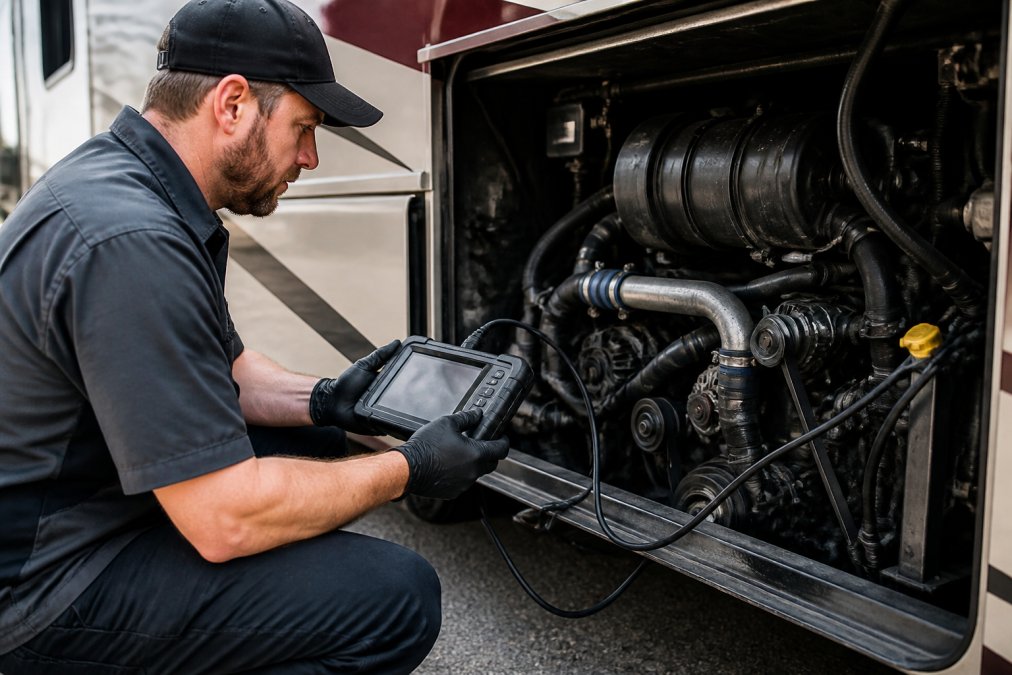
Our diagnostic approach starts with connecting your engine to computer scanning equipment that reads fault codes stored in your RV’s engine control module. These codes pinpoint specific failures: a faulty oxygen sensor, a clogged fuel filter affecting pressure, a malfunctioning thermostat causing overheating, or a turbocharger boost sensor reading incorrectly. Without diagnostics, a mechanic is guessing. With them, we’re targeting the actual problem.
Hard-to-solve breakdowns, the ones where symptoms don’t match obvious causes, are where mobile diagnostics shine. You might describe your RV as “losing power under load” or “running rough at idle.” Those complaints could stem from a dozen different causes. Our computer scan narrows it down to the actual fault, saving hours of trial-and-error troubleshooting.
The diagnostic process also prevents unnecessary repairs. A shop without proper tools might recommend replacing an expensive component when the real problem is a $50 sensor or a simple calibration adjustment. Mobile diagnostics give you the information to make smart repair decisions. You know exactly what’s wrong, what it costs to fix, and whether the fix is worth doing now or later.
Common Diesel RV Failures and What Mobile Mechanics Can Fix
Diesel RVs fail in predictable patterns. Understanding which problems mobile mechanics can resolve on-site and which require shop-based work helps you decide when to call for roadside assistance.
Radiator and cooling system failures are among the most common roadside emergencies. A cracked radiator, failed thermostat, or broken water pump leaves your engine at risk of catastrophic overheating. Mobile mechanics can often replace radiators, repair cooling leaks, or replace thermostats on-site, getting you back on the road within hours instead of days.
Turbocharger problems range from boost loss to complete failure. A failing turbo might make your RV feel underpowered or produce excessive black smoke. Mobile diagnostics identify turbo faults quickly. Depending on the failure, we can sometimes repair or replace the unit on-site; other scenarios require shop-based work.
Fuel system issues, clogged filters, fuel pump failures, or injector problems, prevent engine start or cause rough running. These are often fixable roadside. A fuel filter replacement takes minutes. Fuel pump replacement is more involved but still manageable with mobile equipment.
Electrical gremlins that even dealerships struggle to diagnose often respond to systematic troubleshooting with proper diagnostic tools. Intermittent no-start conditions, warning light issues, or charging system problems frequently have simple root causes once you scan the engine and identify fault codes.
Transmission concerns like slipping, delayed engagement, or overheating sometimes require shop-based diagnostics, but mobile assessment can determine whether the issue is fluid-related, a sensor fault, or a deeper mechanical problem.
The key distinction: mobile mechanics excel at diagnosis and rapid repair of mechanical and electrical failures. We cannot perform extensive rebuilds or jobs requiring multiple days of work. Our strength is getting your RV running again quickly so you can continue your journey or reach a full-service shop if deeper work is necessary.
RV Diesel Engine Repair Cost Factors You Should Know
Understanding what drives repair costs helps you make smart decisions when a mobile diesel mechanic arrives at your breakdown location. Several factors influence the final bill, and knowing them upfront prevents surprises.
Diagnostic time is the first cost factor. Computer scanning and physical inspection take time depending on problem complexity. Simple issues, a loose hose, a failed sensor, a clogged filter, diagnose quickly. Intermittent electrical faults or performance complaints require more investigation.
Parts availability affects cost and timeline. Common replacement items, thermostats, radiators, water pumps, fuel filters, are often carried on our service vehicles, meaning you pay for the part and labor but avoid waiting for ordering. Specialized components like turbochargers or transmission parts may require ordering, extending your timeline.
Labor complexity varies dramatically. Replacing a thermostat takes time. Replacing a radiator might take longer. Turbocharger replacement could take even more time. The more complex the repair, the longer the technician is on-site, and the higher your total cost.
CALL or TEXT NOW:712-827-0207 →
On-site repair versus shop transfer affects your overall expense. Roadside repair eliminates towing fees, which can run several hundred dollars. Even if a repair takes longer on-site, you’re often ahead financially compared to towing plus shop labor.
Preventative maintenance costs less than emergency repair. A scheduled radiator flush costs far less than replacing a failed radiator. Regular fuel filter changes prevent fuel pump damage. Coolant system maintenance prevents overheating failures. Mobile mechanics can handle preventative work at your yard or terminal, reducing the likelihood of roadside emergencies.
For specific cost information, contact Mudhollow Diesel Mechanics directly at 712-827-0207 or text for a quote based on your situation.
Why Mobile Repair Beats Towing to a Shop
The traditional breakdown scenario, call a tow truck, get hauled to the nearest shop, wait days for diagnosis and parts, is expensive and disruptive. Mobile repair changes that calculus entirely.
Towing costs alone often exceed several hundred dollars, depending on distance. A 50-mile tow from I-80 to a service center can cost $300-500 before any repair work begins. Mobile repair eliminates that expense entirely. Our technician arrives at your location, diagnoses the problem, and fixes it on-site in most cases.
Shop wait times are another hidden cost. Dealerships and full-service shops maintain appointment schedules weeks out. A breakdown on Monday might not be addressed until Thursday or Friday. Meanwhile, your RV sits idle, you’re stranded, and your schedule is disrupted. Mobile repair happens today, often within hours of your call.
Parts ordering delays plague traditional shops. A radiator failure requires ordering a replacement, which might take 3-7 days. With mobile repair, we assess whether we carry the part or can source it quickly. If we can’t, we communicate that upfront so you make informed decisions about your next steps.
Diagnostic transparency is a mobile mechanic advantage. You’re present during the diagnosis process. You see what the technician finds, understand the problem, and make repair decisions based on facts rather than a shop’s phone call hours later. That transparency builds confidence and prevents unnecessary repairs.
Reduced downtime is the bottom line. A roadside repair that takes three hours beats a shop scenario requiring three days of waiting, towing, and coordination. For fleet operators and RV owners on tight schedules, that difference is enormous.
Mobile repair also works for preventative maintenance. Rather than scheduling shop time, we arrive at your yard or terminal during off-hours, perform maintenance work, and minimize operational disruption. That flexibility is impossible with traditional shops.
How to Prepare When a Mobile Diesel Mechanic Arrives
When you’ve called for mobile repair, a few preparation steps ensure the technician can work efficiently and complete the job as quickly as possible.
Clear the engine bay and surrounding area. Remove loose items, hoses, or equipment that might interfere with diagnostic connections or repair access. A clean workspace speeds up diagnosis and reduces the risk of tools or parts getting lost.
Have your RV keys and documentation ready. The technician needs to start the engine, run diagnostics, and test-drive the RV to verify the repair. Keys should be immediately accessible. Your maintenance records help the technician understand previous issues or repairs.
Describe symptoms clearly. When did the problem start? What does it feel like, loss of power, rough running, warning lights, strange noises? Does it happen consistently or intermittently? Detailed symptom description helps the technician narrow down the diagnosis faster.
Know your RV’s specifications. Engine model, year, and mileage are useful. If you have previous diagnostic reports or shop records mentioning similar issues, share them. That history accelerates diagnosis.
Ensure safe parking. If you’re on the shoulder of I-80 or I-29, position your RV safely away from traffic. Use hazard lights and reflective triangles if available. A safe work environment lets the technician focus on the repair rather than traffic safety.
Be present during the diagnosis. Stay nearby while the technician works. You’ll understand what’s wrong, why it happened, and what your repair options are. That presence also prevents miscommunication and ensures you approve any work before it begins.
Ask questions. Don’t hesitate to ask why a repair is necessary, what it involves, or how long it takes. A good mobile mechanic welcomes questions and explains the technical details in terms you understand.
When your diesel RV breaks down, the difference between a smooth recovery and days of frustration often comes down to who you call first. A mobile diesel mechanic for RVs, someone with modern diagnostics, the right tools, and years of experience, can get you rolling again while you’re still at the roadside. Mudhollow Diesel Mechanics has been delivering that service across I-80 and I-29 for 15+ years. We diagnose hard-to-solve problems accurately, repair most issues on-site, and keep you moving. When breakdown happens, call or text 712-827-0207 for immediate roadside assistance. Fast, expert mobile repair, that’s what we do.
Frequently Asked Questions
Q: What should I have ready when calling for mobile diesel roadside assistance?
A: Gather your RV’s make, model, year, and engine type before calling. Write down any warning lights or symptoms you noticed, unusual sounds, loss of power, overheating, or electrical issues. Note your exact location, including mile marker if you’re on the highway. If you’ve had recent service, have that documentation available. The more detail you provide, the faster a mobile diesel mechanic can diagnose the problem on arrival.
Q: How do mobile diesel mechanics handle complex engine diagnostics on-site?
A: Modern mobile mechanics arrive with computer diagnostic scanners that connect directly to your engine’s control systems. These tools read fault codes, monitor sensor data, and identify problems that aren’t visible during a basic inspection. For complex issues like transmission problems or aftertreatment system failures, on-site diagnostics often pinpoint the root cause without requiring a tow. If parts must be ordered, the mechanic provides a clear estimate before proceeding.
Q: Are mobile diesel mechanics equipped to handle major engine components like turbochargers?
A: Yes, fully equipped mobile service trucks carry tools and replacement parts for turbocharger repair and replacement, radiator work, fuel system repairs. However, some major jobs, like complete engine rebuilds, may require shop facilities. Most roadside breakdowns involving turbochargers, cooling systems, and electrical troubleshooting can be resolved on-site, avoiding the cost and delay of a tow truck.
Q: What are the primary benefits of choosing mobile repair over a traditional shop?
A: Mobile repair eliminates towing costs, reduces downtime, and gets you back on the road faster. You avoid shop wait times and dealership markups. A mobile mechanic brings diagnostic tools and heavy-duty equipment to your location, whether that’s the highway shoulder or your yard. Most customers avoid a tow entirely because the repair happens where you are, not hours later at a distant facility.
This article was written using GrandRanker