Table of Contents
- What a Heavy Duty Mobile Mechanic Service Actually Does
- Heavy Duty Truck Diagnostic Tools Used On-Site
- On-Site Repairs Covered by a Mobile Mechanic Service
- Preventive Maintenance for Commercial Trucks at Your Yard
- Mobile Diesel Repair Cost: What Affects Your Bill
- DIY Roadside Repairs vs. Calling a Certified Technician
- What to Have Ready When You Call for Roadside Help
- Frequently Asked Questions
Last Updated: August 18, 2026
What a Heavy Duty Mobile Mechanic Service Actually Does
A heavy duty mobile mechanic service brings full diesel repair capability directly to your location, whether that’s a highway shoulder at midnight or your fleet yard on a Sunday. At Mudhollow Diesel Mechanics, we operate on one core reality: every hour a commercial truck sits idle costs money, and towing it to a distant shop makes that cost worse.
A fully equipped service truck arrives at your breakdown location carrying diagnostic computers, specialty tools, and common replacement parts. A certified technician runs diagnostics, identifies the fault, and completes the repair on-site. Most roadside fixes resolve faster than arranging a tow and waiting in a shop queue.
Modern mobile diesel repair trucks carry the same diagnostic equipment found at dealerships, along with heavy-duty tools for air brake work, fuel system repairs, and electrical troubleshooting.
Types of Commercial Vehicles Serviced
A professional heavy duty mobile mechanic service handles:
- Semi-trucks and tractor-trailer combinations
- Agricultural haulers and grain trucks
- Flatbed and step-deck trailers
- Refrigerated trailers and reefer units
- Box trucks and medium-duty commercial vehicles
- RVs and motorhomes with diesel powerplants
The common thread is the diesel engine and commercial operation.
24/7 Emergency Roadside Assistance vs. Scheduled On-Site Calls
Emergency roadside assistance is reactive: a truck breaks down and a technician responds quickly. Scheduled on-site service is proactive: a fleet manager books a maintenance window during off-hours. Both use the same equipment and technicians. Fleet operators who use both get the best outcome: fewer emergency breakdowns because scheduled maintenance catches problems early.
Heavy Duty Truck Diagnostic Tools Used On-Site
Professional mobile diesel repair depends on diagnostic capability matching dealership service bays. Without it, a technician is guessing. With it, fault codes get read accurately and repairs get done right the first time.
Quality mobile service trucks use tools like the Autel Commercial Vehicle series, which supports bi-directional testing, J1939 and J1708 protocols, and advanced functions including DPF regeneration and urea drive resets. The Jaltest Commercial Vehicle Diagnostics Kit provides dealer-level access to fault trees and wiring diagrams in the field. According to FMCSA commercial vehicle safety resources, modern commercial trucks carry dozens of networked electronic control modules requiring OEM-grade tools to read accurately.
What Dealership-Level Diagnostics Look Like in the Field
Dealership-level diagnostics in the field means the technician connects to the truck’s diagnostic port, reads all active and stored fault codes across every module, and runs bi-directional tests to verify component operation. For a truck throwing an aftertreatment fault, that means commanding a forced DPF regeneration cycle and confirming completion.
The key advantage is distinguishing between a sensor fault and actual component failure. A technician with proper equipment can test a NOx sensor output live and compare it against spec, avoiding unnecessary parts replacement.
On-Site Repairs Covered by a Mobile Mechanic Service
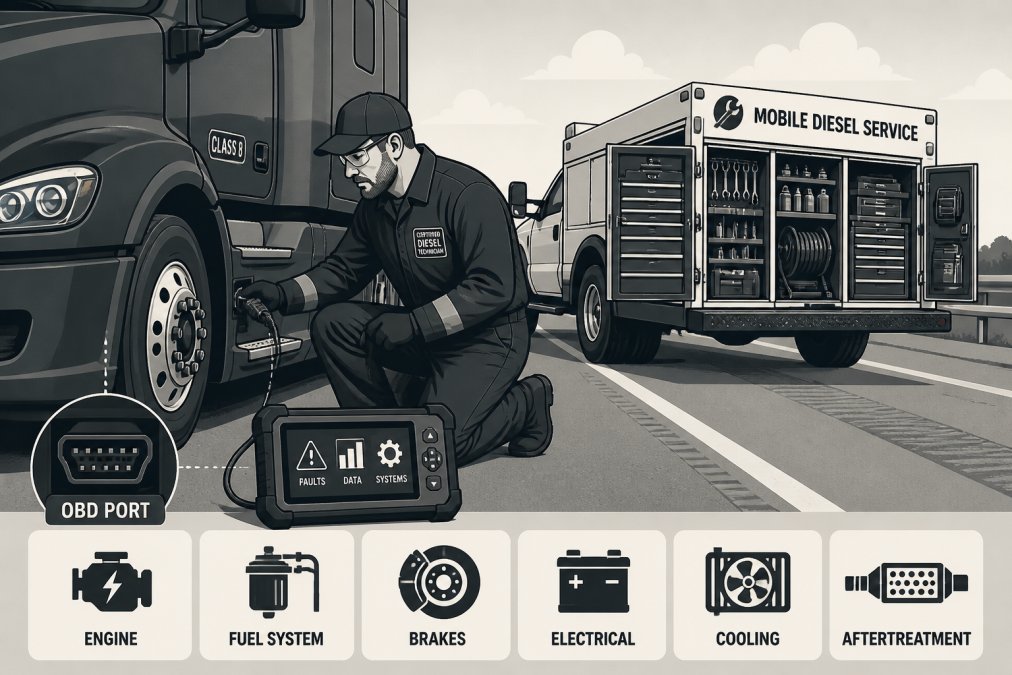
The scope of repairs a mobile mechanic service can complete on-site is broader than most fleet managers assume. A well-stocked service truck carries components that fail most often on commercial vehicles, covering the majority of breakdown scenarios.
Diesel Engine and Aftertreatment System Repairs
Diesel engine repairs handled roadside include fuel system faults, injector issues, coolant and radiator replacements, belt failures, and turbocharger problems. Aftertreatment work, including DPF cleaning and DEF system diagnostics, represents a growing share of mobile repair calls as emissions-controlled engines age.
The EPA regulations on heavy-duty diesel emissions systems require aftertreatment systems remain functional and unmodified. A qualified mobile technician can perform DPF regeneration cycles and diagnose sensor faults without voiding compliance.
Air Brake, Suspension, and Drivetrain Work
Air brake systems are among the most common failure points on commercial trucks. Mobile repair covers air line replacements, slack adjuster adjustments, brake chamber swaps, and gladhand repairs. Suspension work includes spring hanger repairs, air bag replacements, and torque rod bushing swaps. Drivetrain repairs typically cover U-joint replacements and driveshaft work.
Most suspension and brake work can be completed roadside without a shop hoist.
Reefer and Trailer Maintenance
Refrigerated trailer units require specialized attention. Reefer repair covers fuel system faults, electrical troubleshooting, belt replacements, and temperature control diagnostics. Trailer maintenance includes lighting repairs, brake work, and on-site welding for frame issues.
For food-grade carriers, a reefer failure is a cargo loss event. Fast mobile response prevents losses that dwarf repair costs.
Preventive Maintenance for Commercial Trucks at Your Yard
Scheduled preventive maintenance is the most cost-effective service a mobile mechanic provides. A technician servicing three trucks during off-hours costs a fraction of three separate breakdown calls and doesn’t pull equipment from service.
CALL or TEXT NOW:712-827-0207 →
Preventive maintenance typically covers oil and filter changes, fuel filter replacements, coolant inspections, belt and hose checks, brake adjustments, tire checks, and DPF maintenance. Per FMCSA’s driver and carrier safety guidance, carriers must maintain systematic inspection and maintenance programs. Mobile on-site service makes this practical for small fleets without dedicated facilities.
Scheduled Fleet Maintenance vs. Reactive Breakdowns
A breakdown on I-80 involves a stranded driver, late delivery, cargo issues, and recovery logistics. Scheduled maintenance at your yard involves none of that. Fleet managers consistently find reactive repairs cost more per incident than scheduled service when accounting for hidden costs: driver downtime, missed loads, and potential DOT violations.
| Maintenance Type | Timing | Typical Scope | Primary Benefit |
|---|---|---|---|
| Scheduled on-site service | Pre-planned, off-hours | Full PM checklist, multi-truck | Prevents breakdowns, reduces downtime |
| Emergency roadside call | Reactive, any hour | Fault diagnosis, critical repair | Gets truck moving again |
| Dealer shop visit | Scheduled, during hours | Full service, warranty work | Comprehensive but slow |
| DIY yard maintenance | As needed | Basic checks, fluid top-offs | Low cost, limited scope |
Mobile Diesel Repair Cost: What Affects Your Bill
Mobile diesel repair cost depends on the fault nature, parts required, technician travel distance, and call timing. After-hours emergency calls carry a premium over scheduled daytime service. What mobile repair typically avoids is the towing charge, shop parts markup, and extended labor time from shop queues.
Ask your mobile mechanic service about minimum call charges before you need them. Most operations have a minimum fee covering travel and the first hour of labor.
Mobile Repair vs. Towing to a Shop: Which Costs Less
Towing a Class 8 truck any significant distance is expensive. Add shop diagnostic fees, parts markup, and multi-day wait time, and mobile repair wins for most common breakdowns. Cases where towing wins are those requiring a lift, press, or major overhaul that cannot be completed roadside.
For fuel system issues, air brake failures, electrical faults, and cooling system repairs, mobile service resolves issues faster and at lower total cost. Mudhollow Diesel Mechanics carries extensive roadside parts inventory to avoid technicians needing to leave and source parts.
DOT Compliance and Why Repair Quality Matters
Under FMCSA out-of-service criteria for commercial vehicles, trucks with certain defects are legally prohibited from operating. A brake fault, lighting violation, or failed aftertreatment system results in an out-of-service order.
A mobile repair by a certified technician, properly documented and warranted, provides the paper trail protecting you in roadside inspection. A quick fix by an unqualified person does not.
Never drive a truck with an active out-of-service defect to reach a repair shop. Operating an out-of-service vehicle carries fines exceeding repair costs and violates your safety record.
DIY Roadside Repairs vs. Calling a Certified Technician
Experienced drivers can handle simple roadside fixes: blown fuses, loose air line fittings, burned-out marker lights. Modern heavy-duty trucks are different. A check engine light could indicate a sensor, wiring harness, injector, or aftertreatment fault. Without a diagnostic scanner reading specific fault codes, you’re guessing.
Air brake systems require proper tools, correct torque specs, and post-repair testing. An incorrectly adjusted slack adjuster or improperly seated brake chamber can fail at highway speed.
The practical rule: if the repair requires a diagnostic scanner, involves brakes, touches fuel injection, or affects the drivetrain, call a certified technician.
What to Have Ready When You Call for Roadside Help
Speed of response starts with information provided on the first call. Before you call, gather:
- Vehicle information: Year, make, model, VIN, engine make and displacement
- Fault codes: Write down codes exactly if displayed
- Location: Mile marker, highway, direction, and nearby landmarks
- Symptoms: What happened, when, and whether the truck is drivable
- Load status: Whether loaded, refrigerated, or time-sensitive
- Access: Shoulder, exit ramp, rest stop, or private lot
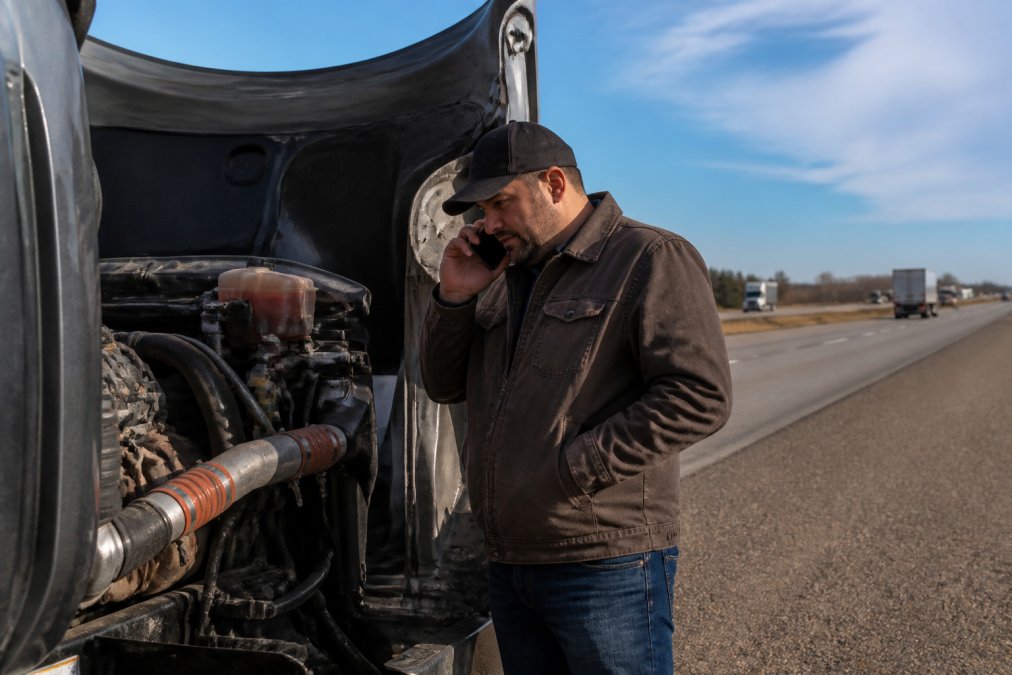
The single most useful thing you can provide when calling for roadside help is the exact fault code from the truck’s display. That one piece of information cuts diagnostic time significantly and increases the chance the technician arrives with the correct part.
For fleet managers running multiple trucks, keeping a breakdown card in each cab with vehicle specs and the service number pre-loaded saves critical minutes when a driver is stressed on a busy interstate.
Getting a commercial truck back on the road after a breakdown requires fast response, accurate diagnostics, and the right parts on hand. Mudhollow Diesel Mechanics provides 24/7 heavy duty mobile mechanic service across the I-80 and I-29 corridors, with fully equipped service trucks carrying dealership-level diagnostic tools and a working parts inventory. Whether you need emergency roadside assistance or scheduled preventive maintenance at your yard, our team eliminates the tow and gets you moving faster. Call or text Mudhollow Diesel Mechanics now at 712-827-0207.
Frequently Asked Questions
What common services does a heavy duty mobile mechanic provide?
A heavy duty mobile mechanic service handles diesel engine diagnostics, DPF regeneration, air brake repairs, fuel system work, electrical troubleshooting, coolant and radiator replacements, belt and tensioner repairs, suspension work, and reefer unit maintenance. Most calls are resolved on-site without a tow. The service truck carries a parts inventory sized for the most frequent roadside failures on Class 8 tractors and commercial vehicles, so technicians can complete many repairs in a single visit.
Is a mobile mechanic cheaper than towing to a repair shop?
For most roadside breakdowns, mobile diesel repair costs less in total than towing plus shop labor. You eliminate the tow bill entirely, avoid shop storage fees, and get back on the road faster, which cuts revenue lost to downtime. Mobile diesel repair cost varies by repair type, parts required, and travel distance, so contact the service provider directly for an accurate quote rather than assuming a flat rate applies to your situation.
What should I have ready when I call a mobile truck repair service?
Before calling, note your exact location including mile marker and highway, your truck’s year, make, model, and VIN, and a clear description of the symptoms or fault codes showing on your dash. If you have a DOT number or fleet account, have that available too. The more detail you provide upfront, the better the technician can pre-load the right parts and diagnostic equipment before arriving, which shortens repair time significantly.
How do I verify the credentials of a mobile diesel mechanic?
Ask whether the technician holds ASE certifications for medium and heavy-duty trucks, which are issued by the National Institute for Automotive Service Excellence. You can also ask about experience with your specific truck make and whether the service truck carries commercial-grade diagnostic scanners capable of reading J1939 and J1708 protocols. A reputable provider will explain their qualifications clearly and stand behind completed work with a stated warranty policy.
This article was written using GrandRanker