Table of Contents
- What You’ll Need Before You Start
- Step 1: Build a Preventive Maintenance Checklist for Farm Machinery
- Step 2: Watch for the Signs of Diesel Engine Failure in Tractors
- Step 3: Inspect Fuel Systems, Filters, and Hydraulics
- Step 4: Use Mobile Diesel Diagnostic Services for Agricultural Equipment
- Step 5: Follow Harvest Season Safety Protocols
- Common Mistakes to Avoid When Preventing Equipment Breakdowns
- Frequently Asked Questions
Last Updated: September 16, 2026
What You’ll Need Before You Start
Learning how to prevent agricultural equipment breakdowns in Iowa starts with one uncomfortable truth: most harvest-season failures were decided months earlier. Learning how to prevent agricultural equipment breakdowns in Iowa starts with one uncomfortable truth: most harvest-season failures were decided months earlier. The breakdowns rarely come out of nowhere, a bearing chirping in June, a fuel filter overdue in August.
Before you touch a wrench, gather these items:
- Your machine’s technical service manual (paper or digital)
- A grease gun and the correct grease spec for each machine
- Replacement fuel filters, air filters, and hydraulic filters on hand
- A coolant refractometer and a battery load tester
- A clipboard or phone app for logging checks
- Basic hand tools plus a flashlight or headlamp
The most common mistake we see is buying filters after the failure, not before. When a machine is down mid-harvest, parts stores are picked over and every hour of downtime stacks up. Stock one full filter set per machine before September.
Step 1: Build a Preventive Maintenance Checklist for Farm Machinery
A preventive maintenance checklist for farm machinery ties every inspection and service task to a specific machine and interval, turning maintenance from a memory exercise into a routine. Operations that avoid major breakdowns follow the same pattern: daily checks take minutes, weekly checks take an hour, and seasonal service is scheduled around the calendar, not around a failure.
Daily and Weekly Checks That Catch Small Problems Early
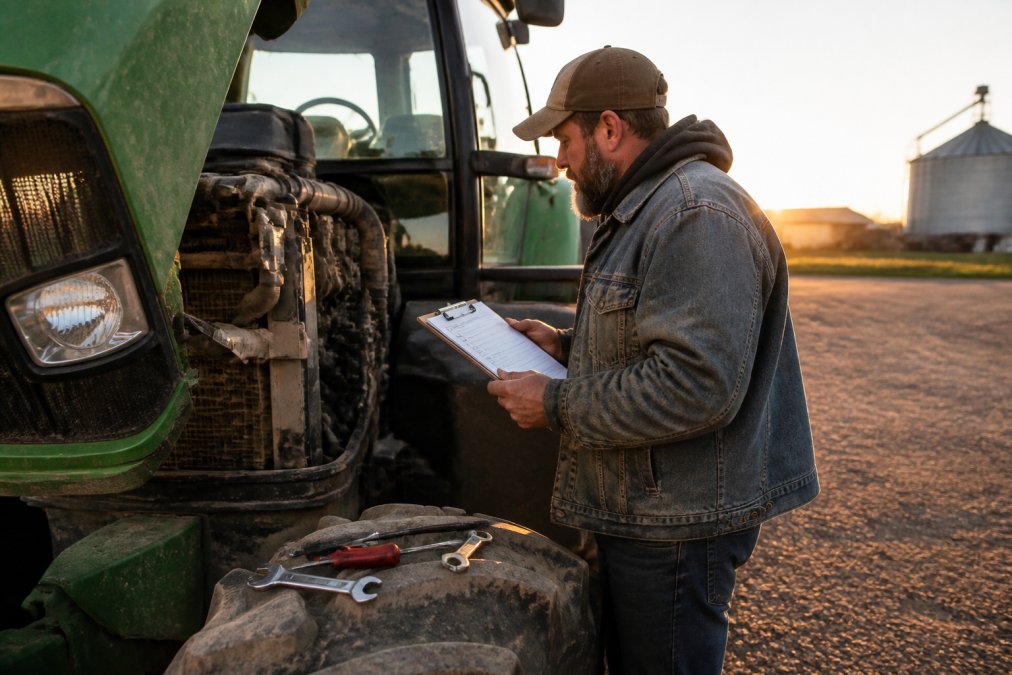
Daily checks take under ten minutes per machine. Before startup, look for fluid puddles, cracked belts, and loose guards; check engine oil, coolant, and hydraulic fluid; confirm lights and the slow-moving vehicle emblem are clean and visible.
Seasonal Service Intervals for Tractors, Combines, and Grain Carts
Seasonal service is where equipment lifespan is decided. Before spring fieldwork, service the cooling system and check hydraulic hoses for cracking. Before harvest, do the same on combines and grain carts, plus inspect the separator, rotor, and unloading auger drive.
A simple interval structure works for most operations:
| Interval | What to Check | Why It Matters |
|---|---|---|
| Daily | Fluids, belts, lights, tires | Catches leaks and loose parts early |
| Weekly | Belt tension, chain lubrication, battery | Prevents wear and electrical failure |
| Pre-season | Oil, filters, cooling, hydraulics | Resets the machine before heavy use |
| Post-season | Full inspection, storage prep | Prevents rust and spring surprises |
Winterization for the Freeze-Thaw Cycle
This is the step most generic guides skip, and the one that matters most here. The repeated freeze-thaw cycle through late fall and early spring is hard on equipment in ways a single cold snap is not: water expands when it freezes, contracts when it thaws, and does that dozens of times in a season, finding every weak point in a cooling system, hydraulic line, or seal.
Work through these before the first hard freeze:
- Cooling system. Test coolant concentration with a refractometer. A mix too weak will not protect the block; too rich loses heat-transfer efficiency. Check freeze plugs, hoses, and the radiator for pitting that freeze-thaw accelerates.
- Fuel system. Treat diesel for cold-weather gelling and drain water separators more often, since condensation inside a partially full tank is worse with wide day-night temperature swings.
- Batteries. Cold reduces cranking capacity, so load-test and clean terminals before storage.
- Hydraulics and seals. Rod seals and hoses crack faster through freeze-thaw. Inspect for weeping and replace anything suspect.
- Block heaters and DEF systems. Confirm the block heater works before you need it, and store diesel exhaust fluid within its temperature range.
Reading Onboard Diagnostics Before They Become Breakdowns
Modern tractors, combines, and sprayers carry dozens of sensors feeding an engine control module and a controller area network. Those sensors log fault codes long before a machine quits, and most operators never look until something fails.
Step 2: Watch for the Signs of Diesel Engine Failure in Tractors
The signs of diesel engine failure in tractors usually appear weeks before the machine quits. Learn them and you get a repair window instead of a breakdown.
Watch for these signals:
- Hard starting, especially when cold. Often a fuel or compression issue, not just a weak battery.
- Excessive black or white smoke. Black points to over-fueling or air restriction; white can mean injector or coolant problems.
- Power loss under load. A tractor that pulls weaker than last season is telling you something.
- Knocking or unusual noise. Bearing failure and injector issues both announce themselves.
- Rising coolant temperature. Engine cooling problems rarely fix themselves.
- Increased fuel consumption. A sudden jump often tracks to injectors or air intake.
Keep a simple log of any symptom you notice, with the date and hours on the machine. When a technician arrives, that log shortens diagnosis dramatically and often saves a return visit.
Step 3: Inspect Fuel Systems, Filters, and Hydraulics
Fuel system and filter maintenance is the highest-return habit in diesel reliability. Diesel carries water and contaminants, and dirty fuel is a leading cause of injector damage and hard starting.
Step 4: Use Mobile Diesel Diagnostic Services for Agricultural Equipment
Mobile diesel diagnostic services for agricultural equipment bring computer diagnostics and heavy-duty tools to your machine instead of sending it to a shop. Moving a broken combine or tractor costs time and money, and shop queues during harvest can run days deep.
What Sophisticated Mobile Diagnostics Actually Do
A basic code reader tells you a fault exists. Real diagnostics tell you why, using live data and the ability to watch a machine behave under load.
CALL or TEXT NOW:712-827-0207 →
On a service call, a technician typically:
- Pulls active and stored fault codes from the engine control module and other controllers on the machine’s network.
- Reads live sensor data while the engine runs, fuel rail pressure, turbo boost, exhaust gas temperature, injector balance rates. A static scan cannot show a sensor that only drifts when hot or under load.
- Performs bidirectional tests, commanding injectors, EGR valves, and turbo actuators to confirm whether a part responds.
- Checks the wiring and grounds behind a fault, because a bad ground or chafed harness often mimics a failed sensor and a parts-swap will not fix it.
Professional Repair vs. DIY: A Decision Framework
Most guides say do your own maintenance and call a pro when stuck. Here is a clearer way to split the work.
Do it yourself when:
- The task is routine and mechanical: filters, grease, fluid checks, belt and chain inspection, visual walkarounds.
- The fault is obvious and physical: a cracked hose, a loose guard, a flat battery you can load-test.
- You have the manual, the correct spec, and the tools on hand.
Call a mobile technician when:
- The fault is electronic or intermittent, or the machine throws codes you cannot clear.
- The repair needs live diagnostics, bidirectional testing, or manufacturer-level software.
- The machine is down during a critical window and the cost of guessing wrong is another day of downtime.
- The problem involves the systems that need specialized tooling and experience, such as turbochargers, radiators, and aftertreatment.
Sourcing Parts Fast During Peak Season
Rural parts sourcing is where a lot of downtime is actually lost. During peak harvest, common filters, belts, and sensors get picked over fast, and a machine can sit waiting on a part a city dealer has in stock but cannot deliver until tomorrow.
Practical habits that shorten the wait:
- Build supplier relationships before harvest, not during it, so you have a name to call and a standing account.
- Stock one full filter set and the common failure parts per machine before the season starts.
- Ask your technician which components tend to fail on your specific machine models, then keep those on the shelf.
- Keep a documented parts list with part numbers so anyone can call it in without guessing.
Step 5: Follow Harvest Season Safety Protocols
Harvest season safety protocols protect people first and equipment second, and the two are connected: a properly maintained machine is also a safer machine.
Follow these practices:
- Shut down and lock out before servicing any equipment.
- Never reach into a running machine, even briefly.
- Keep PTO shaft safety shields in place and inspect them before each use.
- Ensure slow-moving vehicle emblems are clean and visible, especially at dusk.
- Train every operator on emergency shutdown locations.
- Keep fire extinguishers charged and accessible on combines and tractors.
- Schedule breaks to prevent fatigue-related mistakes during long harvest days.
Common Mistakes to Avoid When Preventing Equipment Breakdowns
The biggest mistake is treating maintenance as a season, not a habit. Reliability comes from daily and weekly checks done consistently, not one thorough spring service.
Other mistakes we see regularly:
- Skipping the post-season inspection, which lets small issues sit all winter.
- Running filters past their interval to save a few minutes.
- Ignoring small noises, especially bearing and gearbox sounds.
- Waiting for a failure before scheduling professional diagnostics.
- Overlooking electrical system integrity until a machine will not start.
- Deferring machinery replacement decisions until a machine fails mid-harvest.
The operations with the fewest breakdowns are not the ones with the newest equipment. They are the ones with a written schedule, a stocked parts shelf, and a technician relationship established before the emergency.
Frequently Asked Questions
What are the most common causes of agricultural machinery failure?
The most frequent causes are clogged fuel filters, worn belts, loose chains, low coolant, and contaminated hydraulic fluid. In western Iowa, temperature swings from below freezing to over 90°F accelerate wear on rubber seals and hoses. Skipping pre-season inspection lets small issues like a cracked belt or dirty fuel filter grow into full breakdowns. A consistent preventive maintenance checklist catches these before they stop your tractor in the field.
How often should heavy-duty diesel equipment undergo preventive maintenance?
Most heavy-duty diesel equipment needs a basic inspection every 50 to 100 operating hours, with full service at 250 to 500 hours. During harvest season, check fluids, filters, and belts daily. Before planting and after harvest, schedule a complete pre-season inspection. Mobile diesel diagnostic services for agricultural equipment can perform these checks at your yard, so you avoid hauling machines to a shop and losing field time.
What are the signs of a failing turbocharger in farm equipment?
Watch for a loss of power under load, excessive black or blue exhaust smoke, a high-pitched whine, or oil leaking around the turbo housing. A failing turbocharger often triggers a check engine light and increases fuel consumption. If you notice these signs of diesel engine failure in tractors, stop operating the machine. Continued use can push metal fragments into the engine and turn a repairable turbo into a full engine replacement.
Why is mobile diagnostic testing critical for modern agricultural fleets?
Modern tractors and combines rely on electronic control modules that store fault codes. Mobile diesel diagnostic services for agricultural equipment read those codes on site, so technicians pinpoint electrical or sensor issues without towing the machine. This saves hours of downtime and avoids the guesswork of replacing parts blindly. For fleets running multiple machines, on-site diagnostics during scheduled maintenance keep every unit field-ready.