Table of Contents
- What On-Site Agricultural Equipment Repair Actually Covers
- Preventive Maintenance for Agricultural Machinery: A Seasonal Checklist
- Mobile Diesel Repair for Farm Equipment: How Field Service Works
- DIY vs. Professional On-Site Agricultural Equipment Repair
- Safety Protocols for On-Site Repairs in the Field
- Tool Kits for Field Maintenance: What to Keep on Every Machine
- Minimizing Downtime: Emergency Repair Availability and Fleet Management
- Frequently Asked Questions
Last Updated: August 17, 2026
What On-Site Agricultural Equipment Repair Actually Covers
On-site agricultural equipment repair is diagnosing and fixing farm machinery where it breaks down, in the field, yard, or loading dock, rather than hauling it to a remote shop. A qualified mobile technician arrives with tools, diagnostics, and replacement components to complete the repair on location.
The scope is broader than most operators expect. At Mudhollow Diesel Mechanics, we handle everything from routine service to complex mechanical failures on the same call: engine diagnostics and heavy-duty repair, hydraulic systems troubleshooting, drivetrain and transmission service, electrical diagnostics, and fleet maintenance on scheduled rotations.
The core advantage is operational efficiency. A tractor or combine that breaks down mid-harvest cannot wait days for a tow and shop queue. A mobile technician on-site within hours preserves your harvest window and protects yield. When the technician arrives fully equipped, repair quality matches shop work, the difference is speed and cost, both in your favor.
Preventive Maintenance for Agricultural Machinery: A Seasonal Checklist
Preventive maintenance is the single most effective way to reduce unplanned equipment downtime. A structured service schedule catches worn components, low fluid levels, and developing faults before they cause failure during critical operations.
Spring Pre-Season Inspection Steps
Run through these steps before the first field day:
- Engine and cooling system – Change engine oil and filter, inspect coolant concentration, check belts and hoses for cracking or wear, verify the air filter is clean.
- Hydraulic systems – Check hydraulic fluid level and condition, inspect hoses and fittings for leaks, test cylinder operation and response pressure.
- Drivetrain and transmission – Inspect gearbox fluid, check PTO shaft and universal joints for play, verify clutch adjustment.
- Electrical diagnostics – Test battery voltage and charge capacity, inspect wiring harnesses for rodent damage, verify all lighting and sensor circuits.
- Tillage equipment and planter calibration – Inspect disc blades, coulters, and row units for wear, calibrate seed meters and fertilizer rates, verify depth control settings.
- Tire and track condition – Check inflation pressure, inspect for sidewall cracking, verify lug wear on drive tires.
- OEM parts inventory – Stock critical wear items: filters, belts, fuses, and hydraulic fittings specific to your equipment models.
According to USDA Agricultural Research Service guidance on equipment readiness, pre-season inspection is one of the most cost-effective practices in precision agriculture because failures during peak season carry disproportionate cost.
Fall Post-Harvest Shutdown Checklist
Post-harvest shutdown protects machinery longevity through the off-season:
- Thorough cleaning – Remove all crop residue from grain augers, headers, and cooling fins to prevent corrosion and pest nesting.
- Fluid changes – Change engine oil, hydraulic fluid, and coolant where the service interval has been reached.
- Fuel system – Add fuel stabilizer to diesel tanks, run the engine briefly to circulate it through injectors.
- Bearing and lubrication points – Grease all zerks, inspect bearings on augers, conveyors, and row units.
- Battery maintenance – Disconnect or connect to a maintenance charger for storage, especially in cold climates.
- Structural inspection – Check frames, hitches, and welds for cracks that developed under load; schedule on-site fabrication and repairs before spring.
| Season | Priority Check | Why It Matters |
|---|---|---|
| Spring Pre-Season | Hydraulics, engine, planter calibration | Prevents failure during first field days |
| Mid-Season | Fluid levels, tire pressure, electrical | Catches developing issues before harvest |
| Fall Post-Harvest | Cleaning, fuel stabilization, bearings | Protects machinery longevity over winter |
| Winter Storage | Battery, structural welds, OEM parts stock | Ensures spring readiness without delays |
Mobile Diesel Repair for Farm Equipment: How Field Service Works
Mobile diesel repair eliminates the need for a tow and shop visit by dispatching a fully equipped service truck directly to the machine’s location. The technician arrives with computer diagnostics, hand tools, hydraulic fittings, electrical test equipment, and commonly needed OEM-compatible parts.
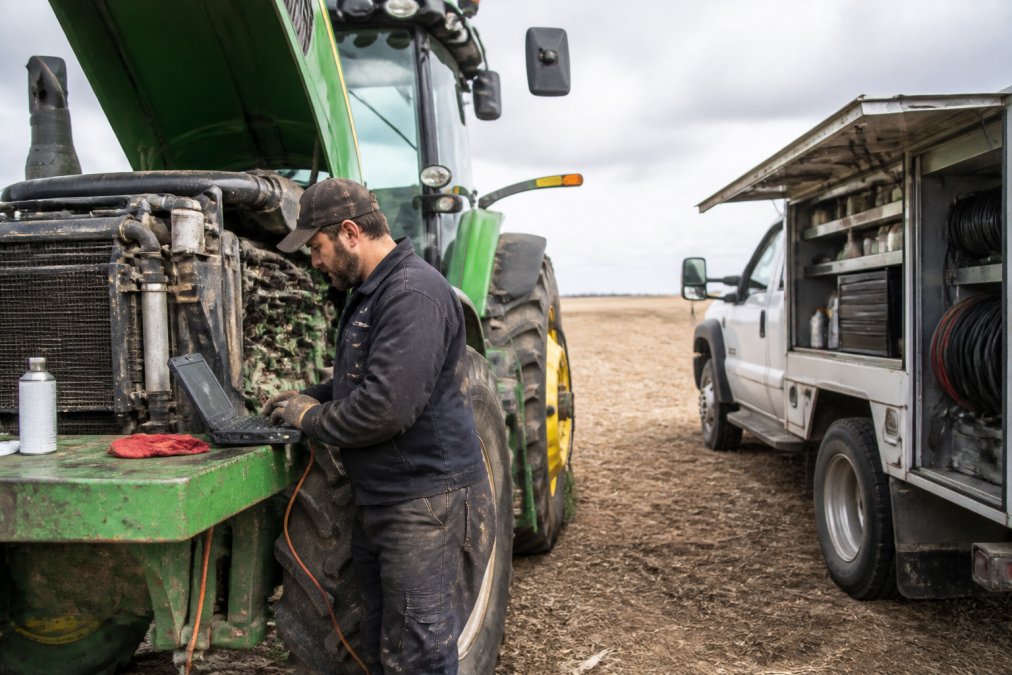
The field service process typically follows this sequence:
- Initial call and dispatch – The operator describes symptoms; the technician prepares likely parts and tools before leaving.
- On-site diagnostics – Service trucks carry laptop-based diagnostic systems that read fault codes from engine control modules, transmission controllers, and hydraulic management systems.
- Root cause identification – The technician confirms the fault, checks for secondary damage, and communicates repair scope to the operator.
- Component replacement or repair – Most common failures, including injectors, sensors, solenoids, hydraulic hoses, and electrical faults, are resolved on the first visit.
- Post-repair verification – The technician runs the machine through operating cycles to confirm the repair holds.
Engine Diagnostics and Electrical Troubleshooting in the Field
Modern mobile technicians carry the same diagnostic software used by dealers. Engine diagnostics in the field covers fault code reading, injector performance testing, turbocharger pressure verification, and exhaust system analysis on heavy-duty diesel engines.
Electrical diagnostics goes deeper than checking fuses. A qualified field technician can trace wiring faults through CAN bus networks, diagnose sensor failures, and repair or replace control modules. Electrical gremlins are often the root cause of symptoms that look mechanical, and chasing the wrong component wastes time and money.
As documented in OSHA’s technical guidance on field equipment repair safety, proper diagnostic procedure before disassembly reduces both repair time and technician injury risk.
Hydraulic Systems and Drivetrain Repair On-Site
Hydraulic systems are the most common source of agricultural machinery downtime outside of engine failures. On-site hydraulic repair covers hose replacement, fitting swaps, cylinder resealing, pump pressure testing, and valve block diagnostics. A technician with a portable hydraulic test kit can identify whether pressure loss is in the pump, control valve, or actuator without removing the system.
Drivetrain repair in the field covers PTO failures, gearbox seal replacements, and universal joint swaps. A failed PTO shaft during planting season is harvest-threatening. Having a mobile technician resolve it in two hours versus waiting three days for a shop appointment is the difference between a minor inconvenience and significant yield loss.
DIY vs. Professional On-Site Agricultural Equipment Repair
The right choice depends on the failure type, your mechanical skill level, and the cost of being wrong.
DIY is appropriate for:
- Fluid and filter changes within your mechanical comfort zone
- Greasing and lubrication on standard zerk fittings
- Replacing air filters, fuel filters, and belts you have done before
- Tire inflation and basic visual inspections
Professional on-site repair is necessary for:
CALL or TEXT NOW:712-827-0207 →
- Any fault code requiring diagnostic software
- Hydraulic system pressure faults (incorrect repair can cause catastrophic failure)
- Electrical faults in modern CAN bus systems
- Structural cracks requiring
- Drivetrain or transmission disassembly
- Any repair where an incorrect fix creates a safety hazard or secondary failure
A DIY attempt on a hydraulic fault that results in a blown cylinder can cost several times more to fix than calling a mobile technician. The honest rule: if the repair requires a tool you do not own, software you cannot access, or a skill you have not performed before, the professional call is the cheaper option when you factor in the cost of getting it wrong.
Keep a log of every repair, fluid change, and service interval on each machine. This record helps mobile technicians diagnose recurring faults faster and provides documentation for warranty claims or resale.
Safety Protocols for On-Site Repairs in the Field
On-site repairs carry risks that a controlled shop environment manages automatically. In the field, those controls must be deliberate.
The ASABE safety standards for agricultural equipment maintenance establish baseline protocols for operators and technicians working on farm machinery.
Key safety requirements for any on-site repair:
- Lockout/tagout procedures – Before any mechanical work, the engine must be off, the key removed, and hydraulic pressure fully relieved. Stored hydraulic pressure in a lowered implement can release suddenly and cause serious injury.
- Stabilize the machine – Never work under a raised implement or header without mechanical safety locks in place. Hydraulic holds are not a substitute for physical blocking.
- Fuel and fire hazard management – Keep ignition sources away from fuel lines, filters, and batteries during repair. Have a fire extinguisher accessible on the service truck.
- Personal protective equipment – Eye protection, gloves, and steel-toed footwear are minimum requirements. High-visibility vests are essential when working near roadways or farm lanes.
- Communicate the work zone – Place cones or flags around the machine if it is on or near a road. Other equipment operators need to know the area is occupied.
- Hot surfaces and pressurized systems – Allow engines and exhaust systems to cool before contact. Never open a pressurized cooling system without following the manufacturer’s depressurization procedure.
A common mistake is skipping the hydraulic pressure relief step because the machine “looks like it’s resting.” Implements retain pressure even when the engine is off. This is one of the most frequent causes of serious injury during field repair.
Never place any part of your body under a raised implement, header, or loader bucket that is supported only by hydraulic pressure. Always engage the mechanical safety lock or use rated blocking before working underneath.
Tool Kits for Field Maintenance: What to Keep on Every Machine
Every piece of farm equipment should carry a basic field maintenance kit to handle minor issues that stop a machine when a technician is an hour away.
Standard field kit for tractors and combines:
- Adjustable wrench and basic socket set (metric and standard)
- Hydraulic hose repair fittings and a hose cutter (sized to your most common hose diameters)
- Electrical tape, wire connectors, and a test light or multimeter
- Spare fuses for every circuit on the machine (keep the fuse chart from the operator’s manual in the kit)
- Spare belts for any drive belt on the machine
- Grease gun loaded and ready
- Fluid top-off containers: engine oil, hydraulic fluid, coolant
- Zip ties and hose clamps in multiple sizes
- Tire plug kit and a portable inflator
- A copy of the operator’s manual or a QR code link to the digital version
For combines and large planters, add:
- Spare row unit components: seed discs, closing wheels, gauge wheel bearings
- Spare header drive components specific to your model
- Spare auger flighting sections if you run grain carts
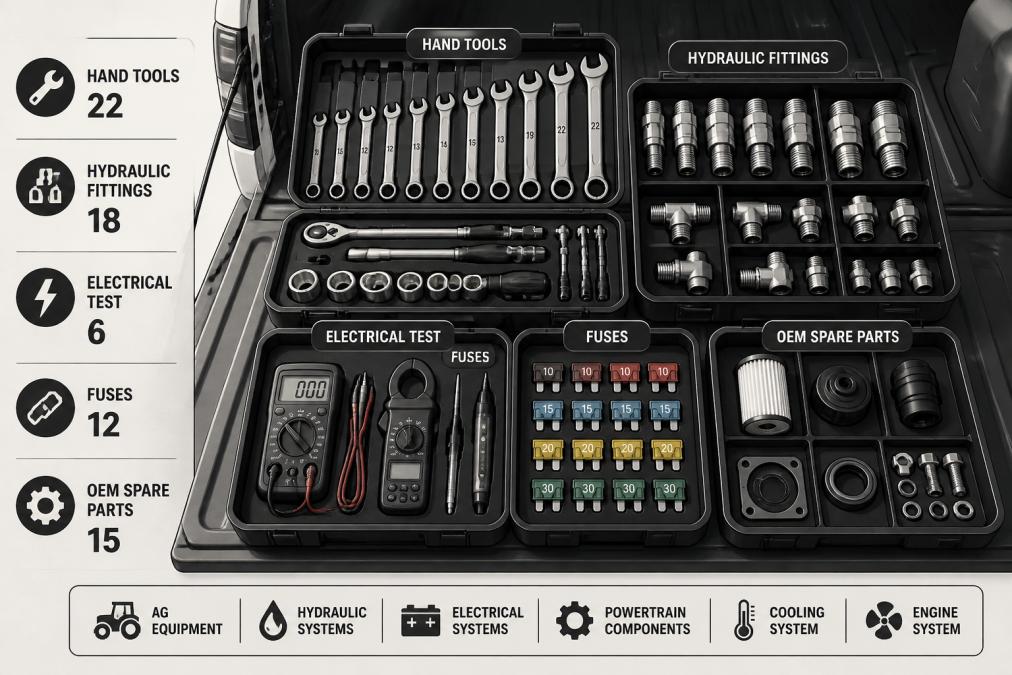
Close-up of an organized heavy-duty field tool kit laid out on a pickup tailgate in bright sunlight, showing wrenches, hydraulic fittings, electrical test equipment, spare fuses, and OEM-style spare parts arranged in labeled trays
The goal of a field kit is to bridge the gap between a breakdown and professional technical support arriving on-site.
The most overlooked item in most field kits is the spare fuse set. Electrical faults are common, fuses are cheap, and running out of the right amperage fuse can shut down a machine for hours over a one-dollar part.
Minimizing Downtime: Emergency Repair Availability and Fleet Management
Equipment downtime during planting or harvest is a direct financial loss measured in acres per hour. The most effective downtime reduction strategy combines scheduled preventive maintenance with access to rapid emergency repair response.
For fleet management across multiple machines:
- Assign service intervals to a calendar, not to a mileage or hour meter alone. Machines that sit during off-season still need pre-season inspection before field days begin.
- Establish a relationship with a mobile technician before you need emergency service. When a technician already knows your fleet, equipment models, and common failure points, response is faster and diagnosis is more accurate.
- Keep a machine-by-machine fault log. Recurring faults on specific equipment indicate a systemic issue, not random bad luck.
- Stock the OEM parts most likely to fail on your specific models. Waiting for parts to ship is often the longest delay in any repair. A technician who arrives and finds the part already on-site cuts hours off the job.
- Plan emergency repair access for off-hours. Breakdowns do not respect business hours. Knowing your mobile repair provider’s availability for 2 AM calls before the season starts is fleet management.
Mudhollow Diesel Mechanics provides scheduled on-site preventive maintenance for agricultural hauling fleets and emergency response for breakdowns across the service area, bringing computer diagnostics and fully equipped service trucks directly to the machine’s location. The operational advantage over towing to a shop is the hours saved between breakdown and repair completion.
Equipment downtime during a critical season can cost far more than any repair bill. Mudhollow Diesel Mechanics brings fully equipped mobile service directly to your location, with computer diagnostics, OEM-compatible parts, and the technical depth to handle engine diagnostics, hydraulic systems, electrical faults, and drivetrain repair on-site. Skip the tow, skip the shop queue. Call or text Mudhollow Diesel Mechanics now at 712-827-0207 to schedule preventive maintenance or get emergency field support when you need it most.
Frequently Asked Questions
Are farmers allowed to fix their own agricultural equipment?
Yes. Federal law does not prohibit owner-operators from repairing their own farm equipment. The 2022 Federal Trade Commission right-to-repair policy statement supports access to parts, tools, and repair information. That said, complex repairs involving heavy-duty engine systems, hydraulic systems, or electrical diagnostics carry real safety risks. For straightforward tasks like fluid changes or filter swaps, DIY is practical. For anything involving on-site agricultural equipment repair beyond basic maintenance, a qualified mobile technician reduces both risk and long-term cost.
What does a mobile agricultural equipment mechanic do on-site?
A mobile agricultural equipment mechanic travels directly to your field, yard, or roadside location with a fully equipped service truck. They perform engine diagnostics, electrical troubleshooting, hydraulic system repairs, drivetrain work, and component replacement without requiring you to haul equipment to a shop. For farm equipment, this means faster turnaround during planting or harvest windows when every hour of equipment downtime directly impacts your operation.
How does on-site repair reduce equipment downtime compared to shop repairs?
On-site agricultural equipment repair eliminates two major time losses: the haul to the shop and the shop queue. Towing a large tractor or combine can take hours and cost hundreds of dollars before any repair begins. Mobile technicians arrive at your location, run diagnostics, and complete most mechanical failures the same day. For fleet management operations running tight harvest schedules, that difference can mean finishing a field on time rather than losing a full day or more.
What are the benefits of preventive maintenance for agricultural machinery?
Scheduled preventive maintenance for agricultural machinery extends equipment lifecycle, reduces the chance of mid-season mechanical failure, and keeps OEM parts warranties intact. Service intervals for filters, fluids, belts, and hydraulic systems are set by manufacturers for a reason: skipping them compounds wear. A structured maintenance schedule, especially one tied to seasonal use patterns like pre-planting and post-harvest inspections, catches small problems before they become expensive field repairs.
This article was written using GrandRanker