

Quick Summary
Cummins diesel engines are designed for heavy-duty performance, but problems involving fuel delivery, turbochargers, cooling systems and emissions components can affect engine operation. Recognizing common warning signs helps identify issues before they lead to costly repairs.
- Loss of engine power may indicate fuel delivery, turbocharger or emissions problems.
- Engine overheating can result from cooling system faults.
- Faulty fuel injectors may cause rough idling and poor engine performance.
- DPF, DEF and EGR issues can trigger warning lights and engine derating.
- Professional computer diagnostics help identify fault codes and underlying engine problems.
Cummins Engine Giving You Trouble?
We bring mobile diesel diagnostics and repair services directly to your truck along I-80 and I-29 to help identify engine problems and get you back on the road.
A Cummins engine losing power usually comes down to fuel, air, and boost, or an emissions fault that made the engine computer cut power. Hard starting, smoke, rough idle, and warning lights point to the same few systems- fuel delivery, air intake, the turbocharger, emissions, cooling, and electronics. No single symptom names the part, so test before you replace anything.
You’re on I-80 with a load behind you, the pedal’s down, and the truck won’t pull. This guide to diesel engine troubleshooting covers the common problems, what causes them, and when to call for Cummins engine repair.
Key Takeaways
- Power loss, hard starts, smoke, rough idle, and warning lights are the usual first signs. None of them point to one part by themselves.
- On engines with emissions equipment, the ECM can cut power on purpose. Clearing the code does not fix the fault behind it.
- Pull fault codes before you replace anything. A turbo complaint can turn out to be a boost leak, a sensor, or a fuel problem.
- “4th gen” and “5th gen” are Ram pickup labels. Check recalls, service bulletins and repair history for your exact truck, not a years-to-avoid list.
- A red stop lamp, low oil pressure, overheating or a metallic knock means stop safely and call a mechanic.
What Are the Most Common Problems With Cummins Diesel Engines?
Cummins builds engines for pickups, box trucks, RVs, and Class 8 semis. They share the same basic systems, so the same symptoms show up across the line. Some parts, like the DPF, EGR, and DEF system, only exist on engines with emissions equipment. A 6.7L in a Ram pickup and an ISX or X15 in a semi don’t fail the same way.
Use this table as a starting point:
| What you notice | Possible causes | What a technician checks first |
| Power loss or struggling under load | Plugged fuel filter, low fuel pressure, boost leak, turbo actuator, DPF or DEF fault | Fault codes, fuel pressure, boost readings |
| Hard start or no start | Weak batteries, fuel supply problems, air in the fuel, worn injectors | Cranking speed, fuel supply |
| Rough idle or misfire | Injectors, fuel quality, low compression | Injector and cylinder balance data |
| Black smoke | Too much fuel or too little air | Air filter, intake restriction, boost leaks |
| White smoke | Unburned fuel or coolant burning | Compression, coolant loss, EGR cooler on equipped engines |
| Blue smoke | Oil burning | Turbo seals, rings, crankcase vent |
| Low boost or a whine from the turbo | Boost leak, turbo actuator, turbo wear | Charge-air hoses, actuator movement |
| Warning light, regen request or reduced power | DPF, EGR, NOx sensor, or DEF doser problem | Aftertreatment fault codes |
| Coolant loss, overheating, ticking or knocking | Leaks, head gasket, exhaust leak, valvetrain wear | Pressure test, exhaust leak check, oil analysis |
Owners ask about 6.7 Cummins issues and 6.7 Cummins reliability. Forum threads and shop write-ups usually point to weak spots in the systems around the engine, such as emissions parts and sensors, not the block. Nobody publishes a clean failure rate, so treat reliability talk as opinion until you check your own truck’s records.
To see how we narrow a symptom down at the roadside, read our guide to on-site diesel engine troubleshooting.
Why Is Your Cummins Engine Losing Power?
Don’t assume it’s the turbo or the injectors. Power loss has many causes, and the cheap ones come first.
The engine control module (ECM) can also cut power on purpose. That’s a derate. On engines with emissions equipment, the ECM does it when it sees an emissions, temperature, or protection fault. Cummins’ driver lamp guide says a flashing DPF lamp can mean the engine automatically reduces power, and a red stop lamp with the DPF lamp means a regeneration didn’t finish in time. DEF faults work the same way. The EPA has asked manufacturers to update their DEF software so a fault gives drivers more time before power drops. Ask your dealer whether your truck has the update.
Clearing the code won’t fix a derate. The fault comes back until someone repairs the cause. Our guide to a semi truck engine losing power covers more of these cases.
People who search for 5th gen 6.7 Cummins problems or 4th gen 6.7 Cummins problems find the same short list- fuel, boost, and emissions faults. We cover the generation differences further down.
Fuel Filter, Fuel Pump, and Injector Problems
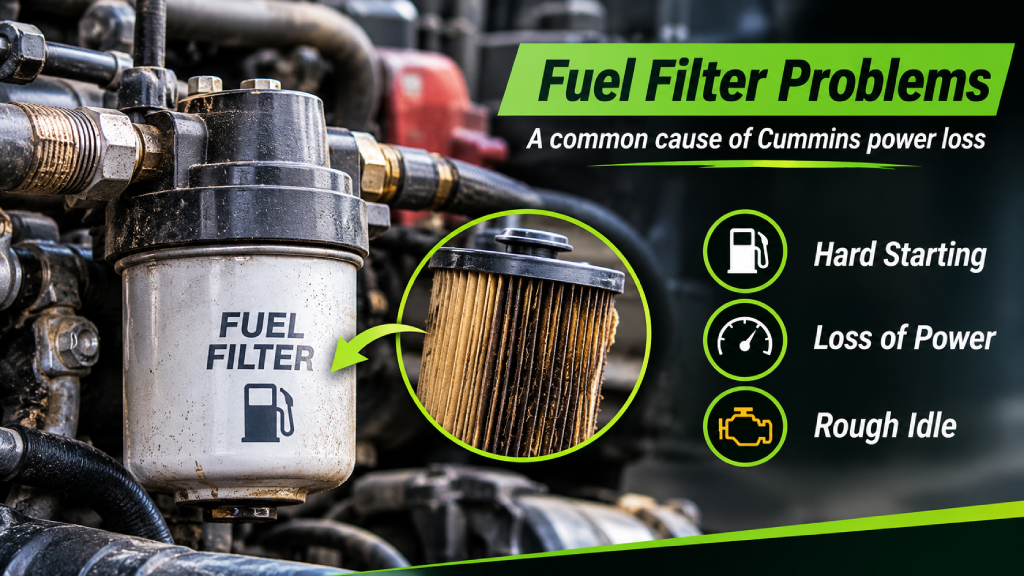
Start here. A plugged filter, a weak lift pump, bad fuel, or worn injectors can starve the engine under load. If the truck pulls fine empty and falls flat with weight on, suspect fuel. Air in the fuel does the same thing. See the signs of air in diesel fuel lines and how to prime the system after a filter change.
Turbocharger and Boost Pressure Problems
A boost leak is easy to miss. A loose clamp, a split charge-air hose, or a leaking intercooler boot lets pressure escape before it reaches the engine. A technician checks the hoses and boots, reads boost from the MAP sensor, and watches whether the variable geometry turbo (VGT) actuator moves the way the ECM commands. If the actuator sticks or lags, boost drops and the truck feels lazy. Prove the air side tight before you buy a turbo.
DPF, EGR, and Aftertreatment Faults
On equipped engines, a plugged DPF, a stuck EGR valve, a weak NOx sensor, or a failing DEF doser can each trigger a derate. A regen request light, frequent regens, or reduced power means diagnose, don’t repeat. A forced regen is the right move in some cases. It won’t help when the filter needs cleaning or replacing, or when another part is causing the fault, as a technician’s guide to DPF regens explains. Our DEF repair page covers the fluid side.
Common signs of engine trouble include power loss, abnormal smoke, hard starting, rough running, and warning lights. Patterns vary by engine and fault, and no single sign confirms the cause.
Request a Truck Mechanic: 712-827-0207
Common Cummins Engine Problems, Causes, and Repair Solutions
Good Cummins engine repair starts with the symptoms. These are six common problem areas- the signs, the likely causes, what a technician checks, and where the repair goes. When the job allows, we do diesel truck repair and engine work on site.
DPF and Emissions System Problems
Signs:
- frequent regens
- a DPF or regen request lamp
- reduced power
- DEF
- NOx fault codes.
Soot from short trips and long idling, a weak injector or boost leak upstream, a filter full of ash, a failing NOx sensor, or crystallized DEF at the doser.
Before anyone cleans or replaces a part, a technician checks active and stored codes, sensor readings, regen history, and the aftertreatment system’s condition. Repairs range from a sensor or doser to cleaning or replacing the filter. Fix whatever loaded the filter, or it loads again.
VGT Turbocharger and Actuator Failure
Signs:
- low boost
- sluggish acceleration
- a whistle
- Squeal
- grinding from the turbo
- boost fault codes.
Soot can gum up the vanes, and the electric actuator that moves them can wear out. A technician checks for boost leaks first, then compares commanded and actual vane position with a scan tool, then inspects the turbo. Repairs range from a new actuator to a cleaned turbo to a replacement. Don’t skip the leak check.
Fuel System and Injector Problems
Signs:
- rough idle
- hard starts
- Misfires
- Smoke
- Worse fuel economy
A technician checks filter restriction, fuel quality, supply and rail pressure, and each injector’s performance. If your oil level climbs or smells like diesel, fuel may be getting into the crankcase. Get it checked and take an oil sample. Ask which test pointed to which injector.
Grid Heater and Intake Problems on Applicable 6.7L Engines
Many 6.7L Cummins pickups use an electric intake grid heater to help cold starts. Owners and shops report cases where the heater’s fastener loosens or fails, dropping metal into the intake. That’s a reported failure on some configurations, not a sure thing on every truck.
A separate issue is a safety recall on certain relays in 2021 to 2023 Ram trucks with the 6.7L Cummins. A short in the grid heater relay can cause a fire. Check your VIN with NHTSA’s recall lookup. Before any repair or upgrade, confirm your exact engine generation and its service information.
Cracked Exhaust Manifold and Exhaust Leaks
Signs
- A ticking that gets louder under throttle
- An exhaust smell
- Soot streaks near the manifold
- and slow turbo response.
A leak ahead of the turbo robs it of drive pressure. A technician inspects the manifold, gaskets, and mounting hardware. A leaking gasket needs a different repair than a cracked casting.
Head Gasket Failure and Coolant Loss
Signs:
- Coolant loss with no visible leak
- Overheating
- Persistent white smoke
- bubbles or pressure in the coolant system.
A leaking EGR cooler, a cracked head, or a failed water pump seal can look the same. Test first, with a cooling-system pressure test and a combustion-gas check, before anyone pulls a head. For more on cooling faults, read our guides to semi truck radiator cooling issues and diesel engine overheating.
How to Troubleshoot Cummins Engine Problems
Diesel engine troubleshooting follows a sequence, and this is how it is done in a professional inspection. It doesn’t replace the service procedures for your exact engine. Follow the manufacturer’s safety steps before you touch anything. Computer diagnostics read the codes and live data.
Check the Warning Lights and Fault Codes
Write down every active and stored code before you clear anything. Clearing erases the history a technician needs. Note which lamps are on and when they came on.
Inspect the Basic Fuel, Air, and Fluid Systems
Check the fuel filter, the air filter and intake restrictions, visible leaks, coolant level, and oil level. Do it with the engine off and cool.
Check Live Data and Test Suspected Components
A technician uses diagnostic software to watch fuel pressure, boost, sensor readings, aftertreatment data, and cooling performance while the engine runs. Then they test the suspect part- a pressure test on the charge-air system, a command test on the turbo actuator, or a sensor checked against a known value.
Identify the Root Cause Before Replacing Parts
One symptom can have several causes. Low boost might mean a loose clamp, a bad sensor reading, a sticking actuator, or a fuel problem. If you swap parts on a guess, you pay for every wrong one. Proper diesel engine diagnostics prevent that and stop repeat failures. Before you approve a part, ask for the test result that points to it.
Get Roadside Truck Service Now: 712-827-0207
What Is the Difference Between 4th-Gen and 5th-Gen 6.7 Cummins Problems?
First, the labels. “4th gen” and “5th gen” are Ram pickup names, not Cummins engine families. Four Wheel Trends dates the 4th gen from 2010 and the 5th gen from 2019. Semi engines like the ISX and X15 aren’t covered in this section.
Equipment, emissions hardware, calibration, maintenance history, and production year all change what a technician finds. The model year alone won’t tell you.
4th-Generation 6.7 Cummins Issues
Research your exact model year and configuration. Look up recalls and service bulletins for your VIN and read the repair history. The fuel, boost, and emissions faults covered above apply here, but they don’t hit every truck.
5th-Generation 6.7 Cummins Issues
The 5th gen moved to hydraulic roller lifters, according to SlashGear, and some owners report a ticking noise and lifter or cam damage. Others say a tick can be normal, and shops disagree on how common failure is. Stellantis has published a service bulletin on the correct oil grade for 2019 and newer 6.7L trucks. Check it against what’s in your engine, then check codes and emissions equipment on your own truck. Don’t assume every 5th gen shares the same weak spots.
Which 6.7 Cummins Years Should You Research Carefully?
Online lists of 6.7 Cummins years to avoid mixing documented problems with opinion, and they contradict each other. We won’t hand you one. Sort the evidence yourself:
- Documented: Recalls on your VIN through NHTSA, service bulletins, and warranty coverage.
- Owner reports: Forums and groups. Useful clues, not proof.
- Your truck: Service records, oil analysis results, stored fault codes, and past emissions or turbo repairs.
- Before you buy: Have a local diesel mechanic inspect the truck.
How Much Does Cummins Engine Repair Cost?
Nobody can price a Cummins repair without fault codes and an inspection. The price follows the cause. These factors move it most:
- Diagnostic time: A hard-to-find boost leak takes more labor than a plugged filter.
- Parts and labor: Access matters. An easy-to-reach part costs less to replace.
- Clean, repair, or replace: Cleaning a DPF or a turbo actuator can cost less than replacing it, when cleaning is the right call.
- Engine generation and emissions setup: The same symptom can mean different parts on different engines.
- Secondary damage: Running on a fault can turn one repair into two.
For an accurate estimate, give the shop your engine model, symptoms, fault codes, and whatever the inspection finds. When you call us, we text you the minimum charge before we dispatch, so you know the starting cost.
Questions about a quote? Contact us or read what affects truck repair pricing.
When Should You Call a Semi Truck Mechanic or Mobile Diesel Mechanic?
Call when the problem needs a diagnosis you can’t make from the shoulder. A semi truck mechanic or diesel engine mechanic can read the codes, test the system, and tell you whether the truck can keep rolling.
Warning Signs That Need Prompt Attention
Stop safely and call for any of these- severe or sudden power loss, a red stop lamp, overheating, low oil pressure, heavy coolant loss, or a metallic knock. Cummins says a red stop engine lamp means stop the engine as soon as it is safe. Don’t try to finish the run. Driving on can turn a repair into a rebuild.
When Mobile Diesel Repair Makes Sense
A mobile diesel mechanic can run diagnostics and handle some Cummins engine repair where the truck sits. What’s possible is based on the fault, the location, the equipment, and the parts on hand. Mudhollow Diesel Mechanics is a family-owned mobile diesel repair company with 25+ years of hands-on experience. A call goes like this:
- Call: Tell us what the truck is doing and where it is.
- Quote by text: Before we dispatch, we text you the minimum charge.
- On-site diagnosis: We read codes, test the system, and find the fault.
- Repair when possible: We carry parts and equipment on our service trucks. If the job needs shop equipment, such as major internal engine work, we explain that and arrange the next step.
From Walnut, IA, we cover I-80 from Omaha, NE to West Des Moines, IA, and I-29 from Mound City, MO to Sioux City, IA, including Council Bluffs. See our western Iowa coverage, our service radius, Council Bluffs service, and emergency roadside services. We’re open 4 AM to 11 PM, 7 days a week.
What Information to Share With the Mechanic
Have this ready when you call:
- Engine or truck model and model year
- Symptoms and when they happen: under load, at idle, cold, hot
- Warning lights on the dash
- Fault codes, if you have them
- Recent repairs
- Your exact location
Talk to a Certified Diesel Mechanic: 712-827-0207
How Long Does a Cummins Engine Last?
No single mileage fits every Cummins. Engine life relies on the engine family, duty cycle, load, idle time, maintenance and repair history. A pickup, a box truck, and a Class 8 tractor live very different lives.
Manufacturers talk about B10 and B50 life. DieselHub explains that these are statistical estimates. B10 is the mileage by which 10 percent of engines are expected to need a major repair or overhaul. It doesn’t predict a date for your engine.
Judge a specific engine by its records. Look at maintenance history, oil consumption, blow-by or compression test results, and any past major repairs. Mileage alone tells you little. A high-mileage engine with clean records is better than a low-mileage one that idled for years and skipped service. For most buyers, the 6.7 Cummins reliability debate comes down to the history of the truck in front of them.
Frequently Asked Questions
What Are the Most Common Problems With Cummins Diesel Engines?
The main categories are fuel delivery, power loss, turbocharger and boost faults, starting problems, emissions-system faults on equipped engines, and cooling concerns. Which one you have depends on the engine and the symptoms. A technician reads the codes and tests before naming a part.
What Are the Top 5 Signs of Engine Trouble?
Power loss, abnormal smoke, hard starting, rough running, and warning lights. Symptoms vary by engine and fault, and no single sign confirms a specific problem. Note when each one happens and tell the mechanic.
What Should I Do If My Cummins Engine Is Losing Power?
Find a safe place to stop and check the dash. If a red stop lamp is on, shut the engine down. Write down any fault codes before you clear them. Avoid hard loading and repeated forced regens, then call for a diagnosis.
Can a Mobile Diesel Mechanic Fix a Cummins Engine on the Roadside?
Often, yes, for diagnostics and many eligible repairs. It depends on the fault, location, equipment, and parts on hand. Major internal engine work can require shop equipment, and we explain that and arrange the next step. Read more about our mobile truck repair service.
Need a Mechanic at Your Truck?
Pull the codes, test the cheap things first, and don’t buy parts on a guess. That is diesel engine troubleshooting in one line. If you want a mechanic to come to the truck, we’re open 4 AM to 11 PM, 7 days a week.
Call Now for Dispatch: 712-827-0207