

Table of Contents
- Mobile Diesel Repair Time: What the Average Actually Looks Like
- Mobile Diesel Mechanic Roadside Assistance Time: From Call to Back on the Road
- Emergency Mobile Diesel Repair Diagnostics: How Long Before You Know the Problem
- Factors Affecting Diesel Engine Repair Duration
- Mobile Diesel Repair vs Shop Wait Times: Where the Hours Actually Go
- How to Prepare Before the Technician Arrives
- Frequently Asked Questions
Last Updated: October 1, 2026
Mobile Diesel Repair Time: What the Average Actually Looks Like
Most mobile diesel repair calls are finished in one to three hours. That is the honest answer, and it holds for the majority of roadside breakdowns a fully equipped service truck can handle.
Mobile diesel repair is on-site mechanical work performed at your truck’s location, whether that is a highway shoulder, a rest stop, or a loading dock, rather than at a shop. The clock starts when the technician arrives, not when you call. At Mudhollow Diesel Mechanics, our technicians carry 15+ years of experience and the diagnostic tools to fix most problems without a tow.
The repair window depends on the job. A simple sensor swap takes under an hour. A radiator replacement can run three to four hours. Below, we break down realistic windows by job type so you can plan your day instead of guessing.
Typical repair windows by job type
| Job Type | Typical On-Site Time | What Drives the Duration |
|---|---|---|
| Battery, alternator, starter | 45-90 minutes | Access to mounting bolts |
| Sensor or wiring fault | 1-2 hours | How deep the fault sits in the harness |
| Belt or hose replacement | 1-2 hours | Coolant drain and refill time |
| Turbocharger diagnosis and swap | 2-4 hours | Parts on hand, heat damage |
| Radiator replacement | 3-4 hours | Coolant system flush and bleed |
These windows assume the technician has the right part on the truck. If a part needs ordering, the repair pauses. That is the one factor no mobile mechanic can control.
The single biggest predictor of repair time is parts availability, not mechanical difficulty. Ask the dispatcher what the truck carries before you commit.
Mobile Diesel Mechanic Roadside Assistance Time: From Call to Back on the Road
The total time from your call to rolling again breaks into three parts: dispatch, travel, and repair. Dispatch usually takes minutes. Travel depends on where you are sitting.
On the I-80 and I-29 corridors, a service truck can often reach you faster than a tow truck can hook up and haul you to a shop. That matters because a tow adds its own hour or more before repair work even starts.
Here is how the timeline stacks up:
- Dispatch: 5-15 minutes to confirm your location and issue
- Travel: varies with mile marker and traffic
- Diagnosis: 30-60 minutes on arrival
- Repair: 45 minutes to 4 hours, depending on the job
A common mistake drivers make is waiting to call. Every hour you delay is an hour added to your total downtime. Call or text as soon as you know you are not moving under your own power.
Emergency Mobile Diesel Repair Diagnostics: How Long Before You Know the Problem
Diagnosis usually takes 30 to 60 minutes. Modern computer diagnostics read engine codes in minutes, but a good technician confirms the fault before touching a wrench.
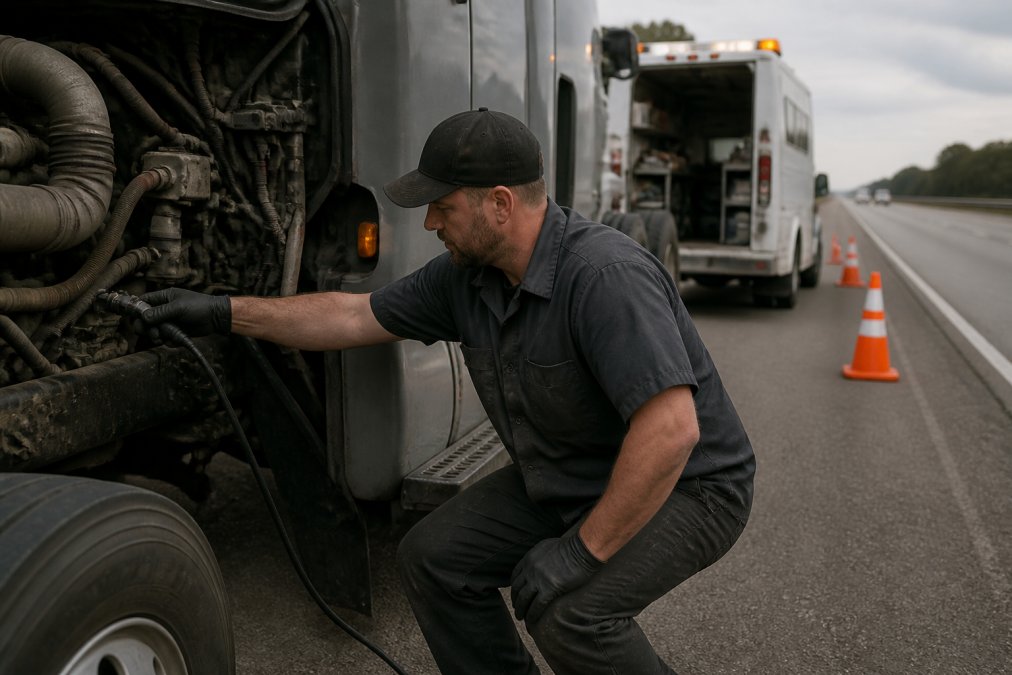
What most guides miss is that the code is a starting point, not an answer. A fault code might point to a sensor when the real problem is a wiring short three feet away. That is where experience separates a fast fix from a repeat breakdown.
Our service trucks carry computer diagnostics built for hard-to-solve electrical gremlins, the kind that stump dealership bays. On-site testing confirms the fault before we order a single part.
Skipping diagnosis to save time backfires. A technician who swaps parts on a guess often leaves the real fault in place, and you break down again within a hundred miles.
Factors Affecting Diesel Engine Repair Duration
Repair duration comes down to a handful of variables that stack on top of each other. Understand how each one moves the clock and you can set a realistic expectation before the service truck ever arrives.
CALL or TEXT NOW:712-827-0207 →
Issue type. This is the biggest lever. A sensor or wiring fault is a one-to-two-hour job because the technician is chasing a signal, not removing hardware. A turbocharger or radiator job is a three-to-four-hour job because the technician has to drain fluids, break heat-cycled fasteners, and refill and bleed the system afterward. The mechanical difficulty is real, but the fluid work and the re-seal are what eat the hours.
Parts availability. A part on the truck is a same-visit fix. A part that has to be ordered turns a three-hour repair into a multi-day event, because the clock stops the moment the technician confirms the part number and does not restart until the part is in hand. This is the single variable no mobile mechanic can compress, which is why a dispatcher who knows what the truck carries is worth more than a dispatcher who promises a fast arrival.
Access and working position. A terminal yard or rest stop lets the technician lay out tools, run a cord, and work standing up. A live traffic lane forces the technician to work in a narrow footprint with one eye on traffic, and that slower, more careful pace adds time to every step. If you can limp to a safer spot, do it, safer access commonly shaves 20-30 minutes off the job.
Weather and traffic. Rain, ice, and high wind slow travel and add safety setup time on arrival. Rush-hour congestion near a busy interchange adds travel time that no one can predict from a dispatch board. A breakdown at 7 a.m. on a clear Tuesday and the same breakdown at 5 p.m. in a storm are not the same call.
Vehicle age and condition. Older rigs have seized bolts, brittle plastic connectors, and corroded grounds. A fastener that should take thirty seconds can take twenty minutes when it snaps and has to be extracted.
If you break down at a terminal or rest stop rather than a live traffic lane, tell the dispatcher. Safer access often shaves 20-30 minutes off the job.
Rank the variables in your head before you call: issue type first, parts second, access third. Those three decide whether you are down for hours or down for days.
Mobile Diesel Repair vs Shop Wait Times: Where the Hours Actually Go
Most guides compare mobile repair to a shop by saying mobile is faster. That is true, but it hides the real question: where do the hours actually go in each path? Walk the timeline and the difference stops being a slogan and becomes arithmetic.
| Scenario | Mobile Repair | Shop Visit |
|---|---|---|
| Simple roadside fix | 1-3 hours total, no tow | Tow plus queue plus 1-3 days |
| Part on the service truck | Same-visit repair | Order and wait behind the queue |
| Major engine work needing a lift | Not suitable | Correct choice |
| Scheduled terminal maintenance | Performed on site, unit by unit | Each unit hauled in and queued |
| Hard-to-solve electrical fault | On-site diagnostics trace the fault | Bay time plus diagnostic queue |
When you compare options, count the tow and the queue as part of the shop’s time, not as overhead. Those two steps are usually longer than the repair itself.
How to Prepare Before the Technician Arrives
Preparation cuts repair time. A driver who is ready when the truck pulls up saves the technician 15-30 minutes of setup.
- Pull as far off the travel lane as safely possible
- Set out triangles or cones behind the vehicle
- Turn on hazard lights
- Note your exact mile marker and direction of travel
- Write down any warning lights or engine codes
- Describe recent symptoms: noises, smells, power loss
- Have your registration and vehicle details ready
- Unlock the hood and cab for quick access
- Keep the key accessible for the technician
- Stay clear of traffic while you wait
Snap a photo of your dashboard warning lights before the technician arrives. It gives them a head start on diagnosis and confirms which codes were active at the breakdown.
Frequently Asked Questions
How much do mobile diesel mechanics charge per hour?
Mobile diesel repair pricing usually combines an hourly labor rate with a service call or mileage charge, so the total depends on your location, the job type, and parts needed. Rates vary by region and provider. Mudhollow Diesel Mechanics does not publish flat rates because every breakdown is different. Call or text 712-827-0207 for a quote based on your specific situation.
Is it faster to use a mobile diesel mechanic than a traditional shop?
For most roadside breakdowns, yes. A mobile diesel mechanic comes to you, so you skip the tow and the shop queue entirely. Diagnostics often take 30 to 60 minutes on site, and many repairs finish within 1 to 3 hours. At a traditional shop, you may wait days just to get into the bay, especially during harvest season or after a cold snap.
What factors influence the duration of a mobile diesel repair?
The biggest factors are the type of failure, parts availability, weather, and your exact location. A clogged fuel filter might take under an hour; a turbocharger replacement takes longer and may require a parts order. Traffic and distance also affect how fast the technician reaches you. Knowing your engine codes and symptoms before the call helps the tech arrive prepared.
What information should I provide to speed up my mobile diesel repair?
Give the dispatcher your exact mile marker or address, truck make and model, engine type, any fault codes showing on the dash, and a clear description of what happened. Mention whether the truck is loaded, if you are in a safe spot, and any recent work done. The more detail you provide upfront, the faster the technician can diagnose and fix the problem.
A breakdown on I-80 or I-29 does not have to mean a tow and a multi-day shop wait. Mudhollow Diesel Mechanics brings fully equipped mobile service to your location, with computer diagnostics, rapid roadside repairs, and technicians who carry 15+ years of experience. Most customers never see a tow truck. Get started with Mudhollow Diesel Mechanics and get back on the road fast. Call or text 712-827-0207.