

Table of Contents
- Mobile RV Repair vs. Shop Service: A Side-by-Side Comparison
- Reducing Commercial Vehicle Downtime With On-Site Repair
- The Cost of Towing vs Mobile Repair: What Fleet Managers Should Weigh
- Mobile Diagnostic Tools for Heavy-Duty Trucks and RVs
- Preventative Maintenance and Fleet Uptime: Building a Program That Works
- Where Mobile RV Repair Fits in Your Fleet Management Software
- Conclusion: Choosing Mobile Repair for Fleet Operations
- Frequently Asked Questions
Last Updated: September 29, 2026
Mobile RV Repair vs. Shop Service: A Side-by-Side Comparison
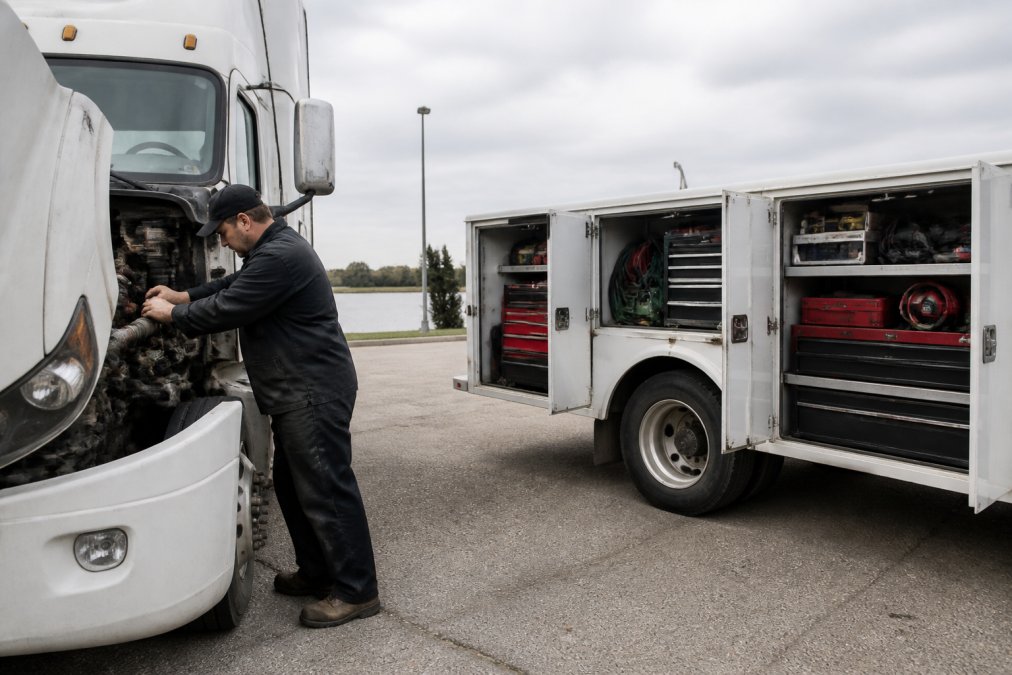
Mobile RV repair is a service model that brings certified technicians and heavy-duty diagnostic equipment directly to a broken-down vehicle, whether it sits on a highway shoulder, at a rest stop, or in a fleet yard. For commercial fleets, that on-site approach changes the math on every breakdown. At Mudhollow Diesel Mechanics, we’ve built our entire operation around it: fully equipped service trucks, computer diagnostics on board, and 15+ years of technician experience focused on getting rigs moving again without a tow.
How Each Option Handles a Breakdown
A shop-based repair starts with a tow. The vehicle leaves your control, waits in a queue, and returns on the shop’s schedule. A mobile unit inverts that sequence: the technician comes to the asset, diagnoses it on site, and completes most repairs in place.
- Shop route: tow dispatch, hookup, transport, intake paperwork, queue, repair, pickup
- Mobile route: dispatch, on-site diagnosis, repair at the vehicle, back in service
- Who controls the timeline: the shop in one case, your operation in the other
That difference compounds across a fleet. A single truck sitting in a dealer lot for a week ties up capital and a driver.
Reducing Commercial Vehicle Downtime With On-Site Repair
Reducing commercial vehicle downtime starts with eliminating the two biggest time sinks in any breakdown: the tow and the shop queue. Mobile repair removes both. The technician arrives with tools and diagnostics, so the repair clock starts at the vehicle instead of hours later at a service bay.
What Every Hour of Downtime Costs a Fleet
A parked commercial vehicle still carries its costs: the load isn’t moving, the driver isn’t producing, and the contract clock keeps running. Many fleet managers track this as revenue per available truck hour. When one unit is down, that number drops for the whole fleet, not just the affected truck.
For most hauling operations, the real cost of a breakdown isn’t the repair invoice. It’s the hours the asset spends unavailable. Mobile repair attacks the availability problem directly.
The Cost of Towing vs Mobile Repair: What Fleet Managers Should Weigh
The cost of towing vs mobile repair comes down to more than the two line items. A tow bill is only the visible expense. Behind it sit the shop’s intake and diagnostic fees, days of lost use, and sometimes a second tow if the first shop can’t handle the job.
Weigh the full picture:
- Tow dispatch and mileage charges
- Shop diagnostic and intake fees
- Lost revenue for every day the unit is out
- Driver downtime or reassignment costs
- Risk of a second tow to a specialty shop
Mobile repair collapses several of those into one service call. The technician diagnoses and repairs at the vehicle, so the unit often returns to service the same day. Pricing depends on the job, the location, and the parts required, so it’s worth requesting a quote for your specific situation rather than comparing flat rates.
Mobile Diagnostic Tools for Heavy-Duty Trucks and RVs
Mobile diagnostic tools for heavy-duty trucks and RVs now match much of what a dealer bay offers. Modern service trucks carry computer diagnostics that read fault codes across engine, aftertreatment, and electrical systems, which matters when a problem doesn’t announce itself clearly.
The hard cases are the ones that matter most. Intermittent electrical faults, sensor gremlins, and turbo or radiator issues that only appear under load often defeat a quick scan.
When you describe a fault to a mobile technician, note the conditions: load, temperature, speed, and whether it’s intermittent. That context often shortens diagnosis more than the fault code itself.
Preventative Maintenance and Fleet Uptime: Building a Program That Works
Preventative maintenance is the highest-use part of any fleet uptime strategy, because it moves work from the roadside to the yard on your schedule. A mobile provider can run scheduled dry-land servicing at your terminal, inspecting the systems most likely to strand a truck: cooling, turbocharging, and electrical.
A workable program looks like this:
CALL or TEXT NOW:712-827-0207 →
- List every unit and its typical duty cycle
- Set inspection intervals by mileage and hours, not calendar alone
- Schedule servicing at your yard during off-hours
- Log every finding and repair against the unit
- Review trends quarterly and adjust intervals
Skipping scheduled inspections to save yard time usually costs more later. A turbo or cooling failure found on the road removes the unit from service for far longer than a planned yard visit would have.
Where Mobile RV Repair Fits in Your Fleet Management Software
Mobile repair slots into fleet management software as a field service workstream. When your dispatch system tracks every unit, you can log a mobile repair call the same way you log a scheduled service, keeping one maintenance history per asset. That integration matters for decisions: if your software shows which units generate the most emergency calls, you can shift those into a preventative program.
How Telematics and Mobile Repair Talk to Each Other
Most commercial fleets already run telematics that streams engine fault codes, coolant temperature, oil pressure, and aftertreatment data. That data is only useful if someone acts on it. A mobile repair provider can work from those alerts directly:
- Fault code alerts, a telematics platform flags a derate or check-engine event; the fleet manager forwards the code to the mobile technician before dispatch, so the truck rolls with the right parts and diagnostic platform.
- Location and routing, GPS position tells the technician where the unit is sitting, whether that’s a yard, a rest stop, or a shoulder, and the service truck routes accordingly.
- Hours and duty cycle, engine hours and mileage data let the provider schedule yard servicing around actual use instead of a calendar guess.
Work-Order Flow: From Roadside Call to Maintenance History
A clean integration follows the same path every time:
- Breakdown or telematics alert triggers a work order in your fleet software.
- The mobile provider receives the unit number, location, and reported fault.
- The technician diagnoses on site and records findings, parts used, and repair notes.
- Those details post back to the unit’s maintenance history, not a separate paper file.
- The fleet manager reviews the history at the next maintenance interval and adjusts the preventative schedule.
When that loop is intact, every roadside repair becomes data. A unit that throws the same turbo or cooling fault twice stops being a surprise and starts being a scheduled yard visit.
What to Ask a Mobile Provider About Integration
Before you add a mobile provider to your vendor list, ask how they handle data:
- Do they provide repair notes and parts records in a format your fleet software can accept?
- Can they work from your telematics alerts, or do they only respond to phone calls?
- Do they log findings against the unit number you already use?
- Will they flag recurring faults so you can move that unit into a preventative program?
| Approach | Tow Required | Typical Timeline | Best For |
|---|---|---|---|
| Mobile on-site repair | Usually not | Same day in many cases | Roadside breakdowns, yard servicing |
| Shop service | Yes | Days, depending on queue | Major overhauls, warranty work |
| Dealer service | Yes | Often a week or more | Complex warranty diagnostics |
Conclusion: Choosing Mobile Repair for Fleet Operations
Every breakdown forces a choice: tow the unit and wait, or fix it where it sits. For fleets that measure uptime in revenue, the on-site option usually wins. Mudhollow Diesel Mechanics brings fully equipped mobile service to your location across I-80 and I-29, with computer diagnostics, rapid roadside repairs, and scheduled yard servicing that keeps units out of the shop queue. Most customers avoid a tow entirely.
Frequently Asked Questions
How does mobile repair reduce commercial fleet downtime?
Mobile repair eliminates the tow and the shop queue. A technician arrives at the breakdown or yard, diagnoses the issue on the spot, and completes most roadside fixes in less time than an in-shop visit. For fleets running I-80 and I-29 corridors, that means assets return to service faster and scheduled loads stay on track. Preventative maintenance at your terminal also catches problems before they cause a breakdown, keeping vehicles in operation instead of waiting for a bay.
Is mobile repair cost-effective for large commercial fleets?
It often is, because the savings come from avoided towing fees, reduced downtime, and fewer emergency repairs. A mobile call eliminates the tow bill entirely for most breakdowns, and on-site preventative maintenance prevents costly on-road failures. Fleet managers should compare the total cost per incident, including lost revenue from downtime, not just the labor rate. Mudhollow Diesel Mechanics provides quotes based on your fleet size and service needs.
What types of RV and diesel repairs can be performed on-site?
Mobile units handle radiators, turbochargers, electrical diagnostics, and most engine-related failures. Technicians carry computer diagnostics and heavy-duty tools to address complex issues that might otherwise require a dealership. For hard-to-solve breakdowns, on-site diagnostics can identify the problem without moving the vehicle.
How does mobile service eliminate the need for heavy-duty towing?
When a technician can repair the vehicle where it sits, the tow truck never gets called. That saves the tow fee and the hours spent waiting for a tow and then a shop opening. Mudhollow Diesel Mechanics reports that 99% of customers avoid a tow because most repairs are completed on-site. For fleets, that means fewer vehicles out of service and less disruption to delivery schedules.
What should fleet managers look for in a mobile repair provider?
Look for certified technicians with heavy-duty diesel experience, fully equipped mobile units, and diagnostic tools that match your fleet’s systems. Ask about response times, service area, and whether they offer scheduled preventative maintenance at your yard. A provider that integrates with your fleet management software makes scheduling and tracking easier. Mudhollow Diesel Mechanics has 15+ years of experience and serves western Iowa along I-80 and I-29.