Table of Contents
- Why Electrical Gremlins Are Different From Other Breakdowns
- Common Electrical Gremlins in Semi-Trucks
- Mobile Truck Electrical Diagnostics: What a Pro Does On-Site
- Troubleshooting Intermittent Electrical Shorts: Step by Step
- Mobile Repair for Electrical Gremlins vs. Towing to a Shop
- When to Call for Mobile Repair for Electrical Gremlins
- Conclusion
- Frequently Asked Questions
Last Updated: September 8, 2026
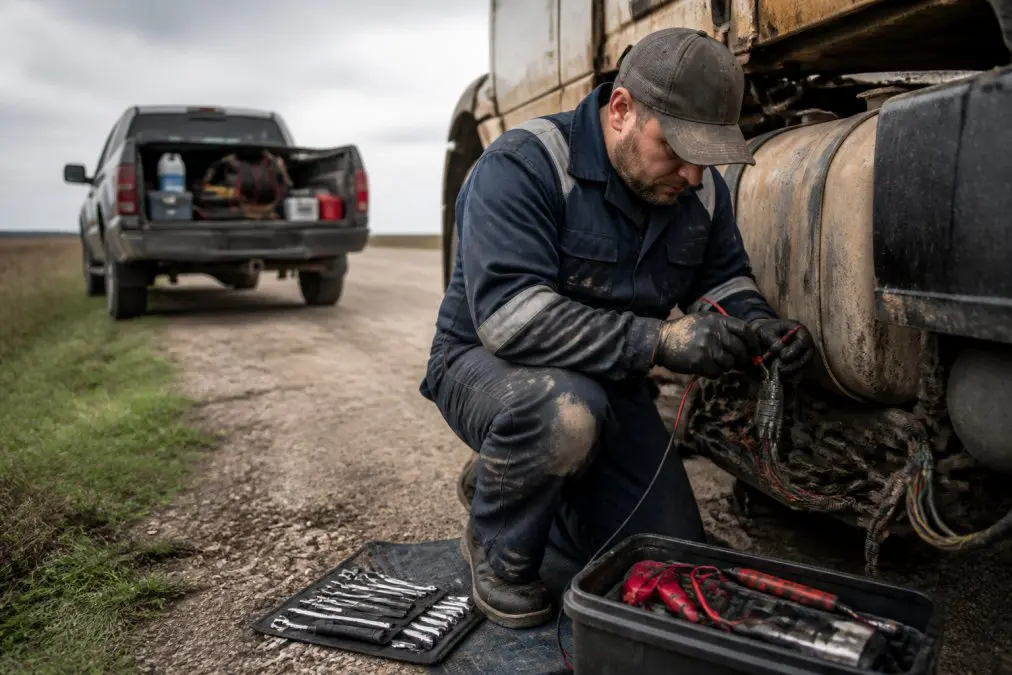
Electrical gremlins are the most frustrating breakdowns a trucker can face. Unlike a blown tire or a bad alternator, these faults are intermittent, invisible, and notoriously difficult to pin down. Mobile repair for electrical gremlins brings the diagnostic firepower of a modern shop directly to your truck, wherever it dies. At Mudhollow Diesel Mechanics, our technicians handle these complex, hard-to-solve failures on-site across the I-80 and I-29 corridors in western Iowa. Below, we’ll show you exactly how professional mobile diagnostics work and why they often beat a trip to the dealership.
Why Electrical Gremlins Are Different From Other Breakdowns
Mechanical failures follow a pattern: a part wears out, it breaks, you replace it. Electrical gremlins break that rule. A short circuit might only occur when the frame vibrates at highway speed, or a control module might fail only after the engine bay reaches a certain temperature. This intermittent nature makes them nearly impossible to diagnose in a static shop bay.
The core problem is that you cannot fix what you cannot see. When a truck dies on the shoulder, the fault is often gone by the time a tow truck arrives. The technician stares at a perfectly healthy wiring harness, and the clock is ticking on your load. This is why a structured troubleshooting methodology matters more than guesswork, and why on-site diagnosis at the moment of failure is so valuable.
Common Electrical Gremlins in Semi-Trucks
While every fault is unique, several electrical issues appear repeatedly in heavy-duty trucks. Knowing these common electrical gremlins in semi-trucks helps you describe symptoms accurately when you call for help.
- Parasitic battery drain: The truck sits overnight and won’t crank in the morning because something, a glovebox light, a faulty relay, is drawing power with the ignition off.
- Intermittent power loss: The dash goes dark and the engine stumbles for a split second, often caused by a loose connection or a failing ignition switch.
- Failed sensors: A bad wheel speed sensor or crank position sensor triggers a check engine light without any obvious mechanical problem.
- Corrosion and grounding issues: Corrosion buildup at ground terminals causes erratic behavior across multiple systems, from lights to the transmission controller.
A common mistake is replacing parts based on a stored trouble code without checking the wiring integrity first. Codes tell you which circuit is failing, not whether the sensor or the wire is the culprit.
The Hidden Culprits: Environmental Factors
What most guides miss is that electrical gremlins are rarely born in the wires themselves. They are almost always triggered by the environment the truck operates in. Understanding these root causes helps you prevent faults before they strand you.
Corrosion is the number one enemy. Road salt, moisture, and the constant temperature cycling of an engine bay create a perfect environment for corrosion. It creeps into connectors, travels up wire strands through capillary action, and turns a solid copper connection into a high-resistance path. The classic symptom is a circuit that works when cold but fails when hot, as the resistance increases with temperature (allaboutcircuits.com). A technician will look for the telltale green or white crust on terminals and use dielectric grease to prevent recurrence.
Moisture intrusion is a close second. A cracked tail light housing, a worn grommet where a wiring harness passes through the firewall, or even a high-pressure wash at a truck stop can force water into connectors and control modules. Water creates a path for current to leak where it shouldn’t, causing erratic behavior that seems to have no pattern. The fault may only appear after rain or a wash, making it seem almost supernatural to the owner.
Rodent damage is more common than you think. Mice and squirrels find the warm, sheltered environment of an engine bay or a parked trailer’s wiring harness irresistible. They chew through insulation, creating short circuits that can take out multiple systems at once. The damage is often hidden inside the harness wrap, so a visual inspection may miss it. A technician will look for chewed insulation, droppings, or nesting material near the harness.
If you park your truck for extended periods, especially in rural areas or near fields, inspect the engine bay for signs of rodent activity. A simple peppermint oil spray on the wiring harness can deter nesting without harming the animals or the truck.
By understanding these environmental triggers, you can take preventive steps and give the technician a crucial head start when you call for mobile repair. Describing that the fault only happens after a rainstorm or that you recently parked near a grain silo can cut diagnostic time significantly.
Mobile Truck Electrical Diagnostics: What a Pro Does On-Site
Mobile truck electrical diagnostics require more than a multimeter and a prayer. A properly equipped service truck carries the same computer-based tools you would find in a dealership bay, including a heavy-duty OBD-II scanner capable of reading every control module on the network. But the real difference between a parts-swapper and a true electrical diagnostician lies in understanding the vehicle’s data network.
Beyond the Multimeter: CAN-Bus System Diagnostics
Modern semi-trucks are rolling data networks. The Controller Area Network (CAN-bus) is the backbone that lets the engine control module (ECM), transmission controller, ABS module, and dash cluster talk to each other over a twisted pair of wires. When a gremlin strikes, it’s often a communication fault on this network, not a simple short in a power wire.
A technician trained in CAN-bus diagnostics doesn’t just look for 12 volts; they use a digital multimeter or oscilloscope to check for proper voltage levels and signal integrity on the network’s two data lines, CAN-High and CAN-Low. They look for a healthy waveform, typically around 2.5 volts with a 2-volt swing, and check for termination resistors at the ends of the network (kvaser.com). A missing or corroded termination resistor can cause intermittent communication errors that make the truck behave erratically, like suddenly losing the dash or refusing to shift.
CALL or TEXT NOW:712-827-0207 →
This level of testing is where a mobile unit shines. The technician can monitor live CAN-bus traffic while the fault is occurring, capturing the exact moment a module drops off the network or sends a corrupted message. This is a unique angle that static shop diagnostics often miss, as the fault may not reproduce on a test drive after the truck has cooled down.
The On-Site Diagnostic Process
The process starts with a battery and charging system test to establish a baseline. A technician then performs a voltage drop test on the suspect circuits to find resistance caused by corrosion or a damaged wire. For intermittent faults, the technician may use a wiring schematic to trace the circuit while physically manipulating the harness to reproduce the vibration that triggers the short. This hands-on approach, combined with CAN-bus communication monitoring, isolates problems that a parts-swapper would miss.
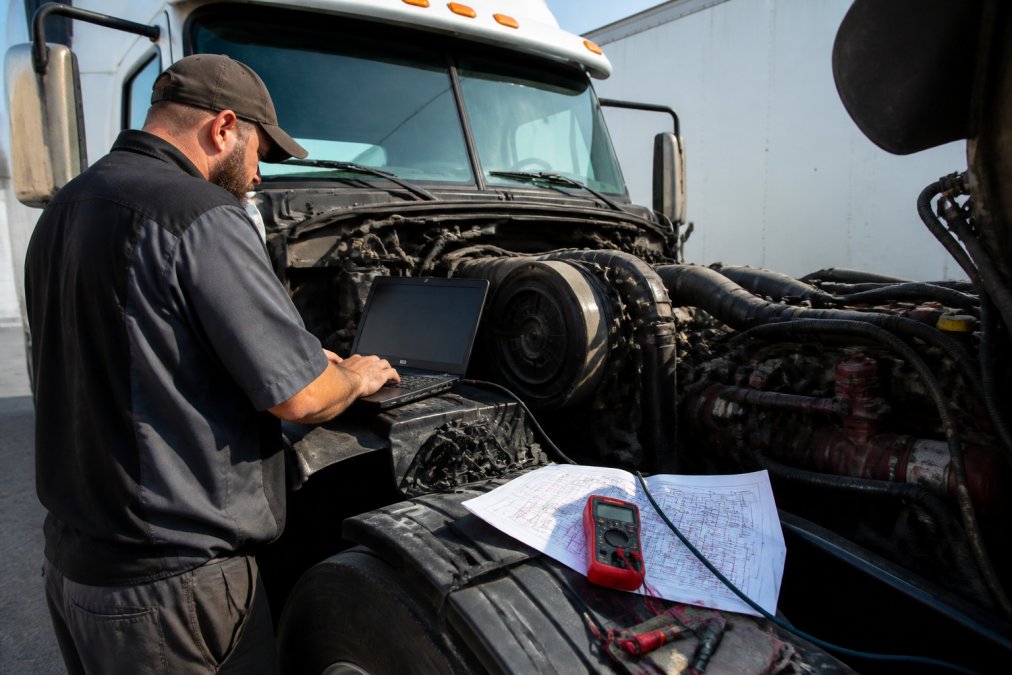
The value of mobile diagnostics is timing. Testing a circuit while the fault is active, on the side of the road, is far more effective than testing it after a tow truck has bounced the truck around for twenty miles. With 15+ years of experience and sophisticated mobile diagnostics, our technicians can trace a CAN-bus fault to its source while the truck is still in its failure state.
Troubleshooting Intermittent Electrical Shorts: Step by Step
When the fault is active, a technician moves through a logical sequence to find the break. This is a methodical process, not a random search.
- Reproduce the fault. The technician drives or vibrates the harness to trigger the symptom.
- Check power and ground. A voltage drop test on the ground side catches most hidden issues.
- Inspect the fuse box. Look for a relay failure or a fuse that shows signs of heat damage.
- Test for continuity. Use the multimeter to verify the circuit path is unbroken.
- Isolate the section. If the wiring harness checks out, the fault lies in the component or the control module.
- Verify the repair. Clear the codes and test the system under load.
Troubleshooting intermittent electrical shorts demands patience. The technician is hunting for a fault that may only exist for a fraction of a second.
Never probe a live airbag or ABS circuit with a standard test light. The added current draw can deploy an airbag or fry a sensitive control module. Use a digital multimeter with high impedance for all modern truck electronics.
Mobile Repair for Electrical Gremlins vs. Towing to a Shop
The cost-benefit analysis of mobile versus shop repair usually favors staying put. Towing a semi-truck is expensive, and you still have to wait for the shop to work you into their schedule, which can mean days of downtime.
Mobile repair for electrical gremlins eliminates the tow entirely. In many cases, a roadside repair is completed in less time than it takes to arrange a tow and wait for the shop to even look at the truck. This speed is critical for owner-operators hauling time-sensitive freight, where every hour of downtime directly hits the bottom line.
| Option | Downtime | Cost Factors | Best For |
|---|---|---|---|
| Mobile Repair | Hours, not days | Service call + labor | Intermittent faults, remote breakdowns |
| Tow to Dealership | Days on the schedule | Tow fee + shop labor | Warranty work, major component replacement |
When to Call for Mobile Repair for Electrical Gremlins
You should call for mobile repair for electrical gremlins when you have a running or partially running truck with an electrical complaint. If the truck is dead on the shoulder but the issue is clearly a battery or starter connection, that is a prime candidate for on-site service.
Call immediately if you notice dashboard warning lights that come and go, a slow crank that is not a dead battery, or intermittent power loss to your lights or accessories. These are the early signs of a wiring integrity problem that will only get worse. Waiting until you are stranded at a truck stop in the middle of the night turns a manageable repair into a crisis.
If your truck dies mid-trip, attempt a safe restart. If it fires back up, do not assume the problem is gone. Electrical faults that appear once will almost always return. Call for diagnostics while you are still in control of where the truck is parked.
Conclusion
Electrical gremlins do not have to end your trip or drain your wallet with a costly tow. Mobile repair for electrical gremlins brings dealership-level computer diagnostics to your truck’s location, finding the intermittent shorts and grounding issues that leave other shops scratching their heads. The key is acting fast: the sooner a technician can test the circuit while the fault is fresh, the sooner you are back on the road. Get started with Mudhollow Diesel Mechanics and turn a frustrating breakdown into a quick, on-site fix. Call or text now at 712-827-0207.
Frequently Asked Questions
What does ‘electrical gremlin’ mean in a truck?
An electrical gremlin is an intermittent fault that appears and disappears without a clear trigger. In semi-trucks, this often shows up as a dash light that flickers, a sensor that fails sporadically, or a no-start that works again after sitting. These faults are hard to trace because the circuit may test fine when the problem is not active. Finding the root cause requires load testing, voltage drop checks, and monitoring wiring and connectors under vibration.
Can mobile mechanics perform advanced electrical diagnostics on-site?
Yes. Professional mobile truck electrical diagnostics require the same tools a dealer uses: a high-end scan tool for CAN-bus communication, a digital multimeter, and access to wiring schematics. A fully equipped service truck can run parasitic drain tests, isolate short circuits, and check control module communication right on the shoulder. This is how mobile repair for electrical gremlins avoids a tow and gets you moving in one visit.
Why are intermittent electrical issues difficult to diagnose?
Intermittent shorts and open circuits often only fail under specific conditions: heat, cold, vibration, or a certain load level. By the time you stop, the circuit may have cooled and works normally again. A technician has to recreate the failure or use data logging to catch it in the act. That is why troubleshooting intermittent electrical shorts takes methodical testing of wiring harnesses, grounds, and connectors rather than just swapping parts.
How do I know if an electrical issue requires a professional technician?
If you have already checked the obvious items like fuses, battery terminals, and visible wiring and the problem persists, call a professional. Issues involving the CAN-bus network, control modules, or intermittent shorts inside a wiring harness need specialized diagnostic tools. Attempting to bypass safety systems or guessing at repairs can damage modules and cost more in the long run. A mobile diesel technician can diagnose the fault on-site and perform the repair safely.