Table of Contents
- What Does One Hour of Commercial Truck Downtime Actually Cost?
- How to Calculate Your Unplanned Downtime Cost
- The Hidden Costs of Truck Downtime That Most Fleets Miss
- Preventive Maintenance Checklist for Commercial Trucks
- Using Telematics and Diagnostics to Cut Truck Downtime
- How Mobile Diesel Repair Benefits Your Bottom Line
- Building a Downtime Reduction Strategy for Your Fleet
- Conclusion: Start Reducing Truck Downtime Costs Today
- Frequently Asked Questions
Last Updated: September 6, 2026
Every minute a commercial truck sits idle, the costs compound silently: lost revenue, missed delivery windows, and mounting stress on the driver and dispatcher. This guide from Mudhollow Diesel Mechanics breaks down exactly how to calculate your truck downtime costs and build a strategy to keep your assets moving.
What Does One Hour of Commercial Truck Downtime Actually Cost?
Commercial truck downtime is the period when a revenue-generating vehicle is out of service due to mechanical failure, maintenance, or repair. The cost of that downtime is not just the repair bill; it is the sum of lost revenue, fixed operating costs, and administrative overhead that continues regardless of whether the wheels are turning.
If your truck earns a certain amount per mile or per load, every hour in the shop is an hour of potential income lost. You are still paying for insurance, loan payments, and depreciation while the truck sits still. Many owner-operators find that a single day of downtime can erase a significant portion of a week’s profit margin.
How to Calculate Your Unplanned Downtime Cost
To actually reduce costs, you need a number you can defend in a budget meeting. The formula below turns your operational data into a dollar figure per hour, and then per breakdown event, so you can prioritize which failures to attack first.
The Downtime Cost Formula
Total Downtime Cost per Hour = (Lost Revenue per Hour) + (Fixed Operating Cost per Hour) + (Driver Labor Cost per Hour) + (Recovery & Administrative Cost per Hour)
Here is how to source each variable from records you already keep:
- Lost revenue per hour: Divide your average monthly freight revenue by the total hours your trucks are dispatched. If a truck grosses $18,000 per month and runs 200 dispatched hours, that is $90 per hour of lost billing opportunity.
- Fixed operating cost per hour: Pull your annual fixed costs, insurance, lease or loan payments, licensing, and depreciation, and divide by your total planned fleet operating hours. The American Transportation Research Institute’s annual cost-per-mile reports show fixed costs typically account for a substantial portion of total operating cost, and those costs accrue whether the truck moves or not (truckingresearch.org).
- Driver labor cost per hour: For hourly drivers, use their wage plus burden. For per-mile drivers, estimate the average hourly equivalent of their typical weekly earnings. A driver waiting on a repair is still costing you their time.
- Recovery and administrative cost per hour: Towing, roadside assistance fees, and the dispatcher’s time spent coordinating the breakdown. Track this from your actual breakdown invoices and payroll records.
A Worked Example for a Typical Class 8 Truck
Consider a fleet truck with the following profile:
| Cost Component | Hourly Value |
|---|---|
| Lost Revenue | $90 |
| Fixed Costs (insurance, lease, depreciation) | $35 |
| Driver Labor (hourly wage + burden) | $28 |
| Recovery & Admin (amortized per breakdown hour) | $12 |
| Total Cost per Hour | $165 |
A radiator failure that takes 10 hours to diagnose, source a part for, and repair now costs $1,650, before you even pay the repair invoice. If that same failure strands the truck overnight, the cost doubles. This is the number to use when you evaluate whether a preventive replacement, a telematics alert, or a faster mobile repair response is worth the investment.
Build a Simple Downtime Cost Calculator
To make this repeatable, create a spreadsheet with the four variables above for each truck in your fleet. Update the revenue and fixed-cost inputs quarterly. When a breakdown occurs, log the total hours out of service and multiply by your calculated hourly rate. Over six months, you will have a ranked list of your most expensive failure modes, and a clear financial case for addressing the top three.
A common pattern among well-run fleets is that 20% of failure types (cooling system, electrical, and turbocharger issues) drive 80% of total downtime cost ([nist.gov](https://www.nist.gov/el/applied-economics-office/manufacturing/topics-manufacturing/manufacturing-machinery-maintenance)). The calculator will surface that 20% quickly.
The Hidden Costs of Truck Downtime That Most Fleets Miss
The obvious costs are the repair invoice and lost miles, but the hidden expenses often cut deeper. These are the costs that quietly erode fleet profitability without showing up on a single line item.
One major hidden cost is customer penalty clauses. Many shipping contracts include strict delivery windows, and a missed deadline can trigger financial penalties or, worse, the loss of a contract to a competitor. Another is driver retention, a driver stranded for hours waiting for a tow is a driver who starts looking for a new employer.
Parts availability is another factor that extends downtime far beyond the initial failure. A radiator or turbocharger on backorder can keep a truck in the shop for weeks. This supply chain impact is often overlooked in downtime calculations, yet it is one of the most common reasons a “quick fix” becomes a multi-day ordeal.
Preventive Maintenance Checklist for Commercial Trucks
A preventive maintenance program is the most effective way to reduce commercial truck downtime costs. Scheduled inspections catch small issues before they become catastrophic failures on the road. The goal is to shift from reactive repairs to planned, predictable maintenance.
Here is a practical checklist to guide your program:
- Daily pre-trip inspections: Driver checks tires, lights, brakes, fluids, and listens for unusual noises.
- Weekly checks: Inspect belts and hoses for cracking or wear, check air dryer operation, and verify all gauges are functioning.
- Monthly inspections: Test the battery and charging system, inspect the cooling system for leaks, and check the condition of the exhaust system.
- Quarterly service: Replace fuel filters, inspect the turbocharger for shaft play or oil leaks, and check the condition of the radiator core.
- Annual major service: Perform a comprehensive inspection including a dynamometer test if available, and review all diagnostic trouble codes.
The most critical element is consistency. A report from the American Trucking Associations highlights that fleets with standardized maintenance intervals experience fewer roadside breakdowns than those with an ad-hoc approach. Record every service in a maintenance log, and review those logs to spot recurring issues with specific components or vehicle models.
Using Telematics and Diagnostics to Cut Truck Downtime
Telematics and onboard diagnostics are only as valuable as the workflow built around them. Top fleets build a structured response system that turns raw fault codes into scheduled repairs. Here is how that system works in practice.
CALL or TEXT NOW:712-827-0207 →
From Fault Code to Repair Order: A Data-Driven Workflow
Modern heavy-duty trucks use the J1939 CAN bus protocol to broadcast diagnostic trouble codes (DTCs) from engine, transmission, and aftertreatment control modules. A telematics gateway captures those codes and transmits them to a fleet management platform. The key is what happens next.
- Triage the code by severity. Not every DTC requires an immediate stop. A code indicating a gradual coolant temperature sensor drift is different from a code indicating active overheating. Your fleet platform should be configured to categorize codes into three tiers: (a) continue operation and monitor, (b) schedule service within the next 200 miles, and (c) pull over immediately.
- Correlate with live data parameters. A fault code alone is rarely the full story. For example, a coolant temperature DTC becomes actionable when you also see the live coolant pressure trending downward over a 30-minute window. That combination points to a developing radiator leak or a failing water pump, not just a faulty sensor. This is where the depth of your telematics data matters.
- Route the truck to the nearest capable repair point. If the data suggests a radiator issue, do not send the truck to a general shop that will need to order parts. Route it to a provider that stocks or can source the specific radiator and has the diagnostic tools to confirm the root cause on arrival.
- Document the fix and close the loop. After the repair, record the actual root cause and the corrective action in your maintenance system. Over time, this creates a failure-pattern database specific to your fleet and routes.
The Limits of Standard Telematics: Why Sophisticated Diagnostics Matter
Standard telematics is excellent at catching sensor readings and basic engine codes. But for hard-to-solve breakdowns, intermittent electrical faults, communication errors between modules, or issues that do not trigger a check-engine light, the data stream often points in the wrong direction.
Professional-grade diagnostic tools can perform a forced regeneration, run a cylinder contribution test, or command individual solenoids and actuators to isolate a fault. They can also read the proprietary codes from each electronic control unit that generic code readers miss. A technician with this level of diagnostic capability can often identify a problem in 30 minutes that would otherwise take a shop days to find through trial-and-error parts replacement.
A Practical Telematics Implementation Checklist
- Set severity thresholds for your top 10 fault codes. Work with your telematics provider to configure alerts that match your operation’s risk tolerance.
- Review weekly exception reports. Look for trucks with repeated low-severity codes, they are often early indicators of a developing failure.
- Integrate telematics with your maintenance schedule. When a truck triggers a service-tier code, automatically generate a work order and reserve a service slot.
- Train dispatchers on data interpretation. They need to know the difference between a code that means “finish the route” and one that means “stop now.”
A common failure mode is alert fatigue. If your telematics system sends an alert for every minor code, your team will start ignoring them. Configure alerts for actionable severity levels only.
How Mobile Diesel Repair Benefits Your Bottom Line
The most direct way to minimize downtime is to bring the repair to the truck, eliminating the two biggest time sinks in a breakdown: the tow truck ride and the shop queue.
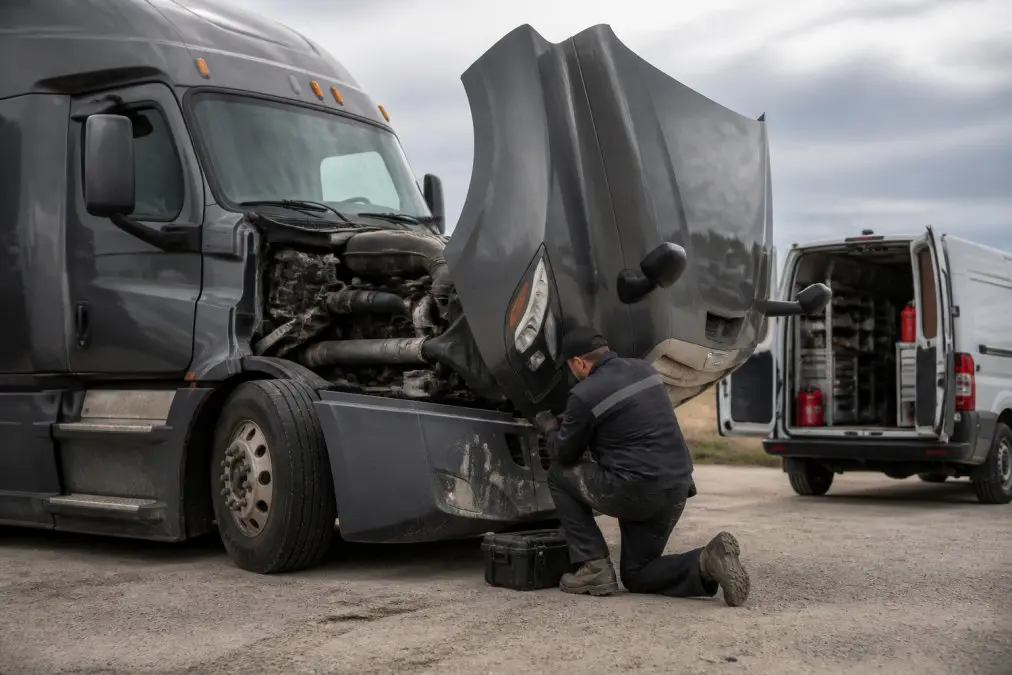
When a truck breaks down on I-80, the traditional response is a lengthy process: call a tow, wait for availability, haul the truck to a shop, and then wait for the shop to fit the repair into their schedule. A mobile service that arrives on-site with the necessary tools and parts can often perform the repair in a fraction of that time. For many common failures like a blown radiator hose, a faulty turbocharger actuator, or a failed sensor, the repair can be completed on the shoulder or in a parking lot, and the truck is back in service the same day.
This approach also avoids the cost of a tow, which can be substantial. For fleets running agricultural haulers out of a yard, scheduling a mobile technician for preventive maintenance at your terminal means your trucks are serviced without ever leaving your property, keeping your operation running smoothly.

Building a Downtime Reduction Strategy for Your Fleet
A reactive approach to breakdowns is expensive. A structured strategy focuses on prevention, rapid response, and continuous improvement.
Start by analyzing your past breakdown data. Look for patterns: Which trucks fail most often? Which components are the culprits? Are certain routes harder on your equipment? This analysis will tell you where to focus your preventive maintenance efforts.
Then, establish a response plan for when failures do occur. This plan should include a list of vetted mobile repair providers who cover your primary routes. Knowing who to call and what their response time is before you need them is critical. When a breakdown happens at 2 AM on a remote stretch of highway, you do not want to be searching for a mechanic.
| Strategy | Key Action | Primary Benefit |
|---|---|---|
| Preventive Maintenance | Standardized service intervals | Reduces breakdown frequency |
| Telematics Monitoring | Real-time fault alerts | Enables predictive repairs |
| Mobile Repair Network | Pre-vetted on-site providers | Cuts downtime per event |
| Data Analysis | Track failure patterns | Targets root causes |
Conclusion: Start Reducing Truck Downtime Costs Today
Downtime is an inevitable part of fleet operations, but its cost is not a fixed burden. By calculating your specific losses, implementing a rigorous preventive maintenance program, and using the right technology and repair partners, you can significantly reduce the financial impact of breakdowns.
When a breakdown does occur, the speed of your response determines the size of your loss. Mudhollow Diesel Mechanics brings fully equipped mobile service trucks and experienced technicians directly to your location across the I-80 and I-29 corridors. Our goal is to get you back on the road fast, avoiding the cost and delay of a tow and the long wait times of a traditional shop. Call or text now at 712-827-0207 to get your fleet moving again.
Frequently Asked Questions
What is the average daily cost of commercial truck downtime?
The average cost varies widely, but industry estimates often place it between $1,000 and $2,500 per day when you factor in lost revenue, driver wages, and repair costs. However, the real number for your fleet depends on your specific operation. To get an accurate figure, calculate your cost per mile, daily revenue contribution, and average repair time. This precise calculation will help you make better decisions about preventive maintenance and emergency repair services.
How does mobile diesel repair reduce fleet downtime compared to traditional shops?
Mobile diesel repair eliminates two major time sinks: the tow truck and the shop’s waiting list. A tow to a shop can take hours, and then your truck waits for an available bay. A mobile service comes to you, often with a 99% rate of avoiding a tow altogether. For many roadside fixes, the repair is completed on-site, getting you back on the road in a fraction of the time it would take to go through a traditional repair process.
What are the most common causes of unplanned commercial truck breakdowns?
Most unplanned breakdowns stem from preventable issues. Tire failures, brake problems, and issues with the electrical system are frequent culprits. However, for fleets that maintain a solid preventive maintenance schedule, the most common causes shift to more complex failures like radiator leaks, turbocharger problems, and sensor malfunctions. These often require sophisticated diagnostics to identify and fix quickly, which is where advanced mobile diagnostics can save significant time.
How can I build a preventive maintenance checklist for commercial trucks?
A strong checklist starts with driver pre-trip inspections and extends to scheduled service intervals. It should include daily checks of fluids, lights, tires, and brakes. At scheduled intervals based on mileage or hours, you should add inspections of the cooling system, air intake, belts, and hoses. The most effective programs use telematics and maintenance logs to track component life and predict failures before they happen, reducing breakdown frequency and keeping your fleet moving.
What role do advanced diagnostics play in reducing repair turnaround times?
Advanced diagnostics are critical for fixing hard-to-solve breakdowns. Instead of a technician guessing, a mobile service uses computer diagnostics to read diagnostic trouble codes and pinpoint the root cause of an issue. This turns a potentially multi-hour repair into a fast, targeted fix. For complex issues like electrical gremlins, this technology is the difference between a quick repair on-site and a lengthy visit to a dealership, significantly reducing your truck downtime.