
Table of Contents
- Why Immediate Action Prevents Long-Term Engine Damage
- What to Do When a Truck Breaks Down
- Diesel Engine Overheating Roadside: Immediate Response
- Low Oil Pressure Warning Truck: What It Means and What to Do
- Roadside Diesel Engine Diagnostics: Getting Accurate Information
- Post-Breakdown Inspection and Repair Follow-Up
- Common Mistakes That Worsen Engine Damage
- Frequently Asked Questions
Last Updated: October 13, 2026
Why Immediate Action Prevents Long-Term Engine Damage
When your diesel engine fails on the highway, the first few minutes matter most. Knowing what to do in those critical moments is essential.
The difference between a minor repair and a full engine rebuild often comes down to how you respond when warning lights appear.
Most drivers panic: they keep driving, rev the engine to see if it clears up, or ignore warning lights because they’re close to their destination.
What to Do When a Truck Breaks Down
Most breakdown advice tells you to pull over and shut the engine off. That is correct for some failures and wrong for others, what protects your engine is knowing which warning you are looking at and whether the engine can be moved at all.
Step 1: Decide Whether You Can Move Before You Stop
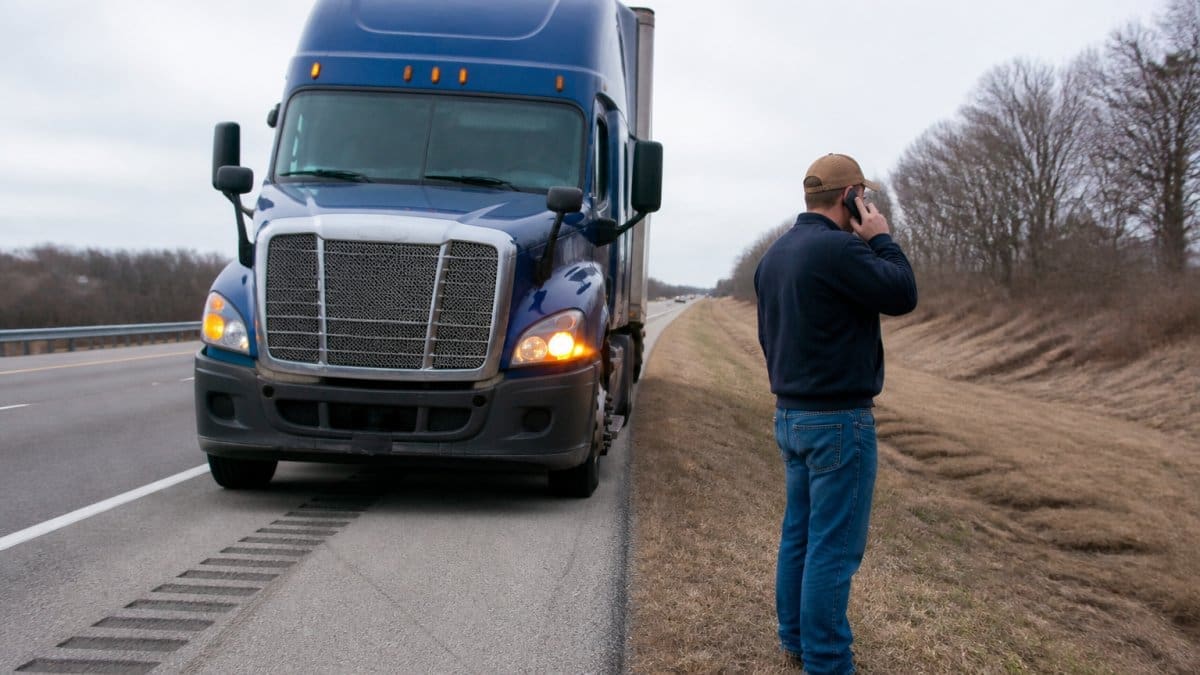
A breakdown on a live lane, blind curve, or bridge is a different problem from one on a wide shoulder. Your first decision is not “stop or keep going”, it is “where is the safest place to stop, and can the engine get me there?”
Shut down immediately, wherever you are, if you see:
- Oil pressure warning light
- Temperature gauge in the red zone
- A sudden loss of power combined with any of the above
You may move a short distance to reach a safer position if:
- A single non-critical warning appears (for example, a check-engine light with no drivability change)
- The engine is running smoothly and the temperature gauge is in its normal range
- You can reach a shoulder, exit, or wide pullout within a very short distance at low speed
If you are unsure which category you are in, treat it as the first. Stopping in an inconvenient place costs far less than turning a repairable fault into internal engine damage.
Step 2: Shut Down in the Right Order
How you shut down matters as much as when. A diesel shut off under load or at high RPM can experience a pressure spike in the cooling and lubrication systems that a normal shutdown avoids.
- Ease off the throttle and let the engine return to idle before switching it off
- Turn the key or press the stop button once, do not cycle it
- Do not rev the engine to “clear” a warning
Once the engine is off, leave it off. Restarting a hot engine with an unresolved fault is one of the most common ways a roadside repair becomes an engine replacement.
Step 3: Read the Warning Correctly
Different warnings carry different urgency. Treating them all the same leads to either unnecessary panic or dangerous delay.
| Warning | What It Usually Means | Correct Response |
|---|---|---|
| Oil pressure light | Lubrication is failing now | Shut down immediately, do not restart |
| Temperature gauge in red | Overheat in progress | Shut down immediately, let cool fully |
| Coolant temperature warning with steam | Pressure loss in cooling system | Shut down, do not open the cap |
| Check-engine light, steady | Stored fault, drivability may be normal | Reduce load, scan at first opportunity |
| Check-engine light, flashing | Active misfire or emissions fault | Reduce speed, stop as soon as safely possible |
| Battery or charging warning | Charging system fault | Electrical systems may fail; stop safely |
| Low fuel pressure or water-in-fuel | Fuel delivery problem | Stop before the engine stalls under load |
A steady check-engine light and a flashing one are not the same warning. A flashing light indicates an active fault that can damage emissions components and, in some cases, the engine itself if driving continues.
Step 4: Capture What Happened Before You Call
Diagnostics are only as good as the information feeding them. Before you call for help, capture the following while it is fresh:
- Which warning lights appeared, and in what order
- The approximate temperature reading when you shut down
- Any sounds, knocking, hissing, whining, or rattling, and where they seemed to come from
A technician who receives this information before arriving can often bring the right diagnostic approach on the first trip; one who receives “it broke down” has to start from the beginning.
Take a photo of the dashboard with the warning lights still illuminated. It is the single most useful piece of information you can hand a technician, and it takes five seconds.
Step 5: Stay Safe While You Wait
- Move to the passenger side of the vehicle, away from traffic
- Do not stand behind or in front of the truck
- Do not open the radiator cap on a hot engine, pressurized coolant can cause severe burns
The engine is protected once it is shut down. Your job while you wait is to make sure you are.
Diesel Engine Overheating Roadside: Immediate Response
Overheating is one of the most common roadside failures. It’s also one of the most dangerous if you don’t respond correctly.
Recognizing Overheating Symptoms
Your temperature gauge creeps into the red zone. The engine sounds louder or rougher than normal. You smell hot coolant or see steam from under the hood.
These are your warning signs. Respond now, not in five miles.
When diesel engines overheat, metal expands beyond design tolerances, gaskets fail, cylinder walls warp, head bolts loosen, and internal seals break down.
Safe Cooling Actions Without Engine Damage
Turn off the engine the moment you notice overheating, and do NOT restart it for at least 15 minutes.
After 15 minutes, check the overflow reservoir, not the radiator itself. If it’s low, you have a leak, a small one might let you limp to a shop, but a major one means you need roadside assistance.
CALL or TEXT NOW:712-827-0207 →
Low Oil Pressure Warning Truck: What It Means and What to Do
The oil pressure warning light is the most serious alert your engine can send, lubrication is failing right now. Metal-to-metal contact increases, friction generates extreme heat, bearings wear rapidly, and seizure can happen in minutes.
Check your oil level with the dipstick. If it’s low, you have a leak, adding oil only buys time, since you’ll lose pressure again within miles.
Roadside Diesel Engine Diagnostics: Getting Accurate Information
Modern diesel engines are complex. What feels like a major failure might be a simple sensor problem. What feels minor might be catastrophic internal damage.
What Modern Mobile Diagnostics Can Reveal
A modern diagnostic scanner connects to your engine’s computer and reads fault codes, telling you exactly what sensors are triggering warnings and why, for example, P0101 (mass air flow sensor fault, often a simple fix), P0335 (crankshaft position sensor fault, prevents starting), or P1234 (fuel injector circuit fault, affects power and emissions).
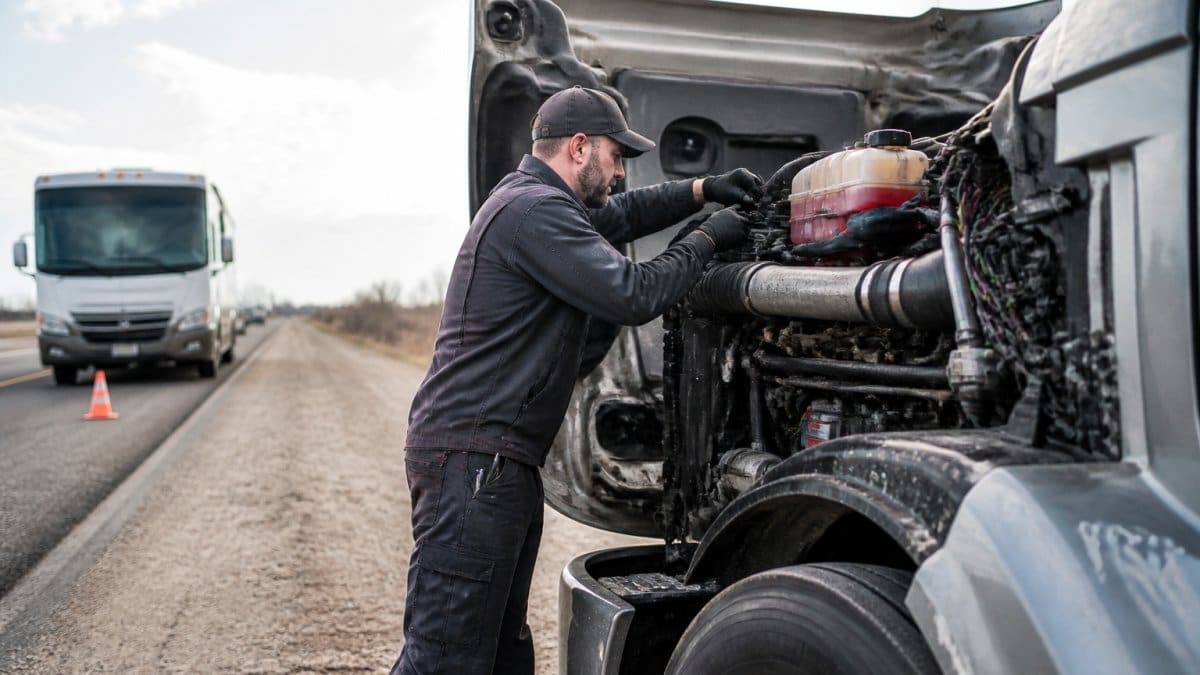
At Mudhollow Diesel Mechanics, our mobile service trucks carry full diagnostic equipment. We read your engine’s fault codes on the shoulder of the highway to determine whether we can fix you roadside or whether you need shop service.
How to Communicate Symptoms to Your Mechanic
When you call for help, describe what you experienced, not what you think is wrong. Tell your mechanic exactly what warning lights appeared, what you heard, smelled, or saw, what you were doing when it happened (accelerating, cruising, cold start), how long the problem lasted before you stopped, and whether it has happened before.
Good communication: “Temperature gauge climbed to the red zone over about two minutes. I smelled hot coolant. I shut down immediately. No steam visible yet, but the hood is hot.” Poor communication: “My engine’s overheating.
Post-Breakdown Inspection and Repair Follow-Up
A repair that gets you moving again is not the same as one that protects the engine long term. Overheating, low oil pressure, and fuel starvation leave traces that may not surface for hundreds of miles, the follow-up window is where long-term damage is either caught early or allowed to compound.
What to Verify Before You Drive Away
Do not treat a successful restart as proof the problem is solved. Before you leave the repair location, confirm these items with the technician:
- Root cause, not just symptom. “It was overheating” is a symptom. “The water pump seal failed and the coolant level dropped below the sensor threshold” is a cause. Ask which one you are getting.
- What was replaced and what was only inspected. A replaced thermostat and a cleaned but reused thermostat housing are different risk profiles.
- Whether the engine was run under load after the repair. A diesel that idles smoothly in a parking lot can still fail under boost or while pulling a grade. Ask if the repair was verified under load.
The Follow-Up Checks That Catch Hidden Damage
Some damage from a breakdown does not announce itself immediately. These checks most often surface a problem before it becomes a second breakdown:
- Oil condition and level over the next few hundred miles. After a low-oil-pressure event, watch for darkening, a metallic sheen, or a level that drops faster than normal. Any of these point to bearing or ring wear that started during the event.
- Coolant level and color. A slow loss after an overheat repair usually means a head gasket or a hairline crack that the original diagnosis did not reach. Discolored coolant can indicate combustion gases entering the cooling system.
- Exhaust color and smell. Persistent white smoke after warm-up, or a sweet smell at the tailpipe, is a classic post-overheat head gasket signal.
If any of these follow-up signals appear, do not wait for the next scheduled service. A pending fault that is ignored after a breakdown is one of the most common paths from a roadside repair to a full engine replacement.
Documenting the Event for Future Diagnostics
Keep a written record of the breakdown and repair: the warning lights that appeared, the conditions, what was replaced, and any follow-up symptoms. Diesel diagnostics rely heavily on history, and a technician who can see what happened last time reaches an accurate diagnosis faster.
This is where mobile diagnostics earns its value after the fact.
When the Follow-Up Points to a Larger Problem
Not every post-breakdown symptom means the original repair failed; some point to damage already present that only became visible once the engine ran normally again. The rule is simple: any symptom appearing within the first few hundred miles after a breakdown repair should be treated as related until a diagnostic scan proves otherwise. Catching it then keeps the repair in the roadside-fix category instead of the engine-rebuild category.
Common Mistakes That Worsen Engine Damage
Drivers make predictable mistakes when their engine fails, turning fixable problems into expensive damage.
Mistake 4: Pouring cold water into a hot engine. Thermal shock cracks engine blocks.
Engine damage from roadside breakdowns is preventable. Stop immediately when warning lights appear.
Mudhollow Diesel Mechanics provides mobile diagnostics and roadside repair across I-80 and I-29 in western Iowa.
Frequently Asked Questions
What should you do first when your engine breaks down on the road?
Pull safely to the shoulder, activate hazard lights, and shut off the engine immediately. Move away from traffic and assess the situation from a safe distance. Do not attempt to restart the engine repeatedly, as this can worsen damage. Call for professional roadside diagnostics rather than limping to the nearest shop. Avoid opening the hood in heavy traffic, and never touch hot engine components. Document any warning lights, unusual noises, or smells before help arrives.
Can low oil pressure cause permanent engine damage?
Yes. Low oil pressure starves engine components of lubrication, causing metal-on-metal friction that leads to bearing wear, piston damage, and cylinder scoring. Even a few minutes of low-pressure operation can cause lasting damage. If your oil pressure warning light activates, shut down the engine immediately and do not restart it. Check your oil level first, but if it is adequate, the problem likely requires professional diagnostics. Continuing to drive with low oil pressure will result in catastrophic engine failure.
How long can a diesel engine run while overheating?
Diesel engines begin sustaining damage from continuous overheating. Head gaskets fail, cylinder walls warp, and internal seals break down under extreme heat. The longer an overheating engine runs, the more expensive the repairs become. If your temperature gauge climbs into the red zone, shut down the engine immediately. Do not attempt to cool it by driving faster or opening windows. Modern mobile diagnostics can identify the root cause, coolant leak, thermostat failure, or radiator blockage, without requiring a costly tow.
Is it safe to restart a diesel engine after a roadside breakdown?
Not until you understand what caused the breakdown. Restarting without diagnosis risks compounding the damage. If the engine overheated, let it cool completely before attempting a restart. If warning lights indicated oil pressure or coolant issues, restarting can destroy the engine. Have a qualified technician perform diagnostics first. Many roadside problems, electrical faults, sensor failures, fuel system issues, can be identified and repaired on-site without a tow, allowing a safe restart only after repairs are confirmed.