

Table of Contents
- The Real Cost of Skipping Fleet Preventive Maintenance
- Common Fleet Maintenance Mistakes That Lead to Breakdowns
- What Happens When Preventive Maintenance Gets Delayed
- Building a Fleet Maintenance Schedule That Works
- Your Fleet Preventive Maintenance Checklist
- How to Reduce Fleet Vehicle Downtime With On-Site Service
- Conclusion
- Frequently Asked Questions
Last Updated: October 4, 2026
The Real Cost of Skipping Fleet Preventive Maintenance
Skipping fleet preventive maintenance trades a small, planned expense today for a much larger, unplanned one later. At Mudhollow Diesel Mechanics, we run mobile diesel diagnostics and repairs across western Iowa, and the breakdown is almost always predictable.
Preventive maintenance means servicing vehicles on a set schedule to catch wear before it causes failure, the difference between a fleet that runs and one that waits on a tow.
The Cost Stack Nobody Adds Up
Most fleets compare the price of a service visit against the price of a repair and call it even. That misses four of the five cost layers a breakdown creates:
- Planned service cost. Labor and parts for the scheduled item, done in a yard, on your clock.
- Deferred repair cost. The failed component plus the labor to reach and replace it, often with collateral damage to nearby parts.
- Transport cost. Getting the truck off the shoulder and to a repair point, plus the driver’s lost hours.
- Downtime cost. Overhead that keeps running while the truck does not: insurance, payments, yard space, dispatch time.
- Lost utilization cost. Loads not hauled, contracts at risk, and the extra wear pushed onto the remaining trucks.
A scheduled inspection touches layer one. A breakdown touches all five at once, the two are not comparable line items.
Why the Numbers Compound Instead of Adding
Deferred maintenance fails in clusters, because one worn part accelerates wear on everything around it.
- A failing water pump stresses the cooling system, and an overheat can warp a head or blow a gasket.
- A clogged filter pushes the engine harder, raising oil and coolant temperatures across the board.
- A soft hose turns into a leak, a leak turns into an overheat, and an overheat turns into a roadside shutdown.
Each skipped item makes the next one worse, which is why fleets that defer maintenance tend to see several trucks fail in the same quarter. The bill arrives all at once, larger than the sum of the skipped services.
The Trade-Off in Plain Terms
| Decision | What You Save Now | What It Costs Later |
|---|---|---|
| Skip a scheduled inspection | The service labor | A failed component plus roadside labor and transport |
| Ignore a small coolant leak | Nothing | A tow, a lost load, and an overheated engine |
| Delay a fluid change | The fluid and labor | Premature wear on parts that cost far more than the fluid |
| Run a worn belt past its interval | The belt | A breakdown mid-route and a rushed repair |
| Push a truck past its interval because another needs work | The scheduling headache | Two trucks down instead of one |
We do not publish flat prices, because real costs depend on the failure, the truck, and the location. The pattern holds: a repair done in a yard on a Tuesday almost always costs less than the same repair done on a highway shoulder at night, and the gap widens with every layer of the cost stack the breakdown touches.
The most expensive repair is the one you did not plan for. A minor issue caught at inspection is a quick fix. The same issue caught after a breakdown usually means transport, a lost load, and a longer repair.
How to Run This Math on Your Own Fleet
You do not need a spreadsheet full of assumptions. Track four numbers per truck for one quarter:
- Scheduled service spend, what you paid for planned work.
- Unscheduled repair spend, what you paid for failures, including parts and labor.
- Days down, every day the truck was unavailable, planned or not.
Most managers who do this find that unscheduled repair spend and days down dwarf the scheduled service line, and the ratio worsens the longer intervals are stretched. That ratio, not a single invoice, is the number to bring to a budget conversation.
Common Fleet Maintenance Mistakes That Lead to Breakdowns
The same mistakes show up across truck fleets, and most come down to treating maintenance as optional when things are busy.
- Waiting for a warning light. By the time a light comes on, the damage is often already done.
- Skipping inspections when the schedule is tight. The busiest weeks are exactly when a breakdown hurts most.
- Ignoring small leaks and odd noises. These are early warnings, not background noise.
A common mistake is assuming a truck that starts and drives is healthy. Many failures build quietly for weeks before showing any symptom a driver would notice.
What Happens When Preventive Maintenance Gets Delayed
Delayed maintenance turns a planned repair into an emergency. The first thing you lose is control of the timing: a scheduled service happens when you choose, a breakdown when the truck chooses.
Unplanned Downtime and Lost Delivery Windows
Unplanned downtime is the real cost, and it is bigger than the repair bill. A truck on the shoulder is not earning, and the load is not moving.
Downtime hits in several ways at once:
- Lost delivery windows. A missed window can mean a lost contract, not just a late load.
- Reduced vehicle availability. One down truck pushes extra work onto the rest of the fleet.
- Lower fleet use. Fewer working trucks means less revenue from the same overhead.
There is also a safety side. The Federal Motor Carrier Safety Administration sets the inspection and repair standards commercial vehicles must meet, and a truck that fails on the road can put your compliance at risk too.
Downtime, not the repair, is the biggest cost of a breakdown. A truck that is not moving still costs you money in overhead, idle drivers, and lost loads.
Building a Fleet Maintenance Schedule That Works
A fleet maintenance schedule is a written plan that sets what gets checked, how often, and who is responsible.
The best schedules are built around how your trucks actually run, not a generic template. Mileage, engine hours, load weight, terrain, and idle time all change how fast parts wear, so a truck pulling heavy loads through hills ages differently than one running steady highway miles.
Set Intervals by Vehicle Type and Duty Cycle
Use the manufacturer’s guidance as your floor, then adjust for how the truck is actually used. A practical starting framework:
| Vehicle Type / Duty | Primary Interval Basis | What to Watch Closely |
|---|---|---|
| Long-haul tractor, steady highway miles | Mileage | Cooling system, turbocharger, belts, fluids |
| Regional delivery truck, frequent stops | Engine hours and mileage | Brakes, air system, transmission, filters |
| Heavy-haul or agricultural truck, loaded most of the time | Engine hours | Cooling system, drivetrain, suspension, tires |
| High-idle truck (PTO, refrigeration, waiting) | Engine hours, not mileage | Oil condition, filters, cooling fan, alternator |
| Older unit past its warranty window | Shorter of mileage or hours | Everything, wear accelerates with age |
Engine hours matter as much as mileage. A truck that idles for hours a day accumulates wear the odometer never shows.
CALL or TEXT NOW:712-827-0207 →
A Workable Interval Structure
| Interval | What Gets Checked |
|---|---|
| Daily, pre-trip | Tires, lights, fluid levels, leaks, brakes, air pressure |
| Weekly | Belts, hoses, battery and connections, air system, coolant level |
| Monthly | Full inspection, filters, grease points, suspension, exhaust |
| By mileage or engine hours | Fluid changes and major component service, per manufacturer guidance |
| Seasonal | Cooling system, heating, cold-weather prep, battery load test |
Prioritize by Risk When Budget or Trucks Are Tight
When money or available trucks are limited, rank each item on two questions: how likely is it to fail, and how bad is it if it does? That gives you four buckets:
- High likelihood, high consequence, do now. Brakes, steering, tires, cooling system on a loaded truck. These are the items that stop the truck and endanger the driver.
- Low likelihood, high consequence, schedule soon. Turbocharger, fuel system, electrical faults. Rare, but expensive and often disabling when they hit.
- High likelihood, low consequence, batch it. Cosmetic wear, minor leaks, interior items. Group them into the next planned service.
- Low likelihood, low consequence, defer. Non-safety, non-disabling items. These are the only ones that can safely wait.
Safety items always sit at the top. Everything else is a scheduling decision.
Assign Ownership, Records, and Reminders
A schedule without an owner is a wish. Assign one person accountable for each interval and give drivers a simple way to report findings.
- Name an owner for each task, not each truck. One person owns daily checks, another owns monthly inspections.
- Log every inspection and repair in one place, a spreadsheet works if it is actually used, and fleet software works better once you have more than a handful of trucks.
- Set reminders by mileage, engine hours, or calendar date, whichever comes first.
- Flag overdue work visibly. An overdue item that nobody sees is the same as a skipped one.
Measure Whether the Program Is Working
A schedule you cannot measure is one you cannot defend at budget time. Track a small set of numbers:
- PM compliance, the share of scheduled services completed on time.
- Unscheduled repair rate, how often trucks fail between scheduled services.
- Downtime hours per truck, planned and unplanned, tracked separately.
- Cost per mile, total maintenance spend divided by miles run.
If PM compliance rises and unscheduled repairs fall, the program is working. If compliance is high but failures are not dropping, your intervals are wrong for your duty cycle, tighten them on the trucks that keep failing.
Start with the trucks that fail most often. Tightening intervals on your worst two or three units usually produces a visible drop in unscheduled repairs within a quarter, and that result is what convinces everyone else to follow the schedule.
Your Fleet Preventive Maintenance Checklist
A fleet preventive maintenance checklist is a simple list your driver or tech works through at each interval, keeping inspections consistent even when different people do the work.
Use this as a starting point and adjust it for your trucks:
The logging matters as much as the checking. A record of what you found and fixed is how you spot a truck that keeps coming back with the same problem.
Photograph anything that looks off during an inspection. A dated photo of a small leak or a worn belt gives you a clear record and helps a mobile tech diagnose the issue before they arrive.
How to Reduce Fleet Vehicle Downtime With On-Site Service
The fastest way to reduce fleet vehicle downtime is to stop moving trucks to the shop. On-site service brings the repair to your yard, your terminal, or the shoulder where the truck stopped.
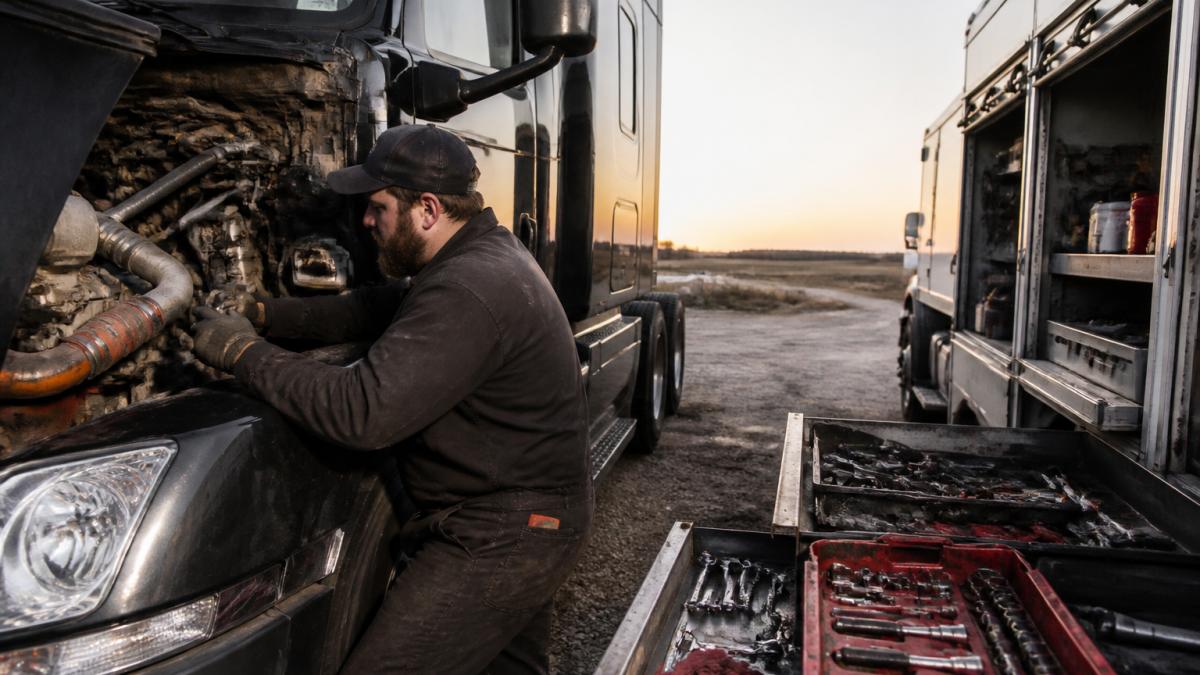
This is where Mudhollow Diesel Mechanics fits. Our service trucks carry heavy-duty tools and computer diagnostics, so we handle most work where the truck sits, no tow, no shop wait, no truck idle for days.
Most roadside fixes resolve in less time than in-shop repairs, because there is no transport time and no queue.
For fleets, we also run scheduled dry-land servicing at your yard. The American Trucking Associations has long pointed to maintenance as a core part of keeping commercial fleets safe and productive, and doing that work on site is how you protect your uptime.
Fleet managers and owner-operators who need preventive maintenance and emergency repairs without losing a truck to a shop for days.
Conclusion
Every fleet faces the same choice: plan the maintenance or pay for the breakdown. Mudhollow Diesel Mechanics brings mobile diesel repair and scheduled on-site servicing to your yard or your breakdown spot, with computer diagnostics, 15+ years of technician experience, and most roadside fixes handled without a tow. Call or text us at 712-827-0207 to set up a maintenance schedule that keeps your fleet moving.
Frequently Asked Questions
What happens when a fleet skips preventive maintenance?
Skipping fleet preventive maintenance lets minor problems turn into major failures. A worn belt becomes a roadside breakdown. A small coolant leak becomes an overheated engine. Each skipped service raises repair costs, increases unplanned downtime, and puts drivers at risk. Fleets that defer maintenance often face emergency towing bills, lost delivery windows, and vehicles stuck in shops waiting for parts. The longer service is delayed, the more expensive the eventual fix becomes.
How often should commercial vehicles receive preventive maintenance?
A practical fleet maintenance schedule groups services by mileage and time so nothing gets missed.
What should a fleet preventive maintenance checklist include?
A fleet preventive maintenance checklist should cover turbo inspections. Document every inspection so you can track repair frequency and spot recurring issues before they cause breakdowns.
How can fleet managers reduce vehicle downtime?
To reduce fleet vehicle downtime, schedule maintenance during off-hours and use on-site service so trucks never leave the yard. Keep spare parts for common failures. Track maintenance records to predict when components will wear out. When a breakdown does happen, mobile diesel repair can often fix the truck on-site, avoiding tow costs and shop wait times. Fleets that combine scheduled service with on-site repair keep more vehicles available.