

Table of Contents
- Mobile RV Repair vs Shop Repair: How the Two Paths Actually Differ
- What a Mobile Technician Brings to the Breakdown
- What Only a Fixed Shop Can Do
- The Cost of Towing a Large RV and How It Shifts the Math
- Mobile RV Diagnostic Tools vs In-Shop Equipment
- Chassis Failures vs House Systems: A Decision Matrix for Major Issues
- How to Find a Reliable Mobile Diesel Technician
- Warranty Work, Insurance Claims and Parts Logistics
- Frequently Asked Questions
Last Updated: September 28, 2026
Mobile RV Repair vs Shop Repair: How the Two Paths Actually Differ
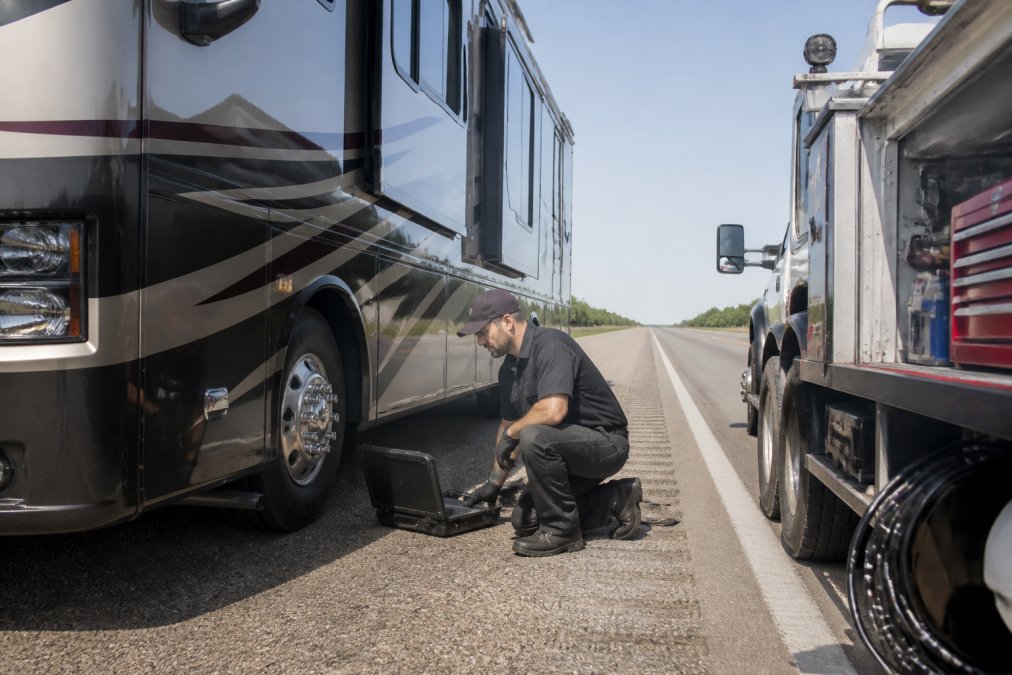
When a diesel pusher loses a radiator or a turbo on the shoulder of I-80, the first decision is rarely about money. It is about whether the rig moves at all. Mobile RV repair is a service model where a fully equipped technician comes to the vehicle, diagnoses it on site, and completes the repair at the breakdown location rather than hauling the coach to a fixed facility.
Winner: mobile repair for chassis and drivetrain failures that can be completed roadside. Choose a fixed shop when the job needs a lift, a paint booth, or days of controlled-environment work on house systems.
What a Mobile Technician Brings to the Breakdown
A mobile technician brings the diagnostic and repair capability to the vehicle, which removes the tow from the equation entirely. That single change is the whole value proposition. A service truck with computer diagnostics, heavy-duty tools, and common parts means the coach never has to leave the shoulder.
- No tow bill and no wait for a hook
- Diagnosis and repair in one visit, not two
- The driver stays with the vehicle and the load
- Repairs start the same day the call comes in
What Only a Fixed Shop Can Do
A fixed shop is the right answer when the repair needs equipment that cannot travel. Alignment racks, welding bays, paint booths, and overhead cranes do not fit on a service truck. Neither does a climate-controlled bay for delicate interior or house-system work.
The Cost of Towing a Large RV and How It Shifts the Math
- Vehicle weight and length. A 40-foot diesel pusher with a tag axle is a different tow than a 30-foot gasser. Heavier and longer means a bigger truck and often a second operator.
- Mileage to the shop. Towing is usually billed per loaded mile, and the nearest shop that can actually do the work may be well outside your breakdown radius.
- Recovery versus transport. If the coach is off the pavement, in a ditch, or against a guardrail, that is a recovery, not a tow, and recovery is priced higher.
- After-hours and weekend dispatch. Breakdowns do not schedule themselves. Night, holiday, and weekend calls typically carry a premium.
- Load and trailer. If you are pulling a toad or a trailer, that is a second unit to move or store.
Ask any provider to quote the tow separately before you commit, base hook, loaded miles, recovery surcharge, and after-hours premium as separate lines. When the tow is priced on its own, the mobile-versus-shop math usually flips in mobile’s favor for chassis work.
There is one honest exception. If the diagnosis points to a job that genuinely needs a lift, a fabrication bay, or days indoors, the tow is not waste, it is the cost of getting the vehicle to the only place the work can be done. The mistake is paying for a tow when the repair was portable all along.
Mobile RV Diagnostic Tools vs In-Shop Equipment
Modern mobile diagnostic tools have closed most of the gap with fixed-shop equipment. Today’s service trucks run factory-level scan software for engine, transmission, and aftertreatment faults, and they can pull the same codes a dealership bay would pull.
| Capability | Mobile Service Truck | Fixed Shop |
|---|---|---|
| Computer diagnostics | Yes, factory-level | Yes, factory-level |
| Lifts and alignment racks | No | Yes |
| Welding and fabrication | Limited | Yes |
| Climate-controlled bay | No | Yes |
| Response time | Same day | Appointment queue |
| Tow required | No | Often yes |
Chassis Failures vs House Systems: A Decision Matrix for Major Issues
The type of failure decides the path more reliably than anything else. Chassis problems, meaning the engine, drivetrain, cooling, and running gear, are the natural territory of mobile repair. House systems, meaning the living-quarters electrical, plumbing, and structure, usually are not.
When the Chassis Decides It
Chassis failures are stranded-vehicle problems, and stranded vehicles are mobile problems. A blown radiator hose, a failed turbo, a no-start condition, or a drivetrain fault all leave the coach immobile. Towing it is expensive and slow, and the repair itself is often portable.
When the Coach Body Wins the Argument
House-system failures are usually shop problems even when the coach still drives. A failed slide-out mechanism, a roof leak, a plumbing repair behind cabinetry, or an HVAC service that needs parts and a controlled environment all benefit from a bay, a parts counter, and time.
How to Find a Reliable Mobile Diesel Technician
Finding a reliable mobile diesel technician comes down to verification, not luck. Ask three questions before you hand over the keys: what diagnostics do you carry, what is your service radius, and what does your warranty cover.
- Confirm the technician carries factory-level scan software
- Ask whether the service radius covers your breakdown location
- Get the warranty terms in writing before work begins
- Ask how parts are sourced and how long ordering takes
- Check whether the provider does preventive maintenance at your yard
Warranty Work, Insurance Claims and Parts Logistics
Warranty coverage and insurance claims add a layer most comparisons ignore entirely, and it is the layer that decides whether a mobile repair actually saves you money or just moves the argument to a claims desk. The repair itself is only half the job. The other half is getting it paid for.
CALL or TEXT NOW:712-827-0207 →
Manufacturer Warranty Versus Third-Party Service Contracts
These are not the same thing, and they behave differently when a mobile technician is the one turning wrenches.
- Manufacturer warranty generally requires that the repair be performed by an authorized facility using approved parts, and the claim is filed through the dealer network. A mobile provider who is not an authorized agent may be able to do the work, but the manufacturer may decline to reimburse it.
- Third-party service contracts (the extended warranty you bought at delivery or from a broker) usually reimburse the policyholder or pay the provider directly, but almost always require pre-authorization before work begins. A technician who starts the job without a claim number can leave you holding the invoice.
- Roadside assistance memberships typically cover the tow or the dispatch, not the repair. Do not assume a roadside plan and a service contract cover the same event.
The Paperwork That Decides Reimbursement
To protect yourself, make sure the file contains:
- A written diagnosis with fault codes and the failed component named specifically
- Photos of the failed part before and after removal
- The pre-authorization or claim number, obtained before the first tool comes out
- An itemized invoice separating parts, labor, and any trip or diagnostic charge
- The technician’s credentials and, where required, a business license or certification number. Mudhollow Diesel Mechanics has 15+ years of experienced technicians.
If a provider cannot produce that packet, the repair may still be correct, but the reimbursement may not arrive. Ask up front how the provider handles warranty claims.
Never authorize a major repair before the claim is opened. A ten-minute call to your service contract administrator before the technician begins can be the difference between a covered repair and an out-of-pocket one.
Parts Logistics Decide the Timeline, Not the Location
- Common components, belts, hoses, common sensors, standard filters, many turbo and cooling parts, are frequently stocked on a well-equipped service truck or available same-day from a local distributor.
- Uncommon components, model-specific control modules, proprietary aftertreatment parts, certain transmission internals, have to be ordered regardless of where the coach sits.
Match the repair to the constraint. Portable job plus available part: mobile often wins. Portable job plus ordered part: mobile can still be beneficial, because you avoid the tow while you wait. Non-portable job: the shop is often the correct call, and the tow is the cost of admission.
Insurance claims follow the same logic as warranty. Document the failure, keep the diagnostic report and photos, and confirm with your carrier whether roadside repair or transport is covered before you commit to either. That call can save on tow costs.
Frequently Asked Questions
What types of major RV issues can actually be resolved on the side of the road?
Roadside mobile RV repair handles more than most owners expect: no-start and no-crank conditions, fuel delivery faults, turbocharger and boost problems, cooling system and radiator failures, belt and hose replacement, and sensor or wiring faults traced with computer diagnostics. What it cannot do is anything needing a lift, a controlled clean room, or major teardown. If the repair requires pulling a transmission, replacing a cracked block, or rebuilding a slide-out mechanism, the vehicle moves to a shop. A good technician tells you which category you are in before any work begins.
Does mobile RV repair save money on major repairs by avoiding towing fees?
The cost of towing a large RV is the line item mobile service removes entirely, and for a Class A motorhome that matters because heavy wreckers bill by the mile with a hookup charge on top. Mobile repairs also skip the service-write-up and bay-queue time that shops build into their scheduling. Labor itself is not automatically cheaper, so compare the full picture: tow plus shop labor and days of downtime versus a service call plus on-site labor. For most roadside-capable failures, the on-site route wins on total spend.
Are mobile diagnostic tools as capable as what a dealership uses?
Modern mobile RV diagnostic tools include the same OEM-level scan software and bidirectional controls used in fixed shops, running on laptops and tablets in the service truck. They read chassis ECMs, transmission controllers, ABS modules, and many house-system control boards. The real gap is not the software, it is the physical environment: a shop can put a vehicle on a lift and inspect under load in a controlled bay. Diagnostics travel well; heavy teardown does not.
How do I find a reliable mobile diesel technician when I am stranded?
Start with providers who publish their service radius and response expectations, then ask three questions before booking: do you carry OEM-level scan tools, what is your warranty on the repair, and can you source parts or will I be waiting on an order. A technician with 15+ years of heavy-duty diesel experience will answer these directly. Avoid anyone who quotes a flat price over the phone without seeing the fault codes, and confirm the provider actually services the corridor you are stranded on.
What happens if the mobile tech diagnoses a problem that needs parts ordered?
This is the most common objection to mobile RV repair, and the honest answer is that it depends on the part. Fast-moving components like belts, hoses, filters, sensors, and common turbo parts often ride in the service truck. If the fix needs a dealer-only module or a chassis-specific assembly, the technician orders it and either returns to install on-site or coordinates the next step with you. Ask upfront what the provider stocks and what their typical parts turnaround looks like before you commit.