Table of Contents
- What You’ll Need Before You Call
- Step 1: Verify Technician Credentials and Insurance
- Step 2: Confirm Mobile RV Diagnostic Services and Equipment
- Step 3: Understand Emergency RV Roadside Assistance in Iowa
- Step 4: Weigh On-Site RV Mechanical Repair vs Towing
- Step 5: Ask About Warranty Handling and Parts
- Common Mistakes to Avoid When Hiring Mobile RV Repair
- Frequently Asked Questions
Last Updated: September 22, 2026
What You’ll Need Before You Call
Finding reliable mobile RV repair in western Iowa starts with preparation, not luck. When your motorhome quits on the shoulder of I-80, the quality of your repair depends on how well you vetted the technician before you ever needed one. A mobile RV repair service brings tools, parts, and diagnostic equipment directly to your breakdown spot. That saves you a tow bill and hours of waiting.
At Mudhollow Diesel Mechanics, we’ve worked breakdowns along the I-80 and I-29 corridors for more than 15 years. Here’s what most guides miss: the best time to find a technician is before your rig fails.
Gather these details now so a call goes fast later:
- Your exact location, including mile marker and direction of travel
- RV make, model, year, and engine type
- A clear description of the symptom, not just “it won’t start”
- Your insurance and roadside assistance policy numbers
- A written log of recent repairs and parts replaced
The Federal Motor Carrier Safety Administration roadside safety guidance recommends pulling as far off the travel lane as possible and setting warning devices before any work begins. Do that first. Then make your call.
Step 1: Verify Technician Credentials and Insurance
Ask for credentials before you agree to any work. Ask for credentials before you agree to any work. This protects you if something goes wrong on the roadside.
Request these items:
- A certificate of insurance showing liability coverage
- A business license and a physical business address
- References from other RV owners or fleet managers
Any legitimate mobile repair unit will share this without hesitation. If a technician dodges the question, end the call. Insured and bonded operations are the standard you should hold every provider to.
Skipping the insurance check is the most common and most expensive mistake. If an uninsured technician damages your rig or gets hurt on site, you can be left holding the bill.
Step 2: Confirm Mobile RV Diagnostic Services and Equipment
Modern breakdowns are rarely simple. Electrical system troubleshooting and appliance diagnostics need computer tools, not guesswork. Ask what diagnostic equipment the technician carries on the truck.
A well-equipped mobile workshop should handle:
- Engine and chassis computer scans
- Electrical fault tracing and wiring repair
The National Fire Protection Association publishes codes covering propane and electrical systems in recreational vehicles. A technician who knows these standards will spot safety issues a general mechanic would miss.
What most guides miss is the diagnostic gap. Some mobile mechanics only do basic roadside fixes. Others, like our team at Mudhollow Diesel Mechanics, carry dealer-level scan tools for hard-to-solve problems. Ask which one you’re getting before they arrive.
Step 3: Understand Emergency RV Roadside Assistance in Iowa
Emergency RV roadside assistance works best when you know your coverage and your options before the breakdown happens. Response time depends on your location, weather, and how far the technician must travel. On the I-80 and I-29 corridors, a technician staged near a major interchange can often reach a disabled rig faster than one dispatched from a distant shop, so the provider’s home base matters as much as the phone number.
Here is how to set expectations before you dial:
- Confirm the travel radius the provider covers and whether your mile marker falls inside it
- Ask for a realistic arrival window, not a best-case guess
- Find out whether a service call fee or diagnostic fee applies, and what triggers it
- Check whether your insurer or RV club reimburses mobile repair, and what documentation they require
- Ask whether the technician can complete the repair on the shoulder or needs a safer pull-off
Safety sequencing comes first
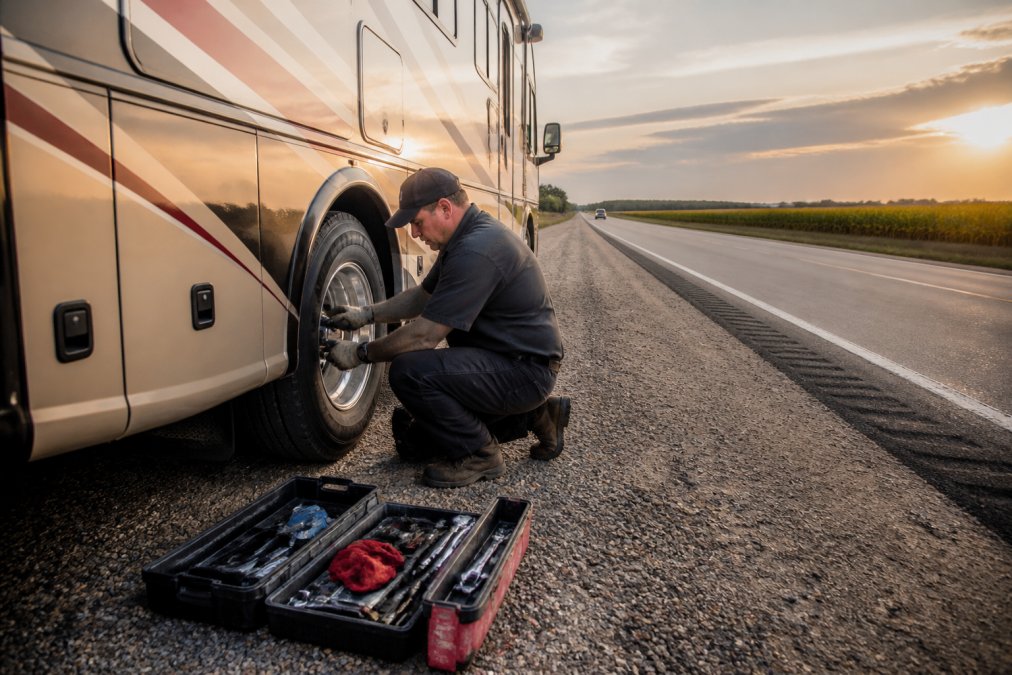
Before any repair begins, get the rig as far off the travel lane as possible and set warning devices. The Federal Motor Carrier Safety Administration roadside safety guidance outlines the placement of reflective triangles and the value of high-visibility gear. Turn on hazard flashers, keep passengers behind the guardrail or well off the shoulder, and stay in the cab with seatbelts on if traffic is heavy. A repair is never worth a secondary collision.
CALL or TEXT NOW:712-827-0207 →
What slows a response
A common pattern is that arrival windows stretch for three reasons: weather, distance, and parts. Snow, ice, and subfreezing temperatures slow every repair and can turn a small fault into a major one. A technician who must source a part from a distant supplier adds time. And a breakdown in a rural stretch between interchanges adds travel minutes no provider can erase. Build a buffer into your own plans when you travel the corridor between November and March.
Save a vetted provider’s number in your phone before you leave, along with your mile marker, insurance policy number, and a photo of your RV’s data plate. When you are standing on a shoulder in the cold, you will not want to hunt for any of it.
Step 4: Weigh On-Site RV Mechanical Repair vs Towing
On-site RV mechanical repair vs towing comes down to one question: can the fault be diagnosed and fixed with the tools and parts on the truck, or does it need a lift, a teardown, or a part the truck does not carry? Most roadside faults, including radiator, turbo, and diagnostic issues, can be handled on site.
| Factor | On-Site Repair | Towing to a Shop |
|---|---|---|
| Time to fix | Often same day | Hours plus shop queue |
| Tow cost | None | Added to your bill |
| Parts access | Limited to truck stock | Full shop inventory |
| Best for | Fixable roadside faults | Major teardown work |
| Diagnostic access | Dealer-level scan tools on equipped trucks | Full shop diagnostic bay |
A decision framework you can use on the shoulder
Ask the technician to walk through three questions out loud:
- Is the fault electronic or mechanical? A sensor, wiring, or module fault often resolves with a scan tool and a replacement part. A cracked block or a seized component usually does not.
- Does the fix require a lift or a teardown? If the answer is yes, on-site repair is the wrong call and a tow is the honest recommendation.
- Is the needed part on the truck? A well-stocked mobile unit carries common failure parts. If the part is not on board and cannot be sourced locally the same day, towing may be faster.
Why the diagnostic gap matters
What most guides miss is that the on-site vs. tow decision is really a diagnostic decision. A technician with dealer-level scan tools can often identify a hard-to-solve fault on the shoulder and repair it without a tow. A technician limited to basic roadside fixes may default to towing because they cannot confirm the diagnosis. Ask which kind of provider you are calling before they arrive.
A provider who can diagnose on site will usually fix on site. A provider who cannot diagnose on site will usually recommend a tow. The equipment on the truck tells you which outcome to expect.
Step 5: Ask About Warranty Handling and Parts
Warranty handling separates a professional operation from a roadside gamble. Ask two questions before work starts: what parts will you use, and what happens if the repair fails?
Look for these commitments:
- Genuine parts or quality equivalents, named up front
- A written warranty on both parts and labor
- A clear process for a warranty claim if you break down again
- A receipt that lists every part and every hour billed
Get the warranty in writing, even on the shoulder. A technician who stands behind warrantied repairs will put the terms on paper without a fight.
Photograph the failed part and the new one before installation. If a warranty claim comes up later, that photo ends most disputes fast.
Common Mistakes to Avoid When Hiring Mobile RV Repair
The biggest mistake is hiring on price alone during a breakdown. Panic pushes people to take the first truck that answers. That’s how owners end up with repeat failures and no warranty.
Watch for these traps:
- No insurance or credentials offered when asked
- No written estimate or warranty terms
- Pressure to pay cash with no receipt
- A technician who won’t explain the diagnosis
- No clear travel radius or arrival window
A common mistake is assuming every mobile mechanic handles diesel and RV systems the same way. They don’t.
Frequently Asked Questions
How do I verify the credentials of a mobile RV technician?
Ask for proof of liability insurance and a physical business address. A legitimate mobile RV repair provider will share these without hesitation. Check that the technician has experience with your RV’s chassis type and systems. Never hire someone who refuses to provide credentials or pressure you to decide immediately.
What should I have ready when calling for emergency RV roadside assistance in Iowa?
Have your exact location ready, including mile marker or exit number on I-80 or I-29, your RV’s make, model, and year, a clear description of the symptoms, and your phone number. Mention whether you are in a safe spot or blocking traffic. This information helps the dispatcher give you an accurate arrival window and send a mobile repair unit with the right tools. If you smell propane or see smoke, say so immediately so the technician can prioritize safety.
Do mobile RV techs handle warranty work?
Some do, but it depends on the technician and your RV’s warranty terms. Many independent mobile RV repair providers are not authorized warranty centers, so work they perform may not be covered. Before booking, ask if they work with your warranty provider or can provide documentation you can submit for reimbursement. If your RV is under a manufacturer warranty, call the manufacturer first to confirm whether mobile repairs are covered and what paperwork you need.
How can I tell if a mobile RV repair service is reliable?
Look for clear communication, upfront diagnostic fees, written estimates, and a warranty on parts and labor. Reliable providers will explain what they can and cannot fix on-site and will not promise miracles. Check online reviews for patterns, not just star ratings. Ask how long they have operated in the area and whether they carry genuine or OEM-equivalent parts. A provider that answers questions directly and provides a service call fee structure upfront is usually a safe bet.