

Quick Summary
DPF regeneration helps remove accumulated soot from a diesel particulate filter, maintaining exhaust flow and engine performance. Understanding the different regeneration methods can help truck owners identify problems before they lead to engine derating.
- Passive regeneration occurs naturally during suitable exhaust temperatures.
- Active regeneration uses additional heat to burn accumulated soot.
- Forced regeneration is performed using diagnostic equipment when necessary.
- Frequent failed regenerations may indicate DPF, sensor or emissions system problems.
- Professional diagnostics can help identify the cause of repeated DPF issues.
Experiencing DPF Problems or Engine Derate?
We bring professional computer diagnostics and forced DPF regeneration services directly to your truck along I-80 and I-29.
DPF regeneration burns the soot out of your diesel particulate filter at high exhaust temperatures. When it fails, or the filter clogs, you’ll see warning lamps, worse fuel mileage, less power, or limp mode. Repeated DPF problems often point to a sensor, engine, or exhaust fault that a technician has to test, not just another regen.
Key takeaways
- Regen burns soot, not ash: Ash from oil and fuel additives stays in the filter. Only off-truck cleaning removes it.
- There are three kinds of regen: Passive happens on its own under steady highway load. Active is started by the ECU. Forced is started by a technician with a scan tool.
- A DPF lamp is a request, not always a fault: The lamp stages and timing vary by maker, so check your manual. A red Stop Engine lamp means shut down.
- Low power can have several causes: Soot loading, a bad sensor, or a deliberate ECU derate can all cut power. A derate alone doesn’t prove the filter is bad.
- Failed regens usually trace to a cause: Common ones are short runs and idling, sensors, the hydrocarbon doser, EGR, injectors, or oil.
- Repeating regens won’t fix a fault: Find the cause first. On many trucks, a forced regen won’t even run while a derate or other active fault is present.
- Removing the DPF is illegal tampering: It is not a repair.
- Roadside help is available: Mudhollow reads codes at the truck, and call-outs start with a texted minimum charge.
What Is DPF Regeneration and Why Does It Matter?
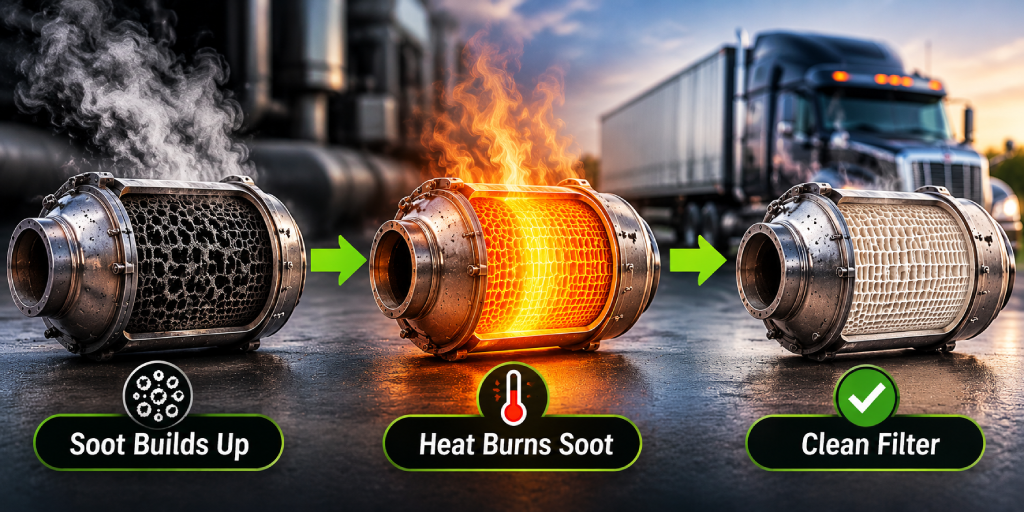
A diesel particulate filter (DPF) is a ceramic filter in your exhaust that traps soot before it leaves the stack. It fills up, so the truck has to burn the soot off now and then. That’s regeneration.
How Does a Diesel Particulate Filter Work?
Exhaust gas has to pass through the walls of the filter, and the walls trap soot. As the filter fills, the gas has a harder time getting out, and backpressure rises. EPA’s DPF operation and maintenance bulletin says the operator should be warned when backpressure climbs too high. It works like a clogged filter on the exhaust side. The engine pushes harder to move gas out, so you lose power and burn more fuel.
Why Is DPF Regeneration Necessary?
Regeneration burns soot into ash, carbon dioxide, and water. That reopens the passages and drops backpressure. It does not remove ash. Ash comes from engine oil and fuel additives, and it doesn’t burn. EPA says it builds up over time and has to be cleaned out with the filter off the truck. So a truck can regen right on schedule and still lose power because the filter is full of ash. When that’s the problem, no regen will fix it. The filter needs a cleaning or a replacement, and our emission system repair handles both.
What Are the Different Types of DPF Regeneration?
There are three, and each requires more effort. Exhaust heat and filter load determine which one runs, and the rules vary by maker and model.
| Type | Who starts it | When it happens |
| Passive | The engine’s own heat | Steady load, like highway driving |
| Active | The ECU | While driving, or parked on some trucks |
| Forced | A technician with a scan tool | Parks when the truck allows it |
Passive DPF Regeneration
Passive regen needs no extra fuel and nothing from you. On the highway, steady load keeps the exhaust hot enough to burn soot. A Volvo engine section in a Prevost coach manual says exhaust temperatures alone are usually high enough during normal highway operation. Stop-and-go routes get less of it.
Active DPF Regeneration
When the exhaust runs too cool, the engine control unit (ECU), the truck’s computer, adds heat. On many engines, it sprays a little diesel into the exhaust ahead of the diesel oxidation catalyst (DOC), which burns it and heats the filter. DPF regeneration while driving often goes unnoticed. If the truck can’t finish one, it asks for a parked regen. Stop, set the brake, and start it from the switch or dash menu. Detroit’s service bulletin puts that at 30 to 40 minutes, with the driver staying on the truck. Park outdoors and keep the exhaust outlet clear of anything that burns.
Forced DPF Regeneration
A forced regen is the technician’s version. They connect a scan tool and tell the ECU to start one. It makes sense when the other regens haven’t cleared the soot, and only if the truck allows it. It isn’t a repair on its own. We read the codes first with our computer diagnostics and find out why the earlier regens failed. Our DPF regeneration service can run one right where you’re parked, when the truck allows it.
What Are the Common Diesel Particulate Filter Problems?
A lamp on the dash doesn’t indicate that the filter is bad. It can mean soot is building up, a regen didn’t finish, or another part of the exhaust aftertreatment system has failed. That’s why diesel particulate filter problems need testing, not guessing.
DPF Warning Light or Check Engine Light
A DPF lamp or check engine light can mean high soot, an unfinished regen, or a failed sensor. Lamp stages and timing differ by maker, and we cover them below.
Increased Fuel Consumption
A soot-loaded filter raises backpressure, and the engine burns more fuel to push exhaust through. Frequent regens add to it, because active regens spend extra fuel to make heat.
Excessive Exhaust Smoke or Burning Smells
Black or white smoke, or a sharp burning smell, can point to an engine or exhaust problem, and only testing shows which. One thing is normal. Cummins’ driver card says some odor is expected while the high exhaust temperature lamp is lit. If the smell is strong and the white vapor is heavy, have the exhaust checked for leaks.
Frequent or Failed Regeneration
Regens that come too often, or never finish, mean the filter isn’t getting clean. Restricted exhaust flow, a bad sensor reading, or an engine problem can cause it. Stop repeating regens and get the cause tested. Our diesel engine diagnostics read the codes and sensor data at the truck.
Why Is Your DPF Causing Low Power?
Soot or ash can restrict exhaust flow, and the ECU can also cut power on purpose. That cut is called a derate. The computer limits engine power when it sees a fault it wants to protect the engine or emissions system from. A DPF causing low power is one possible cause, not the only one, so don’t assume the filter.
DPF Blockage and Restricted Exhaust Flow
A filter loaded with soot or ash lets less exhaust through. The engine fights that backpressure, and you feel weak throttle response and less power.
Sensor and Regeneration Faults
A differential pressure sensor compares exhaust pressure before and after the filter, so the ECU can judge how full it is. Temperature sensors tell it how hot the filter runs. If one reads wrong, the ECU can think the filter is full when it isn’t, or fail to start a regen when it should.
When Does Limp Mode Occur?
Some trucks cut power in steps as soot rises. Cummins’ driver card says engine power can drop automatically when the DPF lamp flashes, and a red Stop Engine lamp means shut down. Detroit lists a low fuel pressure fault on the hydrocarbon doser, the injector that feeds fuel into the exhaust, with a 10% derate. Each maker sets its own levels, so we won’t quote speeds. DEF and SCR faults can derate a truck too, under separate EPA rules. A derate alone doesn’t prove the filter is bad. A technician has to test, and our computer diagnostics can read the codes on the truck.
What Does DPF Service Required Mean?
A DPF service message means the truck needs attention tied to the filter or the regen system. There’s no single meaning for every truck. It depends on the maker, the model, and the exact wording on your screen, so check your manual.
Can You Keep Driving With a DPF Warning?
Check the manual first. As one example, Cummins’ driver card for its EPA 2007 engines says a solid DPF lamp means a regen is due within 2 to 6 hours of running. A flashing lamp means 1 to 2 hours, and power may drop. A flashing lamp with the check engine lamp means park and regen now. A red Stop Engine lamp means shut down until it’s serviced. Other makers set theirs differently. If you see a Stop Engine lamp or lose power sharply, stop safely and call. Our emergency roadside service starts the diagnosis where you’re parked.
When Should You Contact a Diesel Mechanic?
Call when regens keep failing, the lamps stay on, the truck goes into limp mode, or other symptoms show up. And don’t try to clear a DPF warning light with a code reader alone. It goes out after a successful regen or a repair, and clearing the code without fixing the cause won’t fix the fault.
What Causes DPF Regeneration to Fail?
Regens fail for three reasons- how the truck is driven, the parts that feed and monitor the regen, and an engine that makes too much soot.
Frequent Short Trips and Extended Idling
Passive regen needs sustained load. Short runs and long idling keep the exhaust too cool, so soot builds faster than the truck can burn it. EPA bulletins say how often a filter regenerates depends on the duty cycle, among other factors.
Faulty Exhaust Temperature or Pressure Sensors
The ECU relies on these sensors to decide when to regen and whether it worked. A bad reading can start regens that aren’t needed or block one that is. OTR Performance’s list of regen-failure causes includes the DPF pressure sensor and the temperature sensors.
EGR, Fuel Injector, and Engine Problems
A truck that makes too much soot clogs the filter faster. Fleet Maintenance lists a faulty EGR valve, a failing turbo, bad injectors, and poor fuel quality as causes. On many Class 8 engines, the hydrocarbon doser is important too. It feeds fuel into the exhaust for active regen, and a failed doser can’t raise the temperature. OTR says a bad DOC does the same. EPA adds that a DPF can hide a bad injector or rising oil use.
Excessive Ash Accumulation or Filter Damage
Soot burns, but ash doesn’t. When enough ash fills the filter, regen can’t help, and the filter needs off-truck cleaning. A damaged filter may need replacement.
Incorrect Engine Oil
Burned engine oil leaves ash behind, and oils high in sulfated ash feed more of it to the filter. A Shell engineer quoted in Fleet Maintenance says engine makers have recommended oils under 1 percent sulfated ash for DPF engines since 2007. Use the oil your engine maker specifies, and fix oil consumption problems.
How Do You Fix DPF Problems?
The right fix relies on the cause, how much soot is in the filter, the filter’s condition, and the maker’s procedure. A forced regen isn’t the answer to every DPF warning. A technician works in this order:
- Read the warning messages and fault codes.
- Check the sensors, doser, EGR, and injectors that feed the regen.
- Run a regen only if the truck allows it.
- Clean the filter off the truck if ash is the problem.
- Replace the filter only if it’s damaged or can’t be restored.
Check Warning Messages and Diagnostic Trouble Codes
A technician reads the stored fault codes and live sensor data with a scan tool. That shows whether soot is just high or something is stopping the regen. On many trucks, a forced regen won’t run while a derate or another active fault is present, so you fix those faults first.
Complete Regeneration When Appropriate
If the codes are clear and the maker’s procedure allows it, a driving regen or a shop regen can clear the soot. If nobody finds the cause, the soot comes back.
Arrange Professional DPF Cleaning
Regen can’t remove ash or hard deposits. The filter comes off the truck for cleaning. Our Emission System & DPF Repair covers DPF cleaning and replacement.
Repair Faulty Sensors or Related Engine Components
Fix the sensor, doser, EGR, or injector problem that caused it. That’s what lowers the odds of a repeat blockage.
Replace a Damaged DPF When Necessary
If the filter is physically damaged or can’t be restored, replacement is the fix. Removing the DPF is not a repair. It’s illegal tampering under federal law.
At the roadside, the process is simple. You call, we text you the minimum charge before we dispatch, we diagnose the truck, and we repair it when it can be done safely. If it can’t, we’ll say so and point you to the next step.
Request a Truck Mechanic: 712-827-0207
How to Prevent Repeat DPF Regeneration Failures
One failed regen can be a one-off. The same warning coming back is a pattern, and a pattern means a cause that regenerating won’t fix. EPA’s DPF bulletin says to run diagnostics when a filter needs cleaning more often than it should.
Record Recurring Warnings and Regeneration Attempts
Write down the date, the lamps, what the truck was doing, and whether power changed. Include parked regens that didn’t finish. That log helps a technician see patterns a single scan can’t.
Diagnose the Root Cause Before Repeating Regeneration
Forcing regen after regen burns fuel and leaves the cause alone. Check the sensors, doser, EGR, and injectors first. A mechanic who sees your log can test the right part, and our computer diagnostics start from those codes.
Follow the Manufacturer’s Maintenance Schedule
Use the oil, inspection, and DPF cleaning schedule in your maker’s manual. Keep records of oil changes, cleanings, and repairs, as the EPA advises. There’s no single interval for every truck, because each maker sets its own.
Match Driving Practices to the Vehicle’s Requirements
Long idling and short, light-load runs make regens harder to finish. Follow your maker’s instructions for parked regens. And don’t leave the regen inhibit switch on unless you need it. Cummins’ driver card says unnecessary use of it costs fuel economy or leads to more parked regens.
What Happens If You Ignore DPF Problems?
What happens is based on the original fault, but the path is familiar. Warnings repeat, power drops, and fuel use climbs. Then the truck derates or shuts down. A Volvo engine manual says that if a driver keeps running without a regen, the truck takes added steps to protect the engine and aftertreatment system, up to a shutdown, and a parked regen might no longer be possible. That turns a regen you could have done in a parking lot into a service call. Get the cause diagnosed before the truck decides for you. Our emergency roadside service can start at the truck.
When Should You Call a Diesel Engine Mechanic?
Don’t wait for the truck to quit. Call if you suspect a sensor or exhaust fault, if power keeps dropping, or if the truck is stopped on I-80 or I-29. We cover I-80 from Omaha, Nebraska, to West Des Moines, Iowa, and I-29 from Mound City, Missouri, to Sioux City, Iowa, including Council Bluffs. A mobile diesel mechanic starts the diagnosis where you’re parked, and dispatch runs 24/7.
What Does a Diesel Engine Diagnostic Check Include?
A technician reads fault codes, checks sensor readings, reviews soot-load data on trucks that report it, and inspects related engine and exhaust parts for leaks and damage.
What Should You Tell the Mechanic?
Give the make, model, and engine; the warning messages; recent repairs; how the truck has been running; what you’ve already tried; and where you’re parked. Call 712-827-0207 or use our contact page.
Frequently Asked Questions
What Are the Signs That the DPF Is Failing?
Look for a DPF or check engine lamp, regens that come often or never finish, less power, worse fuel mileage, and smoke or a strong burning smell. Fuel use is easy to miss, so watch your mileage. None of these proves the filter is bad on its own. A technician has to test to find the cause.
How Can I Tell If My DPF Is Regenerating?
Sometimes you can’t. On many trucks, a regen runs without any sign. Others give clues, like a higher idle speed or the high exhaust temperature lamp. Indicators vary by make and model, and none is proof alone, so check your manual. A technician can also read the regen status with a scan tool.
How Many Miles Should I Drive to Clear a DPF?
No mileage guarantees a regen. Cummins’ driver card for its older engines says at least 20 minutes of highway-style driving, and other makers differ. Follow your manual. Don’t try a driving regen with an active warning or fault codes. Get the truck tested instead.
What Happens If DPF Regeneration Fails?
The lamps stay on, power can be limited, and the truck can end up derated or shut down. A technician has to find out why the regen failed before choosing a repair, or it will fail again. Repeating a parked regen over and over won’t help if something is blocking it.
Get Professional Help With DPF Problems
If your truck keeps throwing DPF warnings, won’t finish a regen, or has lost power, find the cause before you choose a repair. Owner-operators and fleets can call us on I-80 and I-29. We read the codes at the truck and tell you what can be fixed on the spot.
Call Now, Available 24/7: 712-827-0207