Table of Contents
- What Commercial Truck Roadside Assistance Actually Covers
- Common Roadside Semi Truck Failures and How to Respond
- Heavy-Duty Towing vs. Mobile Repair: Which Saves You Money and Time
- Commercial Vehicle Breakdown Safety Protocols
- 24/7 Emergency Response and What to Expect
- Preventive Maintenance to Reduce Roadside Emergencies
- Insurance, Warranties, and Cost Transparency
- Frequently Asked Questions
Last Updated: September 1, 2026
What Commercial Truck Roadside Assistance Actually Covers
Commercial truck roadside assistance covers emergency repairs when your semi-truck breaks down on the road, flat tires, fuel system failures, electrical problems, or brake issues. Unlike basic passenger vehicle roadside assistance, commercial truck assistance addresses the mechanical complexity of heavy-duty diesel engines, air brake systems, and trailer configurations that require specialized diagnostics and equipment.
The core difference: assistance means getting fixed where you are; towing means getting hauled to a shop. At Mudhollow Diesel Mechanics, we provide mobile repair capabilities. For problems that can be fixed on-site, electrical issues, fuel delivery problems, brake adjustments, battery replacement, mobile repair saves hours of waiting time and eliminates tow costs entirely.
When you’re stranded, the first call matters. Mobile repair services dispatch directly to your location with diagnostic equipment already loaded. For problems that can be fixed on-site, mobile repair saves hours of waiting time and eliminates tow costs entirely.
Common Roadside Semi Truck Failures and How to Respond
Semi-trucks fail on the road for predictable reasons. Most roadside emergencies fall into three categories: electrical and battery issues, fuel system and injection problems, and brake and air system failures.
Electrical and Battery Issues
Electrical failures account for a significant portion of roadside semi-truck breakdowns. Your truck’s battery powers the starter, the alternator keeps it charged while running, and the electrical system controls everything from fuel injection to brake lights. Common failures include a dead battery that won’t turn the engine over, an alternator that’s stopped charging, corroded battery terminals, and faulty starter motors. You’ll recognize these problems by a slow crank, clicking sounds when you turn the key, or complete no-crank situations.
When stranded with an electrical issue, call immediately. A jump start takes 15 minutes if another truck is nearby, but if you’re alone or the battery is truly dead, you need mobile diagnostics to determine whether it’s the battery, alternator, starter, or wiring. Battery replacement on-site takes 30 to 45 minutes.
Never attempt to jump-start a diesel truck from a passenger vehicle or a truck with a different electrical system configuration. Diesel batteries have higher amperage requirements, and mismatched jump-starting can damage both vehicles’ electrical systems.
Fuel System and Injection Problems
Fuel system failures are the second most common roadside emergency. Diesel fuel can gel in cold weather, clogging fuel filters and lines. Water contamination causes injector corrosion and fuel pump failure. Fuel injectors become clogged with carbon deposits, causing rough idle, loss of power, or no-start conditions.
You’ll recognize fuel system problems by a no-start condition where the engine cranks but won’t fire, rough running with loss of power, black smoke from the exhaust, or a check-engine light with fault codes pointing to fuel rail pressure or injector issues. Winter fuel gelling is particularly common in Iowa.
Fuel system diagnosis requires computer diagnostics to read fuel pressure, injector pulse, and fault codes. A clogged fuel filter can be replaced on-site in 20 to 30 minutes. Fuel injector cleaning, fuel pump replacement, or fuel tank water removal typically takes longer and may require mobile service or a tow to a facility with proper equipment.
Brake and Air System Failures
Air brake system failures are critical emergencies because they affect your ability to stop safely. Air system leaks cause gradual loss of brake pressure. Brake drum failures, pad wear-through, or air valve malfunctions can reduce braking effectiveness.
Warning signs include a hissing sound indicating an air leak, a soft brake pedal, reduced stopping power, or a low air pressure warning. If you hear hissing or feel brake fade, pull over safely and call for help immediately.
A mobile technician can diagnose the problem and locate air leaks using soapy water to find bubbles. Full brake drum replacement, brake pad replacement, or air valve repair typically requires a tow to a shop with proper equipment and lift access.
Heavy-Duty Towing vs. Mobile Repair: Which Saves You Money and Time
The choice between mobile repair and heavy-duty towing depends on the problem, location, and your operational priorities.
Mobile repair means a fully equipped service vehicle comes to your location with diagnostic equipment, replacement parts, and tools to perform on-site repairs. Repairs that can be completed on the roadside, battery replacement, fuel filter changes, electrical diagnostics, brake adjustments, air system leak repair, get done in place, and you’re back on the road. No tow costs. No waiting in a shop.
Heavy-duty towing means a wrecker truck comes to your location, secures your semi, and transports you to a service facility. This is necessary when the problem can’t be fixed on-site: complete engine failure, transmission problems, structural damage, or repairs requiring lift access and specialized shop equipment. A heavy-duty tow on I-80 can cost several hundred dollars depending on distance.
If the problem is electrical, fuel system, brake adjustment, or tire-related, mobile repair typically resolves it faster and cheaper. If the problem is major, engine failure, transmission issues, frame damage, you need towing and a shop.
Mobile repair works best for electrical, fuel, and brake system problems that don’t require shop equipment. Heavy-duty towing is necessary for engine, transmission, and structural failures. A service provider who can diagnose on-site and tell you honestly which path you need saves you money and time.
Commercial Vehicle Breakdown Safety Protocols
When your semi-truck breaks down on the highway, safety comes first. Your truck is a 70,000-pound obstacle in traffic (fmcsa.dot.gov).
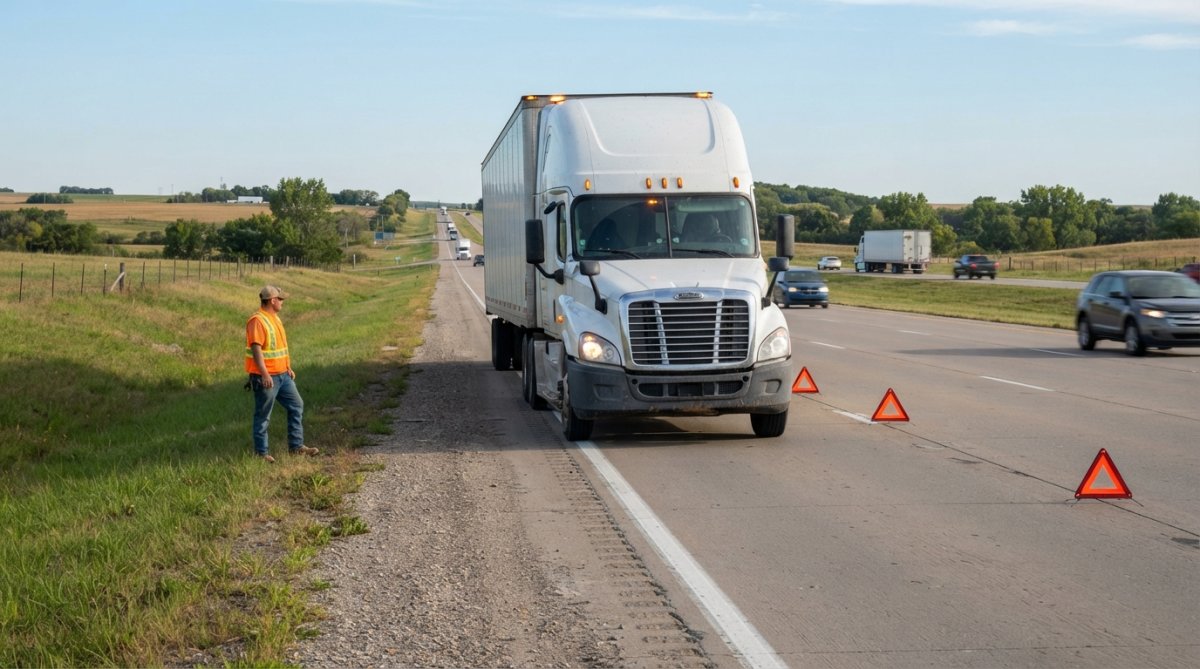
If you feel a problem developing, downshift to a lower gear and coast to the shoulder. Use your hazard lights immediately. Turn your steering wheel fully left toward the shoulder to signal your intent to other drivers.
Once stopped, activate your hazard lights, set your parking brake, and shift to neutral. Put on your high-visibility vest. Place emergency triangles or flares 100 feet behind your truck on the roadway to warn oncoming traffic (fmcsa.dot.gov). Stay out of the travel lanes and away from your truck’s blind spots. Do not stand between your truck and oncoming traffic.
Call for roadside assistance immediately with your location using mile markers or GPS coordinates, the nature of the problem, and your truck’s description. Stay on the phone with the dispatcher until help arrives. Do not attempt repairs on the roadside that require you to work in the travel lanes or under the truck near moving traffic.
CALL or TEXT NOW:712-827-0207 →
24/7 Emergency Response and What to Expect
Commercial truck roadside assistance operates around the clock because breakdowns don’t happen during business hours.
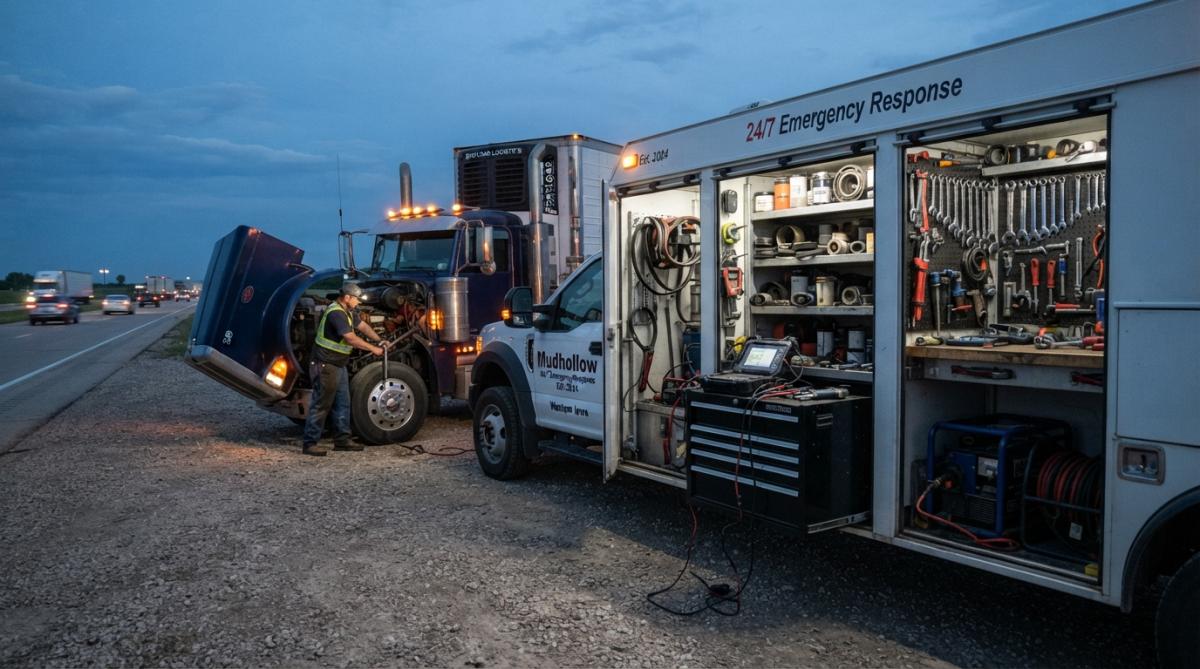
When you call Mudhollow Diesel Mechanics for emergency roadside assistance, a dispatcher takes your information: location, truck description, and problem description. The dispatcher assesses whether the problem can be diagnosed and repaired on-site or whether a heavy-duty tow is necessary. If mobile repair is feasible, the dispatcher dispatches the nearest equipped service vehicle and gives you an estimated arrival time.
Response time depends on your location. When the service vehicle arrives, the technician performs a visual inspection and runs computer diagnostics to identify the problem. Once identified, the technician determines whether repair is feasible on-site or whether you need towing.
Most roadside fixes are resolved within one to three hours from the time you call. Electrical problems, battery replacement, fuel filter changes, and brake adjustments typically take 45 minutes to two hours.
When you call for emergency roadside assistance, have your truck’s year, make, model, and engine type ready. Describe the exact symptoms, what you heard, felt, or saw before the truck stopped. This information helps the dispatcher send the right equipment and the technician arrive prepared to diagnose the problem faster.
Preventive Maintenance to Reduce Roadside Emergencies
The best roadside emergency is the one that never happens. Preventive maintenance catches problems before they strand you on the highway.
Battery health is foundational. Have your battery load-tested twice per year, spring and fall. Replace batteries that fail the test before they leave you stranded. Inspect battery terminals and cables for corrosion and clean them if needed.
Fuel system maintenance prevents most fuel-related roadside failures. Change fuel filters on schedule, typically every 10,000 to 15,000 miles (cummins.com). Use quality diesel fuel from reputable sources. In winter months, add fuel conditioner to prevent gelling.
Air brake system maintenance is critical for safety and reliability. Have your air brake system inspected annually. Check for visible air leaks by listening for hissing sounds when the truck is running. Inspect brake drums and pads regularly and replace them before they wear through.
Electrical system maintenance includes keeping battery terminals clean, checking alternator output to ensure it’s charging properly, and inspecting wiring for damage or corrosion.
| Maintenance Task | Frequency | Impact on Roadside Reliability |
|---|---|---|
| Battery load test | Spring and fall | Prevents no-start failures |
| Fuel filter change | Every 10,000-15,000 miles | Prevents fuel starvation |
| Air brake inspection | Annually | Prevents brake system failure |
| Alternator output check | During regular service | Prevents battery drain |
| Battery terminal cleaning | Every 6 months | Prevents electrical connection loss |
| Fuel conditioner addition | Monthly in winter | Prevents fuel gelling |
Keep detailed maintenance records. When you call for emergency roadside assistance and can tell the technician that your battery was load-tested recently, your fuel filter was changed recently, and your air brake system was inspected recently, it helps the technician narrow the diagnostic scope.
Insurance, Warranties, and Cost Transparency
Roadside assistance costs vary depending on the service, problem, and location. Understanding what your insurance covers, what your truck warranty covers, and what mobile repair services charge helps you make informed decisions.
Most commercial truck insurance policies include roadside assistance as a standard benefit or optional add-on. Common coverage includes towing up to a certain mileage, fuel delivery, lockout service, and jump-starts. Read your policy to understand what’s covered, what the limits are, and whether there’s a deductible.
Truck warranties vary by manufacturer and age. New trucks typically have comprehensive warranties covering defects in materials and workmanship. Many warranties include roadside assistance as a benefit. If your truck is under warranty and a component fails, contact the manufacturer’s roadside assistance line first.
Mobile repair services charge based on the service performed. A battery replacement costs less than a fuel injector cleaning, which costs less than a full air brake system diagnosis. Compare the cost of mobile repair versus towing plus shop repair.
Beware of roadside assistance services that quote prices over the phone without diagnosing the problem first. Honest providers perform diagnostics before quoting a repair price. Get the full estimate in writing.
When your semi-truck breaks down on I-80 or I-29, every minute matters. Mudhollow Diesel Mechanics provides 24/7 emergency roadside assistance with fully equipped mobile service vehicles that diagnose and repair your truck where it stops. We handle electrical failures, fuel system problems, brake and air system issues, and most common roadside emergencies without the cost and delay of towing. Call or text now at 712-827-0207 for immediate assistance.
Frequently Asked Questions
Q: What is the typical response time for commercial truck roadside assistance?
A: Response time depends on your location relative to major corridors like I-80 and I-29, and current demand. Mobile repair services prioritize urgent breakdowns that prevent safe operation. When you call, dispatch will provide an estimated arrival window. Having your exact location, truck description, and symptom details ready speeds up the process. Many roadside repairs are completed faster than arranging a tow and waiting at a shop, especially for common issues like battery replacement, fuel delivery, or jump starts.
Q: How does mobile diesel repair compare to traditional towing for commercial vehicles?
A: Mobile repair eliminates tow costs, reduces downtime, and often fixes problems on-site in minutes rather than hours. Traditional towing to a distant shop means lost revenue during transport and waiting time. Mobile mechanics with computer diagnostics can handle flat tire repair, air system issues, electrical problems, and fuel delivery without moving your truck. If on-site repair isn’t possible, you’ve already had professional diagnostics done, which speeds up shop work. For fleet operations, this difference compounds quickly across multiple breakdowns per year.
Q: What happens if the roadside repair requires parts that need to be ordered?
A: If a breakdown requires parts that aren’t available on the service truck, the mobile mechanic will provide a clear diagnosis and options. Some common parts like batteries, filters, and fuses are typically stocked. For specialized diesel engine components or transmission parts, ordering is necessary. In that case, you have the diagnosis in hand and can arrange shop service or parts delivery with full information. This prevents unnecessary guessing and shop visits. Discuss parts availability during your initial call so you understand the full scope of the repair.
Q: Can mobile repair services handle complex electrical and computer diagnostics on semi-trucks?
A: Yes. Modern mobile diesel repair trucks carry advanced computer diagnostic equipment that can read engine codes, air system faults, and electrical issues just as effectively as shop equipment. This capability lets technicians identify problems that basic roadside checks would miss. Complex issues like intermittent electrical gremlins, sensor failures, and fuel injection problems can be diagnosed and often repaired on-site. If a problem requires specialized software or extended repair work, the diagnosis gives you clear information before deciding on next steps.
This article was written using GrandRanker