Table of Contents
- Why RV Towing Costs Add Up Fast
- Mobile Diesel Repair for RVs: Fix It Where It Broke
- Common RV Engine Failures That Strand You
- On-Site RV Breakdown Diagnostics: What to Expect
- Roadside Assistance Memberships vs. Independent Mobile Repair
- Long-Distance Vehicle Transport as a Towing an Alternative
- DIY Towing Safety and Legal Requirements
- Pre-Tow Preparation Checklist
- Frequently Asked Questions
Last Updated: September 21, 2026
Why RV Towing Costs Add Up Fast
RV towing is the emergency transport of a recreational vehicle to a repair facility after a breakdown or accident. The bill climbs quickly because operators charge by the mile, and a loaded motorhome can weigh far more than most trucks are rated to move.
Mobile Diesel Repair for RVs: Fix It Where It Broke
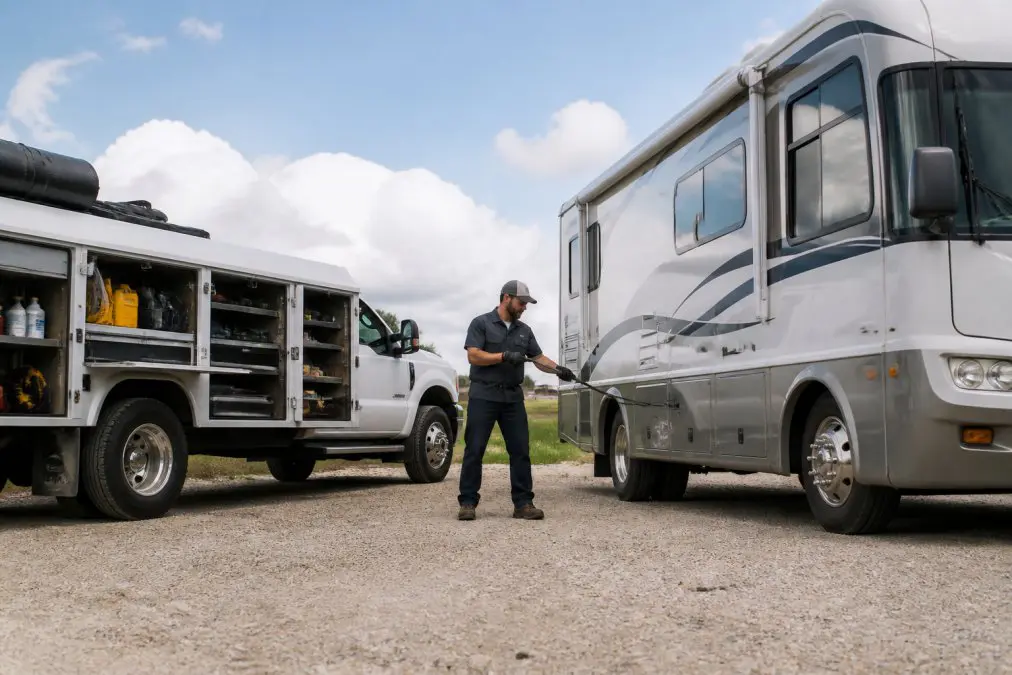
Mobile diesel repair brings the shop to your breakdown. A fully equipped service truck carries the tools, parts, and computer diagnostics needed to fix many failures on the shoulder, at a rest stop, or in a parking lot.
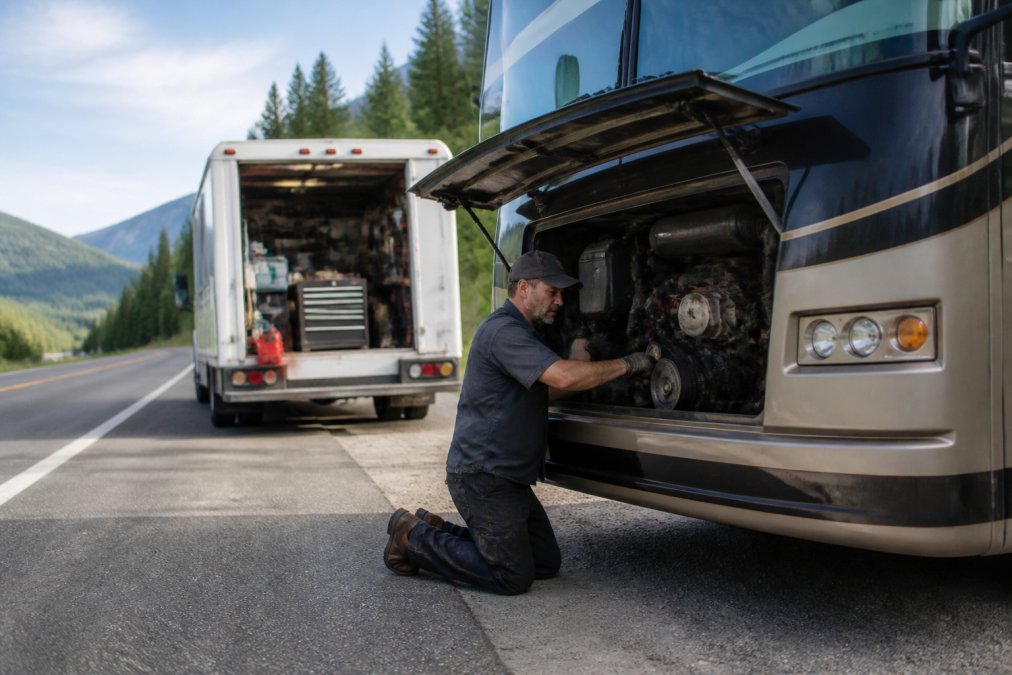
Ask the dispatcher one question before you agree to anything: “Can this be diagnosed on-site?” If the answer is yes, you may skip the tow entirely.
Common RV Engine Failures That Strand You
The failures that strand RVs cluster around a handful of systems. Knowing them helps you describe the problem clearly when you call, which speeds up dispatch and diagnosis.
- Cooling system failures. Cracked hoses, failed water pumps, and clogged radiators cause overheating and leave you on the shoulder.
- Turbocharger problems. Loss of power, excessive smoke, or a whining noise often points to a failing turbo.
- Fuel delivery issues. Clogged filters and failing injectors cause rough running or a no-start condition.
- Electrical and sensor faults. Faulty sensors and wiring gremlins can trigger limp mode or a shutdown with no obvious cause.
- Battery and charging failures. A dead alternator leaves you running on battery power until the engine quits.
On-Site RV Breakdown Diagnostics: What to Expect
On-site RV breakdown diagnostics connects computer scan tools to your engine control module at the breakdown location to read fault codes and live sensor data, replacing the guesswork that leads to unnecessary towing and repeat repairs.
Skipping diagnostics and towing straight to a shop can cost you twice. You pay the tow, then pay the shop to run the same scan you could have had on the shoulder.
Roadside Assistance Memberships vs. Independent Mobile Repair
Roadside assistance memberships and independent mobile repair solve different problems. A membership is insurance against the cost of a tow; independent mobile repair fixes the vehicle so the tow never happens. Both answer the phone the same way, “we’ll send someone”, but the someone who shows up is dispatched with a different job in mind.
What a Membership Actually Buys
A membership is a contract with a cap. The fine print that matters is rarely the headline benefit. Look for these four numbers before you assume you’re covered:
- Per-incident limit. The maximum the program will pay for a single tow or service call. Anything above that comes out of your pocket.
- Annual call cap. How many times per year you can use the benefit before you’re paying retail.
- Distance allowance. Many programs cover a set number of miles and then charge per mile beyond it.
- Vehicle eligibility. Some programs exclude vehicles above a certain gross vehicle weight rating, which can quietly disqualify a loaded diesel motorhome.
The Dispatch Incentive Problem
When you call a membership, the dispatcher’s job is to resolve the call, not diagnose your rig. The provider they send is contracted to transport, and transport is what they get paid for. A tow to a shop closes the ticket; a technician who spends two hours on the shoulder tracing an intermittent sensor fault does not.
When a Membership Pays for Itself
The math is situational, but the pattern is predictable. A membership tends to earn its keep when:
- You travel frequently and far from home, where a single long tow would exceed the annual cost.
- Your rig is heavy enough that retail towing rates climb fast per mile.
- You want one number to call for lockouts, jump-starts, and fuel delivery, not just tows.
A membership tends to be dead weight when:
- Your breakdowns are usually mechanical and fixable on-site.
- You stay within a region where you already have a trusted mobile repair contact.
- Your rig’s weight puts it near or above the program’s eligibility ceiling.
The Practical Setup
The RVers who spend the least on towing are not the ones who picked the “best” membership or the “cheapest” mobile tech. They’re the ones who kept both numbers and made one call before the other. Save a mobile diesel repair number alongside your membership number, and when you break down, ask the mobile provider one question first: can this be diagnosed on-site?
| Option | What It Covers | Best For | Main Limitation |
|---|---|---|---|
| Roadside membership | Towing, fuel delivery, lockout, jump-start, up to a per-incident cap | Frequent travelers wanting tow cost protection | Dispatch is for transport, not on-site repair; caps and weight limits apply |
| Independent mobile repair | On-site diagnosis and mechanical repair | Breakdowns that can be fixed where you stopped | Limited to the provider’s service radius |
| Long-distance transport | Moving a non-running vehicle to a distant shop | Relocating a rig for major work | Scheduled, not immediate |
| DIY flat towing | Bringing your own backup vehicle | RVers who want independence | Requires equipment and setup |
A membership protects you from the cost of a tow. Mobile repair protects you from needing one. The cheapest breakdown is the one that never gets towed.
Long-Distance Vehicle Transport as a Towing an Alternative
The trade-off is time. Transport is scheduled, not dispatched, so it won’t help you at 2 AM on the interstate. Use it for planned moves and major repairs, not emergencies.
Match the tool to the situation: mobile repair for fixable breakdowns, transport for long relocations, and a membership for the rare case where a tow is unavoidable.
DIY Towing Safety and Legal Requirements
DIY towing means using your own equipment to move a vehicle, typically a tow dolly or a flat-tow setup behind a motorhome. It can save money, but it comes with real safety and legal obligations most guides gloss over, the federal standard governing your equipment, the state rules that vary as you cross lines, and the failure points that turn a cheap tow into an expensive repair.
The Federal Floor: FMVSS 121
Supplemental braking systems on towed vehicles are not a manufacturer’s suggestion. Federal Motor Vehicle Safety Standard 121 sets performance requirements for air-braked vehicles, and most states layer their own thresholds on top. The practical takeaway: if your towed vehicle exceeds your state’s weight threshold, you are legally required to have a functioning supplemental braking system, not just a tow bar and safety cables.
State-by-State Braking Thresholds
There is no single national number. States set their own thresholds, and they vary widely, some trigger a braking requirement at a low towed weight, others set it higher, and a few have no explicit threshold but still hold you liable if the setup fails. The safe move is to assume you need supplemental braking on any towed vehicle heavy enough to push your rig in a panic stop, and confirm the rule for every state on your route before you leave.
The Equipment Chain
A tow bar alone is not a towing setup. The full chain includes:
- Baseplate. Bolted to the towed vehicle’s frame. A tow bar without a properly rated baseplate is a failure waiting to happen.
- Tow bar. Rated for the load, inspected for wear at every connection point.
- Safety cables. Redundant, crossed under the hitch so a bar failure doesn’t drop the towed vehicle.
- Breakaway system. A lanyard that applies the towed vehicle’s brakes if it separates from the tow vehicle. Required in many states and cheap insurance everywhere.
- Supplemental braking. The system that makes the towed vehicle help stop itself.
- Lighting. Brake lights, turn signals, and running lights on the towed vehicle must work and be visible.
Weight Ratings You Cannot Ignore
Three numbers govern whether your setup is legal and safe:
- Gross vehicle weight rating (GVWR). The maximum the towed vehicle is rated to weigh, fully loaded.
- Gross combination weight rating (GCWR). The maximum combined weight of the tow vehicle plus everything it’s pulling.
- Towing capacity. The tow vehicle’s rated limit, which is almost always lower than the hitch’s rating.
Insurance and Liability
Your policy may not cover damage that happens while you’re towing another vehicle, and it may not cover the towed vehicle at all. Before you leave, confirm three things in writing: that the tow vehicle is covered while towing, that the towed vehicle is covered while being towed, and that liability extends to a third party if the setup fails.
When DIY Is the Wrong Call
DIY towing makes sense for short, planned moves with a properly rated setup and a vehicle approved for flat towing. It stops making sense when the towed vehicle isn’t approved for flat towing, when the combined weight approaches the tow vehicle’s GCWR, when you’re crossing states with different braking rules, or when the breakdown is mechanical and a mobile technician could fix it on-site instead.
A tow bar without a baseplate, supplemental braking, and a breakaway system is not a towing setup. It’s a projectile waiting for a reason to leave.
Pre-Tow Preparation Checklist
Pre-tow preparation is the set of checks you complete before moving a vehicle, and it’s the difference between an uneventful trip and a roadside disaster. Run through this list every time:
- Confirm the tow vehicle and hitch are rated for the load
- Inspect the hitch assembly, safety cables, and connections for wear
- Verify the towed vehicle’s lights and brakes work
- Check tire pressure and condition on both vehicles
- Secure or remove loose items inside the towed vehicle
- Confirm your insurance covers the tow
- Note your exact location and mile marker before you call for help
- Save a mobile repair number alongside your roadside membership number
Frequently Asked Questions
Is mobile diesel repair cheaper than towing an RV?
In most cases, yes. On-site RV towing alternatives like mobile diesel repair eliminate the tow bill entirely, and 99% of customers avoid a tow when a mobile technician handles the fix where the breakdown happened. You still pay for labor and any parts, but you skip the per-mile towing charge, the shop diagnostic fee, and the days of downtime that come with waiting in a service queue. Ask for a quote before work begins so you can compare it against a tow plus shop estimate.
What should I do if my RV breaks down on the highway?
Pull as far onto the shoulder as you can, turn on hazard lights, and set out reflective triangles if it is safe. Call for mobile diesel repair for RVs before you call a tow, since a technician can often diagnose the problem on the spot. Give the dispatcher your mile marker, the direction you are traveling, and any symptoms like loss of power, smoke, or warning lights. Stay inside the vehicle with your seatbelt on if traffic is heavy.
Can most RV mechanical issues be fixed on the side of the road?
Many can. Common RV engine failures such as radiator leaks, turbocharger problems, fuel delivery issues, and sensor faults are often repairable on-site with the right tools and computer diagnostics. A mobile technician arrives with heavy-duty equipment and can run on-site RV breakdown diagnostics to pinpoint the fault. If a part needs ordering, you will know quickly rather than after days in a shop queue, which lets you decide whether to wait or arrange transport.
Does roadside assistance cover mobile repair services?
It depends on the plan. Many RV roadside assistance memberships cover towing, jump-starts, and fuel delivery but treat mobile mechanic dispatch as a separate service or reimburse only part of the labor. Check your policy exclusions and coverage limits before you need them. If your plan does not cover on-site repair, paying a mobile diesel technician directly is often less than the out-of-pocket expense of a tow plus shop time.
A breakdown never comes at a good time, and the tow bill that follows can turn a bad day into an expensive one. The real fix is to avoid the tow in the first place whenever the problem allows it. Mudhollow Diesel Mechanics brings fully equipped mobile service, computer diagnostics, and rapid roadside repair directly to your location, so you skip the tow and the shop wait. Call or text 712-827-0207 and get back on the road.