
Table of Contents
- Why Advanced Mobile Diesel Diagnostics Matter for Roadside Emergencies
- How Mobile Diesel Engine Troubleshooting Prevents Costly Breakdowns
- Real-Time Data and Fault Code Analysis on the Roadside
- Diesel After-Treatment System Diagnostics: A Critical Component
- Reducing Fleet Downtime with Mobile Repair and Diagnostics
- Electrical System and Sensor Troubleshooting Without the Tow
- Advanced Mobile Diagnostics vs. Traditional Shop Repairs
- Frequently Asked Questions
Last Updated: October 20, 2026
Why Advanced Mobile Diesel Diagnostics Matter for Roadside Emergencies
When your diesel engine starts acting up on I-80 at midnight, you don’t have time for guesswork. Advanced mobile diesel diagnostics pinpoints engine problems on-site using sophisticated computer tools and real-time data analysis, without a tow to a distant shop. At Mudhollow Diesel Mechanics, our experienced technicians solve the problems that leave drivers stranded: electrical gremlins, sensor failures, fuel system issues, and fault codes that dealerships themselves struggle to interpret.
The difference between a quick roadside fix and a multi-day shop wait often comes down to diagnostic accuracy. When a technician connects to your engine’s electronic control module and reads live data from dozens of sensors at once, they can separate real failures from sensor noise. Mobile diesel diagnostics brings that precision to your location, whether you’re at a rest stop, your yard, or the shoulder with traffic passing.
Most breakdowns that look catastrophic turn out to be fixable on-site once you understand what’s actually happening inside the engine. That’s where mobile diesel diagnostics changes the equation entirely.
How Mobile Diesel Engine Troubleshooting Prevents Costly Breakdowns
Mobile diesel engine troubleshooting combines real-time sensor data, fault code analysis, and hands-on testing to identify what’s failing before it gets worse. A technician arrives with diagnostic scanners, electrical testing equipment, and parts for the most common roadside failures, then pulls live data from your fuel injectors, turbo boost pressure, coolant temperature, exhaust back pressure, and dozens of other parameters.

The real power emerges when a sensor reads high but the engine runs fine anyway. That’s not necessarily a sensor failure, it might be a wiring issue, connector corrosion, or calibration drift. Mobile troubleshooting lets us test the actual circuit, verify sensor output against known baselines, and often fix the real problem for a fraction of what a parts cannon approach would cost.
Preventative diagnostics work the same way. Many fleet managers schedule mobile service at their yards to scan for developing issues before they become roadside emergencies, a turbocharger drifting out of boost range, a fuel injector starting to drift, or electrical connections beginning to corrode, all caught before they fail.
Real-Time Data and Fault Code Analysis on the Roadside
Diesel engines generate fault codes whenever a sensor reading falls outside expected parameters. But a fault code is not a diagnosis, it’s a symptom. A P0101 code means “Mass Air Flow Sensor Out of Range,” but that could mean the sensor failed, the intake is restricted, the wiring is corroded, or the sensor needs recalibration. Without real-time data, you’re guessing.
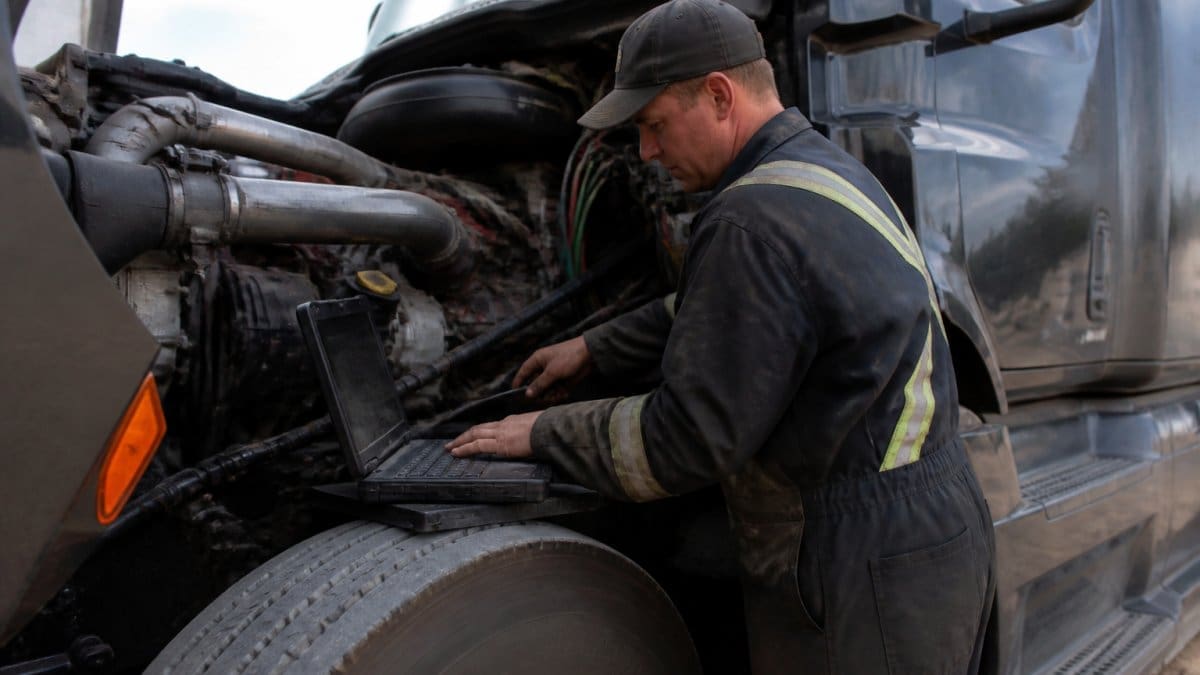
When a technician connects a modern diagnostic scanner, they see what the engine sees: live sensor readings, voltage levels, signal frequency, and historical data logs. They can watch fuel pressure rise and fall with throttle input, see turbo boost ramp up, and measure electrical resistance in circuits. This real-time visibility transforms fault codes from mysteries into clear pointers toward the actual problem.
Consider a common scenario: a truck loses power on a grade, throws a turbo boost code, and the driver thinks the turbocharger is failing. A shop might replace it for thousands of dollars. Mobile diagnostics reveals the issue in minutes: a stuck wastegate solenoid preventing boost control. That’s the difference real-time data analysis makes.
Diesel After-Treatment System Diagnostics: A Critical Component
Modern diesel engines route exhaust through a chain of after-treatment devices, diesel oxidation catalyst (DOC), diesel particulate filter (DPF), selective catalytic reduction (SCR) with diesel exhaust fluid (DEF) dosing, and often exhaust gas recirculation (EGR). Each has its own sensors and control logic, and each can throw codes that look identical to a real hardware failure when the actual problem is a sensor, a wiring fault, or a software condition.
How the system is monitored. The engine control module (ECM) and a dedicated after-treatment module track DPF differential pressure, DOC inlet and DPF outlet temperatures, upstream and downstream NOx readings, DEF level and quality, and EGR flow versus commanded flow. When any drifts outside its window, the module sets a fault and may derate the engine or force limp mode. A code reader tells you which window was violated; it does not tell you why.
The common false-alarm patterns. A DPF that won’t complete a regeneration is frequently not a clogged filter, it’s a failed differential pressure sensor, a cracked DPF temperature sensor, or a regeneration interrupted because the truck never reaches sustained highway speed. An SCR efficiency code is often a degraded NOx sensor or a faulty DEF quality/level sensor rather than a failed catalyst.
How a mobile technician separates real failures from sensor noise. The technician connects a scanner that reads live after-treatment parameters, not just stored codes, and watches them under load. They command a forced regeneration and watch whether DPF differential pressure actually drops, compare commanded versus actual EGR flow, check DEF concentration against reported values, and measure sensor resistance and voltage at the connector to catch corrosion and drift.
Why this matters for compliance and uptime. After-treatment faults are the most common reason a diesel is derated or placed in a compliance hold, and a derated truck isn’t earning.
If your truck has thrown an after-treatment code, do not clear it and keep driving. A cleared code hides the freeze-frame data a technician needs to tell a real failure from a sensor fault, and a derate can return at the worst possible moment.
Reducing Fleet Downtime with Mobile Repair and Diagnostics
For agricultural hauling operations and small fleets, downtime is not an abstract cost, it’s a truck that should be moving product sitting in a shop lot, a driver idle, and a load that may miss its window. The useful question is where the time actually goes and which parts of it mobile diagnostics can compress.
Where the time goes in a traditional repair. A shop-based repair runs through a sequence: wait for a tow, wait in the shop queue, wait for a technician to connect a scanner and form a hypothesis, wait for parts, and, if the first hypothesis was wrong, wait again. Each step adds hours, and they compound.
CALL or TEXT NOW:712-827-0207 →
Where mobile diagnostics compresses the timeline. A mobile technician collapses the tow and queue steps by coming to the vehicle, and much of the diagnostic step by reading live data and testing circuits on-site. The vehicle is diagnosed where it sits, and the repair decision, including which part, if any, is actually needed, is made before the truck moves.
A concrete way to think about the ROI. Fleet owners don’t need a generic “downtime is costly” claim; they need a per-vehicle frame. If a truck earns a known margin per loaded mile and runs a known number of miles per day, each hour of downtime has a rough dollar value, and each day of avoided shop queue is a multiple of that.
The telematics angle most guides miss. Many late-model diesels already stream fault codes and sensor data through telematics or fleet management software, which is useful for spotting a developing trend, DPF regeneration frequency creeping up, a NOx sensor drifting, a turbo boost curve flattening, before it becomes a roadside failure.
Scheduled yard service as a downtime strategy. Fleet managers who schedule mobile service at their yards during off-hours, evenings, weekends, before the day’s loads, can scan multiple trucks in one visit, identify developing issues, and schedule repairs before they become emergencies. That converts unplanned roadside downtime into planned, predictable maintenance windows.
Downtime reduction is not about fixing trucks faster in the abstract, it is about removing the tow step, the shop-queue step, and the misdiagnosis step from the timeline. Mobile diagnostics targets all three, and telematics tells you which truck to point it at first.
Electrical System and Sensor Troubleshooting Without the Tow
Electrical gremlins are often the hardest problems to solve in a traditional shop because they’re intermittent and context-dependent. A truck runs fine in the morning but throws a fault code in the afternoon; a sensor reads high when cold but normalizes when warm. These patterns are invisible in a static shop environment.
Mobile troubleshooting captures the vehicle in its actual operating context. A technician can drive the truck, monitor live sensor data during operation, and often reproduce the fault condition, testing circuits under load and measuring voltage drop across connectors while the engine runs. This real-world approach catches problems that bench testing misses.
Sensor calibration is another area where mobile diagnostics shines. Many sensors don’t fail; they drift out of calibration. A mass air flow sensor reading 5% high will trigger a fault code and limp mode, but replacing it won’t help if the real issue is a contaminated intake or calibration drift. A technician with the right tools can verify the sensor against known baselines and often recalibrate or clean the component on-site.
Advanced Mobile Diagnostics vs. Traditional Shop Repairs
The core difference is speed and accuracy. A shop-based repair starts with a tow, then a queue, then a technician pulling codes and forming a hypothesis. If the hypothesis is wrong, they troubleshoot further; if parts are needed, there’s a wait; if the wrong part was ordered, another wait. Days pass.
Mobile diagnostics compresses this. A technician arrives with sophisticated tools and experience solving diesel problems in the field, pulls real-time data, analyzes it on-site, and makes an informed repair decision immediately. If parts are needed, they often carry common items or can source them while you wait. Most problems are fixed before you’d have even reached a shop.
The accuracy difference matters too. Mobile technicians work from data and field experience, not a code and a parts cannon. They know which fault codes are real failures and which are sensor noise, and which repairs actually solve the problem versus just clearing the code temporarily. That expertise prevents unnecessary parts replacement and keeps you on the road faster.
When your diesel needs advanced diagnostics on the roadside, you need a team that brings precision tools and real experience to your location. Mudhollow Diesel Mechanics operates fully equipped service trucks across I-80 and I-29 in western Iowa, ready to diagnose and repair your truck where it breaks down. We carry the diagnostic scanners, electrical testing equipment, and parts expertise to solve problems on-site, avoiding expensive tows and long shop waits. Call or text 712-827-0207 to reach us now, or visit our service area to learn how we keep fleets moving.
Frequently Asked Questions
What are the main benefits of mobile diesel diagnostics compared to towing to a shop?
Mobile diesel diagnostics eliminate tow costs, reduce downtime, and get you back on the road faster. A technician arrives at your location with advanced diagnostic equipment, identifies the problem in real-time, and often completes repairs on-site. This approach avoids the delay and expense of towing, dealership wait times, and shop labor rates. For roadside emergencies, mobile diagnostics typically resolve issues in hours rather than days.
How do advanced diagnostic tools identify intermittent diesel engine issues that traditional mechanics might miss?
Advanced mobile diagnostics read live fault codes and real-time data from your engine control module, after-treatment system, and electrical sensors. Intermittent problems that appear and disappear leave diagnostic trouble codes in the vehicle’s computer memory. A skilled technician with proper diagnostic software can pull these codes, monitor sensor data while the engine runs, and pinpoint electrical gremlins or sensor calibration issues that basic hand tools cannot detect. This data-driven approach catches problems before they cause major breakdowns.
Can mobile diagnostic services handle modern after-treatment system failures?
Yes. Modern diesel engines rely on after-treatment systems (DPF, SCR, NOx sensors) that are critical for emissions compliance and engine performance. Mobile diesel diagnostics can read after-treatment fault codes, monitor sensor function, and identify regeneration issues or component failures on-site. Advanced diagnostic software allows technicians to access real-time system data and often repair or clear issues without requiring a tow. However, if parts must be ordered, mobile diagnostics still save time by identifying the exact problem immediately.
Why is real-time data analysis important for commercial diesel engines?
Real-time data reveals what is happening inside your engine right now, not just what happened in the past. Commercial diesel engines operate under heavy loads, and subtle sensor drift, fuel system issues, or electrical problems can worsen quickly. Real-time analysis lets technicians see live fuel pressure, boost levels, coolant temperature, and sensor signals while the engine runs. This allows them to catch developing failures before catastrophic breakdown, schedule preventive maintenance accurately, and reduce your cost-per-mile by keeping the engine running efficiently.