Table of Contents
- 1. Eliminate Tow Costs and Get Back on the Road Faster
- 2. Access Mobile Diesel Diagnostic Tools on Site
- 3. Reduce Equipment Downtime with On-Site Repairs
- 4. Schedule Preventive Maintenance for Construction Machinery at Your Yard
- 5. Avoid Dealership Markups and Long Shop Wait Times
- 6. Understand the True Cost of Equipment Downtime in Construction
- 7. Improve Safety and Regulatory Compliance Without Shop Visits
- Conclusion
- Frequently Asked Questions
Last Updated: August 29, 2026
7 Reasons to Choose Mobile Diesel Repair for Construction Fleets
When your heavy equipment breaks down on a job site or your fleet truck limps to the shoulder of I-80, the clock starts ticking. Every hour offline costs money, lost productivity, delayed projects, unhappy clients. The traditional response has always been the same: call a tow truck, wait for a wrecker to arrive, get hauled to a shop 30 miles away, and hope the repairs don’t take three days.
There’s a better way. Mobile diesel repair brings the shop to you. At Mudhollow Diesel Mechanics, we’ve spent years helping construction fleet managers and owner-operators understand that mobile diesel repair isn’t just a convenience, it’s a fundamentally different approach to fleet maintenance that eliminates the hidden costs of downtime, towing, and dealership markups. Below, we’ll walk you through seven concrete reasons why mobile diesel repair makes financial and operational sense for construction fleets, and why the numbers often surprise fleet managers when they actually do the math.
1. Eliminate Tow Costs and Get Back on the Road Faster
The first reason to choose mobile diesel repair is the simplest: you don’t pay to move a broken truck. A heavy-duty wrecker call can run anywhere from $500 to $2,000 depending on distance and time of day (fmcsa.dot.gov). Overnight breakdowns cost more. Weekend emergencies cost more. Long-haul tows to a distant dealership? You’re looking at five figures before any repair work even begins.
Mobile diesel repair eliminates that entire expense. A technician arrives at your location with a fully equipped service truck, diagnoses the problem on site, and often completes the repair without ever loading your equipment onto a flatbed. For construction fleets running tight margins, this single factor often justifies the switch.
Beyond the direct tow cost, there’s the hidden time cost. A wrecker takes 45 minutes to two hours to arrive (fmcsa.dot.gov). Your truck sits idle. Your crew waits. If the repair takes longer than expected at the shop, you’re paying for a rental vehicle or losing a day of work. Mobile repair compresses this timeline dramatically. Most roadside fixes are resolved in less time than in-shop repairs, because the technician comes prepared with the right tools and diagnostic equipment already on board.
Request a response time guarantee when you contract with a mobile diesel repair provider. Knowing whether you’ll see a technician in 30 minutes or three hours changes how you plan your operations and backup logistics.
2. Access Mobile Diesel Diagnostic Tools on Site
Modern diesel engines don’t fail in ways you can fix with a wrench and intuition. They fail with fault codes. A fuel injector problem might trigger 12 different warning lights. An aftertreatment fault could indicate a sensor, a clogged DPF, or a deeper emissions system failure. Without proper diagnostics, you’re guessing, and guessing costs time and money.
This is where mobile diesel diagnostic tools change the equation. A fully equipped mobile service truck carries computer diagnostic equipment that reads fault codes, clears them when appropriate, and helps identify root causes on the spot. You get answers before you commit to a repair path.
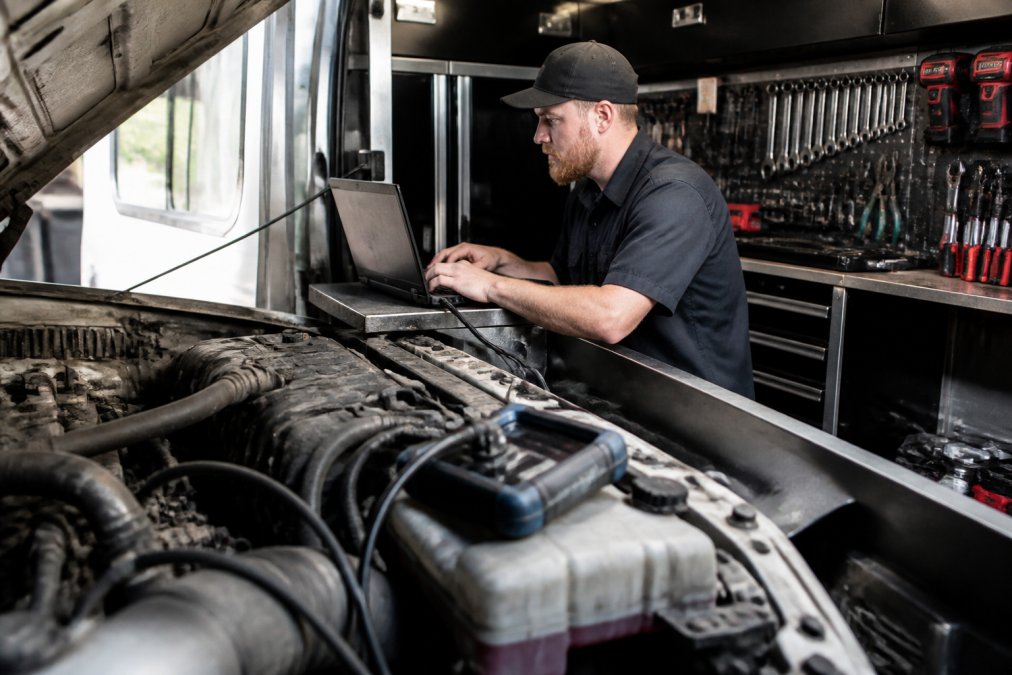
The diagnostic capability matters because it separates real problems from sensor glitches. A construction fleet manager we’ve worked with had a truck throwing a DPF regeneration fault. A dealership wanted to replace the entire aftertreatment system, $8,000+ in parts alone. On-site diagnostics revealed a faulty temperature sensor. The real fix was a $400 part swap that took 30 minutes. Without mobile diagnostics, that truck would have been down for days waiting for shop availability, and the fleet would have paid for an unnecessary overhaul.
Most modern heavy-duty trucks, Cummins, Duramax, Powerstroke, Paccar, have proprietary fault code systems. A technician who specializes in mobile diesel repair understands these systems and carries the software licenses needed to read them. That expertise, delivered to your location, is a significant advantage over generic roadside assistance.
3. Reduce Equipment Downtime with On-Site Repairs
Equipment downtime in construction isn’t just an inconvenience. It’s a compounding financial problem. A dump truck that should be running three loads a day becomes a three-day delay on a project timeline. A concrete pump that breaks mid-pour can halt an entire job site. A refrigerated hauler that loses cooling loses its payload and its next three scheduled deliveries.
On-site repair reduces downtime dramatically because it eliminates the transportation and waiting phases. Your equipment gets fixed where it breaks. The technician brings the tools and parts needed for common failures. If a repair requires ordering parts, you know that immediately, no false hope of a same-day fix followed by a disappointing call that the truck needs to stay overnight.
For construction fleets, on-site repairs also mean your crew can stay on site or nearby instead of making multiple trips to a distant shop to check on progress. Productivity losses shrink. Communication improves. You’re not managing a repair situation from 40 miles away.
The true cost of equipment downtime includes lost revenue, rescheduled jobs, and crew idle time. Most construction fleet managers underestimate this total by 30-50% when comparing mobile repair to traditional shop visits.
4. Schedule Preventive Maintenance for Construction Machinery at Your Yard
Preventive maintenance is where mobile diesel repair earns its value most clearly. Rather than waiting for a breakdown to force a trip to the shop, you schedule maintenance on your terms, during a slow week, on a Saturday when the crew isn’t running jobs, or in the evening at your yard or terminal.
A mobile service truck can handle routine maintenance at your location: oil and filter changes, coolant flushes, air brake inspections, fuel system cleaning, and scheduled service intervals. This approach lets you control the timing, avoid the disruption of towing, and maintain better records of what work was completed and when.
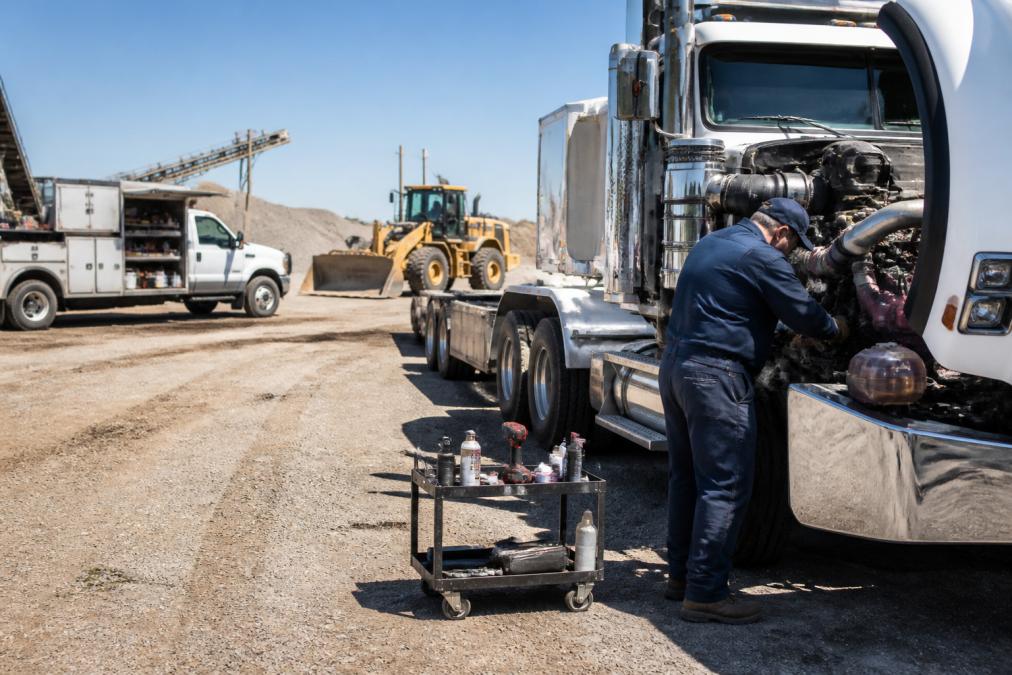
For fleet managers running multiple trucks, scheduled yard-based maintenance creates predictability. You know which vehicles are due for service and can coordinate maintenance windows that don’t conflict with job schedules. Preventive maintenance for construction machinery also reduces the likelihood of unexpected roadside failures, which is where the real cost savings compound. A truck that breaks down on I-80 at 2 AM costs far more to fix than the same truck serviced proactively at your yard.
Skipping preventive maintenance to save short-term costs is a false economy in construction. A $500 preventive service often prevents a $5,000+ emergency repair and multi-day downtime. The math is unambiguous.
5. Avoid Dealership Markups and Long Shop Wait Times
Dealership repair shops operate on a different cost model than independent mobile mechanics. They carry higher overhead, employ more administrative staff, and often have longer wait queues because they’re the “authorized” service center for multiple brands. Those costs get passed to you in the form of higher labor rates and longer turnaround times.
A construction fleet truck that rolls into a dealership service bay on a Tuesday might not be looked at until Thursday. If the repair takes longer than expected or parts need to be ordered, you’re now at a week or more of downtime. The labor rate at a dealership often runs 1.5 to 2 times higher than independent mobile shops because the dealership charges for the facility, the administrative overhead, and the brand prestige.
Mobile diesel repair services like Mudhollow Diesel Mechanics operate with lower overhead. No massive service facility. No bloated administrative staff. No long queue of waiting vehicles. You get a technician who specializes in diesel repair, arrives when scheduled, and completes the work efficiently. The cost structure is simpler, and that simplicity translates to lower rates and faster turnaround.
CALL or TEXT NOW:712-827-0207 →
For construction fleets on tight budgets, the dealership markup can mean the difference between a repair you can absorb and a repair that forces you to defer other maintenance. Mobile repair keeps costs predictable and reasonable.
6. Understand the True Cost of Equipment Downtime in Construction
Most construction fleet managers have never actually calculated the true cost of equipment downtime. They know it’s expensive, but they haven’t quantified it. This blind spot leads to poor decisions about repair strategy.
Here’s what the math looks like for a typical construction fleet:
A dump truck that generates $500 per day in revenue (one to three loads, depending on the market) is offline for two days due to a breakdown and shop wait time. The direct revenue loss is $1,000. But the indirect costs compound: the crew that would have operated the truck still needs to be paid (labor cost: $300-500). The job that was supposed to receive that truck delivery now faces a delay, which might trigger a penalty clause or require rescheduling other work. A three-day delay on a concrete pour can cascade into a week of project delays.
When you calculate downtime cost accurately, mobile diesel repair’s value becomes obvious. If a mobile technician can resolve a breakdown in four hours instead of two days, you’ve prevented $1,500-2,000 in direct and indirect losses. The mobile repair service pays for itself on the first emergency call.
For fleets running equipment like concrete pumps, refrigerated haulers, or specialized construction vehicles, the downtime cost is even higher. A pump that’s offline for a day might represent $3,000-5,000 in lost revenue and project delays. A reefer that loses cooling loses its entire payload.
Construction fleets running equipment with high daily revenue (over $400/day) should calculate their true downtime cost. In most cases, the number justifies investing in a mobile repair contract.
7. Improve Safety and Regulatory Compliance Without Shop Visits
Construction fleets operate under regulatory scrutiny. Commercial vehicles must pass DOT inspections (fmcsa.dot.gov). Air brake systems must meet federal standards. Emissions systems must function properly. Tires, lighting, and safety equipment all have regulatory requirements.
When a safety system fails, a brake light, an air brake component, an emissions sensor, you can’t legally operate the vehicle until it’s fixed. The traditional response is to tow it to a shop and hope the repair happens quickly. But if the shop is backed up, your vehicle sits offline, and you’re now violating regulations by not maintaining a safe, compliant fleet.
Mobile diesel repair allows you to address safety and compliance issues at your yard, on your schedule. A technician can perform a DOT inspection, diagnose brake system problems, test electrical systems, and address emissions issues without moving the vehicle. For fleets that need to maintain regulatory compliance while minimizing downtime, this approach is far superior to the tow-and-wait model.
Additionally, mobile technicians can help you develop preventive maintenance schedules that keep your fleet compliant before violations occur. Regular air brake inspections, fuel system checks, and emissions testing prevent regulatory failures and the associated fines.
Conclusion
Choosing mobile diesel repair for your construction fleet isn’t about choosing a service provider, it’s about choosing a fundamentally different approach to fleet maintenance. You eliminate towing costs, reduce downtime, access professional diagnostics on site, and avoid dealership markups. The financial case is compelling, and the operational benefits compound over time.
If you’re running a construction fleet in western Iowa and managing the stress of unexpected breakdowns, Mudhollow Diesel Mechanics brings expert diesel diagnostics and rapid on-site repairs directly to your location, whether you’re on I-80, at your yard, or at a job site. Our fully equipped mobile service trucks carry computer diagnostics, specialized tools, and the expertise to resolve most repairs without a tow. Call or text 712-827-0207 to schedule preventive maintenance or emergency roadside support, and experience how mobile diesel repair transforms fleet operations.
Frequently Asked Questions
Q: What does a mobile diesel mechanic do?
A: A mobile diesel mechanic brings advanced diagnostic equipment and heavy-duty tools directly to your location, whether on the highway, at a rest stop, or at your yard. They perform on-site repairs, preventive maintenance, fault code diagnostics, and emergency roadside fixes for trucks, commercial fleets, and RVs. This eliminates the need for expensive tows and allows repairs to happen where your equipment sits, minimizing downtime and keeping your fleet operational.
Q: How does mobile diesel repair reduce operational downtime?
A: Mobile repair eliminates the time spent waiting for a tow truck and traveling to a distant shop. Technicians arrive equipped with diagnostic tools and parts to resolve most issues on-site, often completing repairs faster than traditional shop visits. For construction fleets, this means equipment returns to work immediately rather than sitting idle while waiting for an appointment or parts to arrive. Preventive maintenance scheduling also catches problems before they cause breakdowns.
Q: Is mobile diesel repair cost-effective compared to traditional shops?
A: Yes. Mobile repair eliminates tow truck costs, which can run hundreds of dollars per call. You also avoid dealership labor rates and shop facility markups. Most roadside repairs are completed on-site in less time than a shop visit would require, reducing labor costs. For construction fleets running tight schedules, the savings from avoided downtime often exceed the service cost. Call for a quote to compare your specific situation.
Q: What types of construction equipment can be serviced on-site?
A: Mobile diesel repair covers semi-trucks, commercial fleets, and RVs. Services include engine diagnostics, air brake system repairs, fuel injector work, electrical testing, cooling system repairs, and DPF regeneration. Preventive maintenance can be scheduled at your yard or terminal. Contact us to discuss your specific equipment and maintenance needs.
Q: What should fleet managers look for in a mobile diesel mechanic?
A: Look for technicians with modern diagnostic software, fully equipped service trucks, rapid response times, and experience with your specific equipment types. Verify they handle both emergency roadside repairs and scheduled preventive maintenance. Ask about their availability for off-hours service at your yard or terminal. Confirm they use quality parts and stand behind their work with warranties. References from other construction fleets and transparent communication are essential.
This article was written using GrandRanker