
Table of Contents
- What to Do When Your Semi Truck Breaks Down on the Highway
- Common Roadside Semi Truck Failures and How to Identify Them
- Semi Truck Breakdown Safety Procedures You Must Follow
- Mobile Mechanic vs. Towing: Why On-Site Repair Saves Time and Money
- Emergency Roadside Assistance Cost for Commercial Trucks
- How to Get Fast Emergency Roadside Semi Truck Repair
- Preventive Maintenance: Avoid Roadside Emergencies
- Frequently Asked Questions
Last Updated: August 24, 2026
What to Do When Your Semi Truck Breaks Down on the Highway
Your engine cuts out on I-80 at midnight. You’re stranded on the shoulder with a full load, traffic whipping past at 70 mph, and no idea what’s wrong. The right decision in the first five minutes determines whether you’re back on the road in hours or stuck waiting for a tow truck.
Emergency roadside semi truck repair starts the moment you recognize something’s wrong. Pull over safely, activate hazard lights, and move away from traffic. Assess: Is the truck still running? Can you hear grinding, hissing, or electrical clicking? Is there fluid pooling underneath? These observations tell a mobile mechanic what they’re walking into before they arrive.
At Mudhollow Diesel Mechanics, we’ve responded to hundreds of highway breakdowns across I-80 and I-29. Drivers who get back on the road fastest know what to communicate when they call. They don’t panic. They don’t wait. And they don’t assume a tow truck is their only option.
This guide walks you through exactly what happens when your semi truck breaks down, how to identify what’s wrong, and why on-site emergency roadside semi truck repair saves time and money compared to traditional towing.
Roadside breakdowns on interstate highways are dangerous. Never stand between your truck and traffic. Wear a safety vest. Keep your phone accessible. If you feel unsafe, move to a rest area or truck stop before assessing the problem.
Common Roadside Semi Truck Failures and How to Identify Them
Most semi truck breakdowns fall into three categories: electrical and engine issues, brake and hydraulic failures, and tire problems.
Electrical and Engine Diagnostics
Electrical failures are deceptively common. A dead battery, corroded alternator, or failed starter can strand a mechanically sound truck. Listen for what happens when you turn the key. Complete silence usually means battery or starter. Weak cranking points to low charge or corroded connections. If the engine turns over but won’t fire, you’re looking at fuel delivery, ignition timing, or compression issues.
If your truck won’t start, check battery terminals first. Corroded terminals look white, blue, or green. Clean corrosion with a wire brush. If the truck starts after cleaning, you’ve fixed the problem. If not, a mobile mechanic with diagnostic equipment can read why the engine control module isn’t firing.
Keep jumper cables and a basic socket set in your truck. Many roadside electrical issues can be resolved or diagnosed faster with these tools. A [mobile mechanic with computer diagnostics](/services/) can then confirm whether the fix is permanent or temporary.
Tire, Brake, and Hydraulic Issues
Tire failures on a loaded semi are catastrophic. Blowouts can cause jackknifing and loss of control. Brake failures are equally serious. Air brake systems on semi trucks are sophisticated: if air pressure drops below a threshold, the brakes lock automatically as a safety feature (fmcsa.dot.gov).
Hydraulic systems power steering, landing gear, and auxiliary equipment. Hydraulic fluid leaks are usually visible: look under the truck for pooling fluid or wet spots on the frame. Tire problems announce themselves through vibration and handling changes. Check your tire pressure gauge during your walkaround inspection. Brake fade or softness in the pedal suggests air in the brake lines, low brake fluid, or a failing brake component. A mobile mechanic can perform on-site tire repair, replacement, or air brake diagnostics.
Semi Truck Breakdown Safety Procedures You Must Follow
Safety on the roadside is non-negotiable. Activate your hazard lights immediately and move the truck as far off the travel lane as possible. Put on a safety vest and make yourself visible. Never stand between your truck and oncoming traffic. If you’re on a busy interstate at night, consider moving to the next rest area or truck stop before attempting diagnostics.
Call for help before you panic-diagnose. Have your truck’s location (mile marker, highway number, direction), a description of the problem, and your contact information ready. If you suspect a fuel leak, brake fluid leak, or any hazardous spill, do not attempt to repair it yourself. Move away from the truck and wait for professional help. Turn off the engine unless you need to run it for diagnostics.

Never work under a truck without proper support. Never attempt to change a tire on a loaded semi without blocking the wheels and using proper jack stands. A mobile mechanic arrives with proper equipment and training.
Mobile Mechanic vs. Towing: Why On-Site Repair Saves Time and Money
The conventional approach, break down, call a tow truck, get hauled to a shop, costs money and time. A tow truck charges a dispatch fee, mileage rate, and sometimes a minimum charge. The shop charges diagnostic fees before starting repair. You’re paying for a 40-mile tow when the problem might be a $50 fix that takes 20 minutes.
A mobile mechanic eliminates the tow. Mudhollow Diesel Mechanics arrives with a fully equipped service truck: computer diagnostics, heavy-duty tools, spare parts for common failures, and expertise to repair on-site. If the problem is fixable roadside, and most are, you’re back on the road without ever leaving the highway.
The time advantage is substantial. A tow truck takes 30-60 minutes to arrive, then 30-90 minutes to reach a shop. At the shop, you wait for an opening, pay diagnostic fees, wait for repair, and drive back. Total time: 4-8 hours. A mobile mechanic often arrives within 60 minutes and resolves the problem in 30-90 minutes. Total time: 90 minutes to 2 hours.
Towing charges range from $300-600 for a 40-mile tow. Shop diagnostic fees add $100-200. A mobile repair service charges for labor and parts only, skipping the tow cost entirely. For many roadside failures, labor time is shorter because the mechanic focuses solely on your truck.
Emergency Roadside Assistance Cost for Commercial Trucks
Pricing for emergency roadside assistance cost for commercial trucks varies by problem, location, and service provider. Towing costs typically include a base dispatch fee, a per-mile charge, and sometimes a minimum charge. A 40-mile tow might cost $400-700. Diagnostic fees at a shop usually run $75-150 per hour.
CALL or TEXT NOW:712-827-0207 →
Mobile repair services charge for labor and parts. Labor rates are comparable to shop rates, but the time is shorter because the mechanic focuses on your truck alone. The savings come from eliminating the tow and shop overhead.
For a simple electrical fix, corrosion cleaning, or alternator replacement, you’re looking at 30-90 minutes of labor. For brake system diagnosis or tire repair, plan on 1-3 hours depending on complexity. Parts for common failures are usually in stock on a mobile service truck.
Most roadside semi truck failures are fixable on-site. The cost advantage of a mobile mechanic isn’t always dramatic, but the time advantage is. You’re back on the road in hours instead of days, which translates to revenue for owner-operators and reduced downtime for [fleet managers](/testimonials/).
How to Get Fast Emergency Roadside Semi Truck Repair
When you need emergency roadside semi truck repair, the speed of response depends on how clearly you communicate the problem, how far you are from the service area, and whether the mechanic has the right equipment and parts.
What Information to Provide When You Call
Call with your truck’s location first: mile marker, highway number, direction, and nearby exits or landmarks. Describe the problem in simple terms. Don’t diagnose, describe what you observe. “The engine won’t start,” “I hear a grinding noise from the rear,” “I lost power steering,” or “I have a blowout on the drive axle.” Provide your truck’s year, make, and model. Tell the mechanic if the truck is loaded or empty and if it’s leaking fuel or hydraulic fluid. Provide your contact number and confirm you’ll stay near the truck.
Response Time and Service Area Expectations
Mudhollow Diesel Mechanics serves I-80 and I-29 corridors across western Iowa. Response time depends on your location and current demand. Expect 60-90 minutes as a realistic average. Once the mechanic arrives, diagnosis usually takes 20-30 minutes. If the problem is straightforward, a battery issue, blown fuse, simple leak, repair time is another 20-60 minutes. If the problem is complex, the mechanic will stabilize the truck, confirm what needs to happen next, and help you arrange transport if necessary.
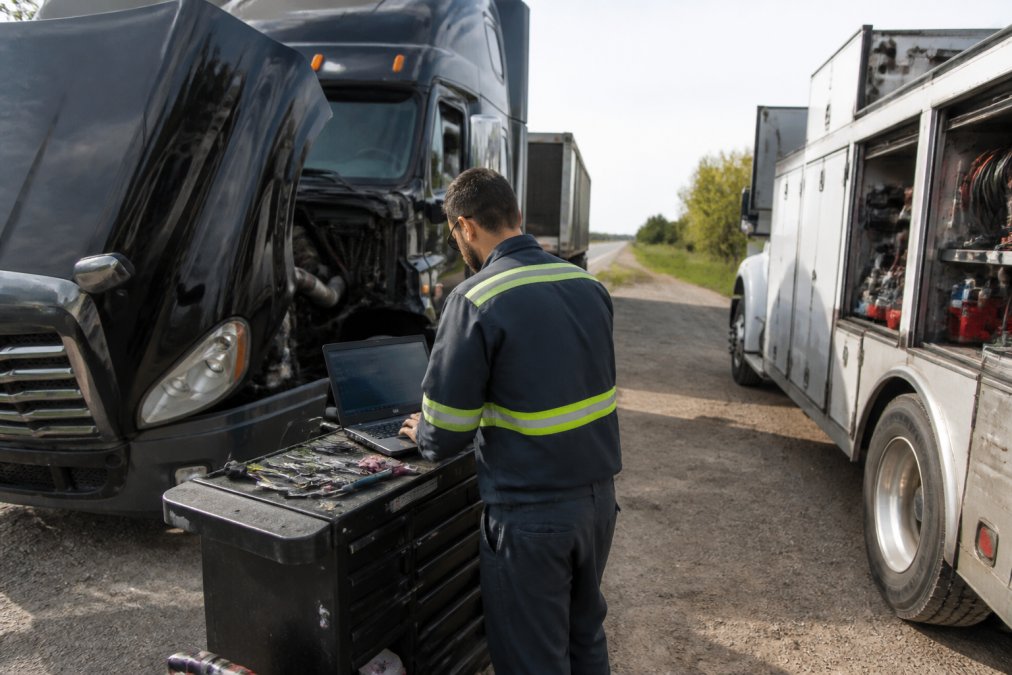
Have your truck’s service history and any previous repair notes available when the mechanic arrives. If your truck had a similar problem before, tell the mechanic. This context saves diagnostic time.
Preventive Maintenance: Avoid Roadside Emergencies
The best emergency roadside semi truck repair is the one you never need. A pre-trip inspection takes 10 minutes: check tire pressure and tread, look for leaks under the truck, test brakes, steering, and lights, and listen for unusual noises during startup (fmcsa.dot.gov). These observations catch 80% of roadside failures before they happen.
Regular maintenance follows your truck’s schedule. Oil changes, filter replacements, coolant flushes, and brake inspections prevent catastrophic failures. For owner-operators, preventive maintenance is insurance. A $300 oil change and filter replacement now prevents a $3,000 engine rebuild later. Track your maintenance and know when your next service is due.
When your semi truck breaks down, your first decision determines everything that follows. Pull over safely, stay calm, and call for professional help. A mobile mechanic with the right equipment and expertise resolves most roadside failures faster and cheaper than traditional towing. Mudhollow Diesel Mechanics specializes in exactly this: rapid diagnosis and on-site repair for semi trucks stranded on I-80 and I-29. We arrive with computer diagnostics, heavy-duty tools, and the knowledge to get you back on the road. Call or text 712-827-0207 for emergency roadside semi truck repair, available 24/7 when you need us most.
| Problem Type | Typical Response | On-Site Fixable | Time to Resolution |
|---|---|---|---|
| Electrical/Battery | 60-90 minutes | Yes | 30-60 minutes |
| Tire Failure | 60-90 minutes | Yes | 45-120 minutes |
| Brake System | 60-90 minutes | Partial | 30-90 minutes |
| Engine Diagnostics | 60-90 minutes | Often | 45-120 minutes |
| Hydraulic Leak | 60-90 minutes | Sometimes | 30-90 minutes |
When your semi truck breaks down on the highway, every minute matters. The decision you make in those first moments, whether to wait for a tow truck or call a mobile mechanic, shapes your entire outcome. A traditional tow truck adds hours and hundreds of dollars. A mobile mechanic with full diagnostics and heavy-duty tools often solves the problem roadside in less time than a tow would take.
Mudhollow Diesel Mechanics brings expert heavy-duty diesel repair directly to your location, eliminating expensive tows and long shop waits. We understand the urgency of a breakdown: you’re losing revenue, your schedule is slipping, and you need solutions. Our mobile service trucks are equipped with computer diagnostics, spare parts for common failures, and the expertise to repair most roadside problems on the spot.
The drivers and fleet managers we serve across western Iowa know this simple truth: a mobile mechanic with the right equipment and knowledge saves time, reduces cost, and keeps operations moving.
Don’t wait for a tow truck. Call Mudhollow Diesel Mechanics now: 712-827-0207. We’re available 24/7 for emergency roadside semi truck repair. Tell us your location, describe the problem, and we’ll get a mechanic to you with the tools and expertise to get you back on the road fast.
Frequently Asked Questions
Q: What should I do first if my semi truck breaks down on the highway?
A: Pull to the shoulder as safely as possible, activate hazard lights, and turn off the engine. Set out warning triangles 100-500 feet behind your truck depending on speed limits. Move to a safe location away from traffic, ideally inside the cab with doors locked. Call for emergency roadside assistance immediately with your location, truck description, and symptoms. Never attempt repairs in active traffic lanes.
Q: What are the most common roadside semi truck failures?
A: Common roadside semi truck failures include tire blowouts, air brake system failures, alternator and electrical issues, coolant leaks, and engine problems. Trailer disconnections, lighting malfunctions, and fuel system issues also occur frequently. Many failures are preventable through regular maintenance checks. On-site diagnostics can identify whether issues require immediate roadside repair or towing to a facility.
Q: How does emergency roadside assistance cost for commercial trucks compare to towing?
A: Mobile repair services eliminate expensive tow truck fees, which can range significantly depending on distance. You pay only for the repair work and technician time, not for the tow. For many roadside issues, on-site diagnostics and repair can be more cost-effective than a tow plus shop labor. Contact Mudhollow Diesel Mechanics at 712-827-0207 for a quote on your specific breakdown situation and service area.
Q: Can mobile mechanics handle complex diesel engine diagnostics on the roadside?
A: Yes, modern mobile service trucks carry computer diagnostics equipment capable of identifying complex electrical, engine, and transmission issues. Technicians can perform advanced troubleshooting on-site and determine whether repairs can be completed roadside or require shop facilities. If parts must be ordered, you have options: wait for delivery, arrange transport, or continue operations if the issue is non-critical. Call 712-827-0207 to discuss your specific diagnostic needs.
This article was written using GrandRanker