Table of Contents
- What a Mobile Diesel Mechanic for Semi Trucks Actually Does
- Emergency Roadside Semi Truck Repair: Speed and Scope
- Mobile Truck Repair Diagnostic Tools and Capabilities
- Heavy Duty Mobile Diesel Repair Cost: What Affects Your Bill
- Preventative Maintenance Checklists for Fleet Downtime Reduction
- Safety Protocols for On-Site Roadside Repairs
- Mobile Diesel Mechanic vs. Towing to a Shop: The Real Difference
- Conclusion
- Frequently Asked Questions
Last Updated: August 22, 2026
What a Mobile Diesel Mechanic for Semi Trucks Actually Does
A mobile diesel mechanic for semi trucks is a fully equipped technician who travels directly to your location, whether that’s the shoulder of I-80, a rest stop, a loading dock, or your yard, to diagnose and repair diesel engines and related systems without requiring a tow. Unlike traditional shop-based mechanics, mobile diesel mechanics bring advanced diagnostics, heavy-duty tools, and specialized knowledge directly to you, minimizing downtime and eliminating expensive towing costs.
At Mudhollow Diesel Mechanics, we understand that every hour a semi-truck is off the road costs money. A mobile diesel mechanic addresses fuel system failures, electrical issues, sensor diagnostics, brake problems, and transmission issues on-site, using computer diagnostic equipment capable of reading fault codes from modern diesel engines. The key difference is that a mobile diesel mechanic performs this work at your location, not in a shop bay. Owner-operators and fleet managers choose mobile service because it keeps trucks moving.
Emergency Roadside Semi Truck Repair: Speed and Scope
Emergency roadside semi truck repair is where mobile diesel mechanics prove their value. The speed isn’t just about showing up fast, it’s about diagnosing and fixing the problem before you lose an entire day of revenue.
Most roadside failures fall into a few categories: fuel system issues that prevent engine start, electrical faults that disable critical systems, brake problems that make the truck unsafe to operate, and sensor malfunctions that trigger limp mode. A mobile diesel mechanic equipped with modern diagnostic software can read fault codes within minutes of arrival, immediately narrowing down what’s wrong.
The scope of what can be repaired on-site is broader than many assume. Fuel injector replacement, alternator swaps, air brake system bleeding, sensor replacement, and electrical troubleshooting are all possible without a shop. If a repair requires a transmission rebuild or engine overhaul, the mobile mechanic will diagnose it accurately and coordinate transport.
Mudhollow Diesel Mechanics operates across western Iowa, covering the I-80 and I-29 corridors where most agricultural haulers and commercial fleets operate. The real difference between roadside repair and towing to a shop is control: you’re not waiting in a queue or paying for a tow truck that could cost $500-$1,500.
Mobile Truck Repair Diagnostic Tools and Capabilities
Modern diesel engines are computers wrapped in metal. Without the right diagnostic tools, a technician is guessing. A mobile diesel mechanic equipped with professional-grade diagnostic software can read fault codes, monitor live sensor data, and perform system tests that pinpoint the exact cause of a failure.
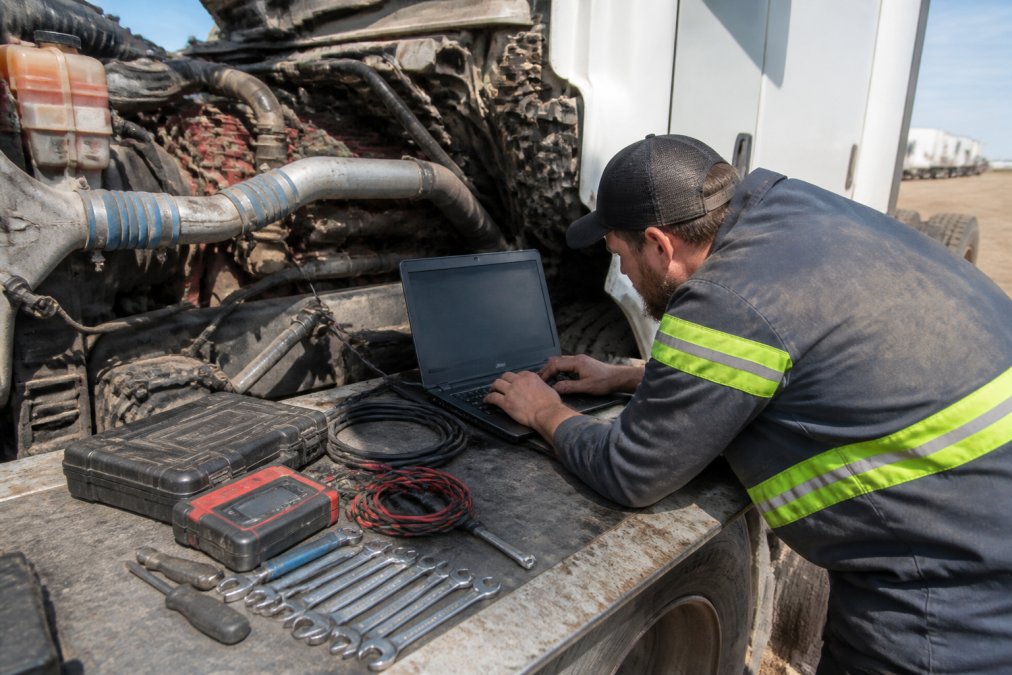
The diagnostic capabilities that matter most are fault code reading, live data monitoring, and sensor calibration. When an engine throws a code, the diagnostic scanner retrieves and translates it. A P0087 code indicates fuel pressure too low, a problem that could stem from a failing fuel pump, a clogged filter, or a bad pressure sensor. A technician with proper diagnostics can monitor fuel pressure in real time and fix it correctly.
Electrical troubleshooting is critical. Modern semi-trucks have dozens of sensors feeding data to the engine control module. A single bad sensor can disable the truck. A mobile diesel mechanic with electrical diagnostic tools can trace wiring faults, test voltage and resistance, and identify whether a sensor is failing or if the wiring harness is damaged.
Aftertreatment system diagnostics are increasingly common. Diesel particulate filters (DPF) and selective catalytic reduction (SCR) systems frequently require service. A mobile diesel mechanic trained on modern emissions systems can diagnose regeneration failures, sensor faults, and fluid level issues without guessing. Professional-grade diagnostic scanners cost between $3,000 and $10,000 and connect via OBD-II port to pull real-time engine data (sae.org).
Fault Code Reading and Sensor Diagnostics
Fault code reading is the foundation of diesel diagnostics. When an engine control module detects a problem, it stores a code. A P-code indicates engine, transmission, or emissions issues. A U-code indicates network communication problems. A mobile diesel mechanic reads these codes and understands what they mean. A P0100 code means mass airflow sensor circuit malfunction. A P0400 means exhaust gas recirculation flow malfunction. Once a fault code is identified, the technician tests the sensor itself. A faulty mass airflow sensor might show a resistance reading of 6 ohms when it should be 2-7 ohms (peer-reviewed research). These tests take minutes with proper equipment and reveal exactly what needs replacement.
Electrical Troubleshooting and Aftertreatment System Diagnostics
Electrical faults are among the most difficult roadside problems because symptoms are often vague. A mobile diesel mechanic approaches electrical problems systematically: testing battery voltage, checking alternator output, tracing wiring for shorts and opens, and testing individual components.
Aftertreatment system diagnostics require knowledge of emissions equipment. A DPF regeneration failure might be caused by a stuck regeneration valve, a faulty pressure sensor, or a clogged filter. An SCR system fault might indicate a urea quality sensor failure or a heater malfunction. Proper diagnostics identify the root cause rather than leading to expensive parts replacement without solving the problem.
Heavy Duty Mobile Diesel Repair Cost: What Affects Your Bill
Cost is a legitimate concern. Many owner-operators worry that mobile service will cost more than traditional shop rates. A mobile diesel mechanic typically charges for service call, labor, and parts. What changes is the total cost when you factor in avoided towing and reduced downtime.
Service call costs vary depending on distance and time of day. Labor rates for mobile diesel mechanics are comparable to shop rates, typically ranging based on complexity and experience. Parts are sourced competitively, and honest shops mark up parts fairly rather than using them as profit centers.
The real cost advantage of mobile service emerges when you calculate avoided expenses. A tow truck costs $800-$1,500 (fmcsa.dot.gov). Shop wait time costs you a day of revenue, potentially $1,000-$2,000 depending on your haul rate. For fleet managers running preventive maintenance, mobile service costs less because technicians work at your yard on your schedule, not during shop hours.
Preventative Maintenance Checklists for Fleet Downtime Reduction
Preventative maintenance is the most cost-effective strategy for reducing downtime. A mobile diesel mechanic can perform scheduled maintenance at your yard or terminal, keeping trucks in service while preventing failures that would otherwise strand you on the road.
A basic preventative maintenance checklist includes:
- Oil and filter change (every 15,000-25,000 miles)
- Coolant system inspection and flush (every 100,000 miles or per manufacturer schedule)
- Air filter replacement (every 50,000-100,000 miles or when restriction is detected)
- Fuel filter replacement (every 15,000-25,000 miles or when water is present)
- Battery load test and terminal cleaning (annually)
- Brake fluid inspection and bleeding (annually or when air enters the system)
- Transmission fluid check and top-up (every 50,000 miles)
- Differential fluid inspection (every 50,000 miles)
- Belt and hose inspection (every 50,000 miles; replace if cracking or swelling is visible)
- Electrical system check: alternator output, starter draw, battery voltage (annually)
The frequency depends on truck age, mileage, and duty cycle. A mobile diesel mechanic tailors the schedule to your operation. Preventative maintenance eliminates the emergency call.
Safety Protocols for On-Site Roadside Repairs
Working on the side of a highway is inherently dangerous. A mobile diesel mechanic must follow strict safety protocols to protect themselves, the truck owner, and passing traffic.
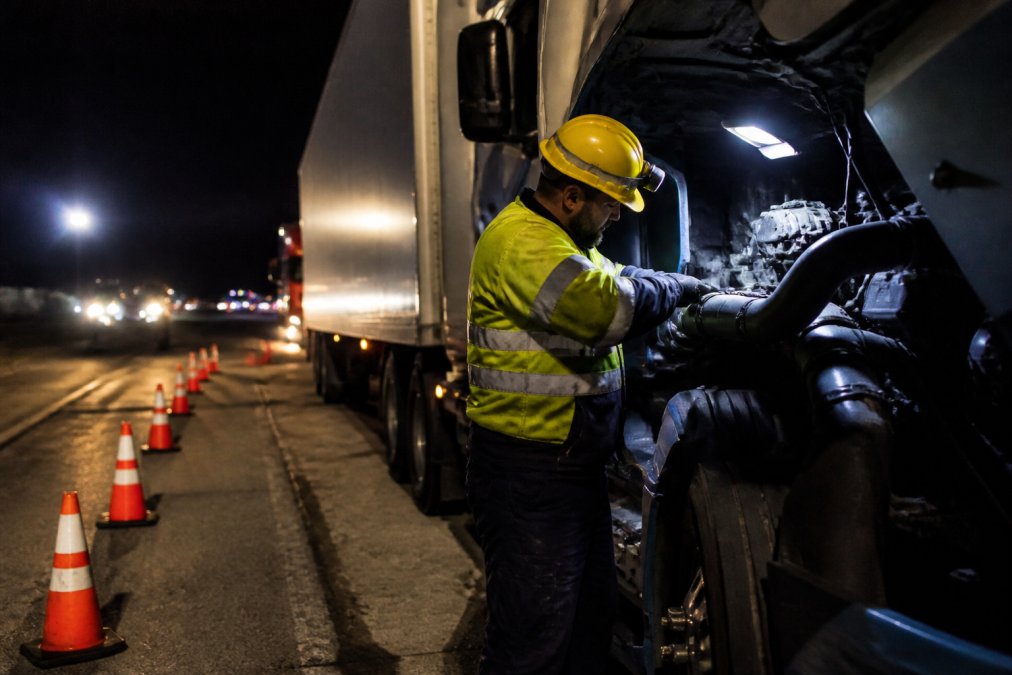
The first safety protocol is scene setup. Before any work begins, hazard flashers are activated, emergency triangles or cones are placed at least 100 feet behind the disabled truck, and high-visibility vests are worn by all personnel.
Equipment safety is critical. Diesel engines operate at high temperatures and pressures. A technician working on fuel systems, cooling systems, or pressurized components must relieve pressure before opening any lines. Personal protective equipment (PPE) is non-negotiable: safety glasses, heavy-duty gloves, and steel-toed boots. For nighttime work, LED work lights are essential.
Lifting and support protocols prevent catastrophic failures. A truck is never worked on with only a jack. Safety stands rated for the truck’s weight must be positioned under the frame, and chocks are placed under wheels to prevent rolling. Electrical safety is critical when diagnosing or repairing systems. The battery is disconnected before major electrical work, and grounding straps are used when working near sensitive electronics to prevent static discharge damage. A mobile diesel mechanic trained in roadside safety follows these protocols every time, regardless of weather, time of day, or pressure to work fast.
Mobile Diesel Mechanic vs. Towing to a Shop: The Real Difference
The choice between mobile repair and towing to a shop depends on the problem and your situation.
Mobile repair wins when the problem is straightforward and can be fixed on-site. A fuel filter replacement, a sensor swap, an alternator replacement, or brake bleeding all take 30 minutes to two hours. A mobile diesel mechanic completes these while you wait, and you’re back on the road the same day. Mobile repair also wins when the breakdown happens in a remote location. If you’re stranded on I-80 between towns, a mobile mechanic is more practical than waiting for a tow truck to arrive, then waiting in a shop queue.
Towing to a shop makes sense when the problem requires equipment or expertise not available roadside. An engine overhaul, a transmission rebuild, or a frame repair requires a shop facility. If diagnostics reveal a major problem, the mobile mechanic will coordinate towing and ensure the shop receives accurate diagnostic information.
The cost comparison is instructive. A tow truck costs $800-$1,500. A shop visit costs $150-$200 per hour for labor, plus parts and markup. If the repair takes three hours, the shop bill is $450-$600 in labor alone, plus parts. Add towing, and the total cost is $1,500-$2,500 for what a mobile mechanic could have fixed. For an owner-operator, days without revenue are devastating. A mobile diesel mechanic is the practical choice for most roadside failures.
Conclusion
A mobile diesel mechanic for semi trucks bridges the gap between roadside breakdown and expensive towing. When your semi breaks down on I-80 or I-29, you need expertise, equipment, and speed. Mudhollow Diesel Mechanics provides all three, with fully equipped service trucks, modern diagnostic software, and technicians trained in heavy-duty diesel systems.
We specialize in rapid roadside repairs, preventive maintenance at your yard, and honest diagnostics that keep your truck operating and your business moving. Whether you’re an owner-operator stranded on the highway, a fleet manager seeking preventive maintenance, or an RV owner needing emergency support, we’re equipped to handle it.
Call or text now at 712-827-0207 to reach Mudhollow Diesel Mechanics. We operate 24/7 across western Iowa, with response times measured in hours, not days. Get your truck back on the road fast.
| Service Type | Typical Timeframe | Best For |
|---|---|---|
| Roadside diagnostics | 30-60 minutes | Identifying fault codes and sensor issues |
| Fuel system repair | 1-2 hours | Injector replacement, filter changes |
| Electrical troubleshooting | 1-3 hours | Sensor faults, wiring issues, alternator problems |
| Brake service | 1-2 hours | Air brake bleeding, pad replacement, sensor diagnostics |
| Preventive maintenance | 2-4 hours | Scheduled oil changes, filter replacement, inspections |
| Complex diagnostics | 2-4 hours | Aftertreatment system issues, transmission faults |
Frequently Asked Questions
What is the typical response time for a mobile diesel mechanic when I break down on I-80?
Response time depends on your exact location and current call volume, but mobile diesel mechanics prioritize emergency roadside calls to minimize your downtime. Call or text immediately when you break down so dispatch can route the nearest unit to you. Having your truck’s location, symptoms, and any fault codes ready speeds up the process.
Can a mobile diesel mechanic handle complex electrical and sensor diagnostics on modern semi trucks?
Yes. Modern mobile service trucks carry diagnostic software and fault code readers capable of handling electrical troubleshooting, sensor calibration, and aftertreatment system diagnostics. If your truck displays check-engine lights or electrical gremlins that even dealerships struggled to diagnose, a fully equipped mobile technician can often identify the root cause on-site. However, if parts must be ordered, you may need to wait for delivery or arrange towing to a shop with inventory.
Is mobile diesel repair actually cheaper than towing to a shop, or does the labor rate offset the savings?
Mobile repair eliminates tow truck costs, which can run $500-$2,000 depending on distance. You also avoid shop wait times that rack up lost revenue for owner-operators and fleets. The labor rate depends on the repair complexity and your service provider, so compare quotes directly. For roadside fixes, fuel system repairs, air brake adjustments, injector replacement, mobile service often pencils out faster and cheaper than a round-trip tow. Contact your provider for a quote based on your specific issue.
Can a mobile diesel mechanic handle preventative maintenance for my fleet at my yard or terminal?
Yes. Beyond emergency roadside assistance, mobile mechanics offer scheduled preventative maintenance at your facility to minimize downtime. Regular air brake system inspections, cooling system flushes, transmission checks, and DPF cleaning can be done on-site. This approach works well for small fleets and owner-operators who want to avoid dealership wait times and high shop rates. Schedule maintenance during off-hours or between runs to keep your vehicles operational.
[EXTERNAL_LINK: American Trucking Associations safety standards for commercial vehicles | trucking.org]
[EXTERNAL_LINK: EPA regulations on diesel engine emissions and aftertreatment systems | epa.gov]
[EXTERNAL_LINK: National Highway Traffic Safety Administration guidelines for roadside repair procedures | nhtsa.gov]
This article was written using GrandRanker