

Table of Contents
- Understanding Preventative Maintenance Requirements for Commercial Truck Warranties
- Truck Warranty Service Intervals: What Your Contract Actually Requires
- Does Truck Warranty Cover Routine Maintenance?
- Building a Commercial Truck Preventive Maintenance Checklist
- Commercial Truck Warranty Maintenance Records: Documentation That Protects Your Coverage
- Common Maintenance Gaps That Void Warranty Coverage
- Preventative Maintenance as a Warranty Protection Strategy
- Frequently Asked Questions
Last Updated: October 9, 2026
Understanding Preventative Maintenance Requirements for Commercial Truck Warranties
Preventative maintenance for commercial truck warranties isn’t optional, it’s the foundation of keeping your coverage intact.
At Mudhollow Diesel Mechanics, we’ve worked with fleets across western Iowa who discovered too late that missed maintenance windows cost them coverage on critical failures.
The preventative maintenance commercial truck warranty requires isn’t busywork. It’s a contract obligation that directly affects your claim outcomes.
OEM Warranty vs. Aftermarket Coverage
OEM warranties, issued by the truck manufacturer, typically have stricter preventative maintenance commercial truck warranty requirements because the manufacturer built the truck and knows exactly how it should be serviced.
Aftermarket warranties, sold by third-party providers, often have more flexible maintenance language, but don’t mistake flexibility for leniency.
Many owner-operators assume aftermarket coverage is easier to maintain. It’s not. Aftermarket providers scrutinize maintenance records more closely because they lack the manufacturer’s direct service network.
How Warranty Language Defines Maintenance Obligations
Your warranty contract contains specific language defining what “preventative maintenance” means for your coverage, and this is where most disputes begin.
Read the fine print. Some warranties list excluded maintenance tasks explicitly, tire rotations, brake pad replacements, or routine wear items.
The contract also specifies who can perform maintenance. Some OEM warranties require dealership service. Others accept any certified diesel technician.
Truck Warranty Service Intervals: What Your Contract Actually Requires
Service intervals define when maintenance must occur, usually in miles, hours, or calendar days, whichever comes first.
Intervals vary by truck model, engine type, and duty cycle. A truck used for heavy-haul agricultural work operates under different stress than one running light loads on flat terrain.
Reading the Fine Print: Manufacturer-Specified Intervals
Manufacturer-specified intervals appear in your warranty document, your truck’s service manual, and often on a placard inside the driver’s door. These are engineering requirements, not suggestions.
The warranty company will request service records showing completion of these intervals.
Document the exact mileage or hours when service is performed. “Oil change performed in March” is not sufficient.
Consequences of Missed Maintenance Windows
Missed maintenance windows have real consequences. The most obvious is claim denial.
Repeated missed maintenance can trigger warranty cancellation.
There’s also the operational cost. Missed maintenance accelerates wear. That skipped oil change shortens engine life, increases fuel consumption, and makes catastrophic failures more likely.
For fleets running multiple trucks, missed maintenance on one vehicle can affect your entire operation.
Does Truck Warranty Cover Routine Maintenance?
No. Commercial truck warranties do not cover routine maintenance. This is the most misunderstood aspect of truck warranty coverage. Owners often assume their warranty includes oil changes, fluid replacements, and filter service. It doesn’t.
Your warranty covers defects in materials and workmanship. It does not cover wear items, consumables, or maintenance tasks required to keep the truck operating normally.
What Routine Tasks Are Excluded
Tire service is excluded. Some warranties exclude brake pad replacement, treating it as a wear item rather than a defect.
Fluids are excluded unless a defect caused the fluid to degrade or leak.
The exclusion list is lengthy because routine maintenance is your responsibility as the truck owner.
What Defects Warranty Actually Covers
Warranty coverage applies to defects in materials and workmanship. A turbocharger that fails due to a manufacturing defect in the bearing is covered.
Warranty coverage also depends on whether you maintained the truck according to contract terms.
Powertrain coverage is the broadest warranty category for commercial trucks. It typically covers the engine, transmission, transfer case, differentials, and associated components.
Building a Commercial Truck Preventive Maintenance Checklist
A preventive maintenance checklist is your operational roadmap and your warranty protection document combined. It ensures nothing gets missed and creates the documentation record that protects your coverage.
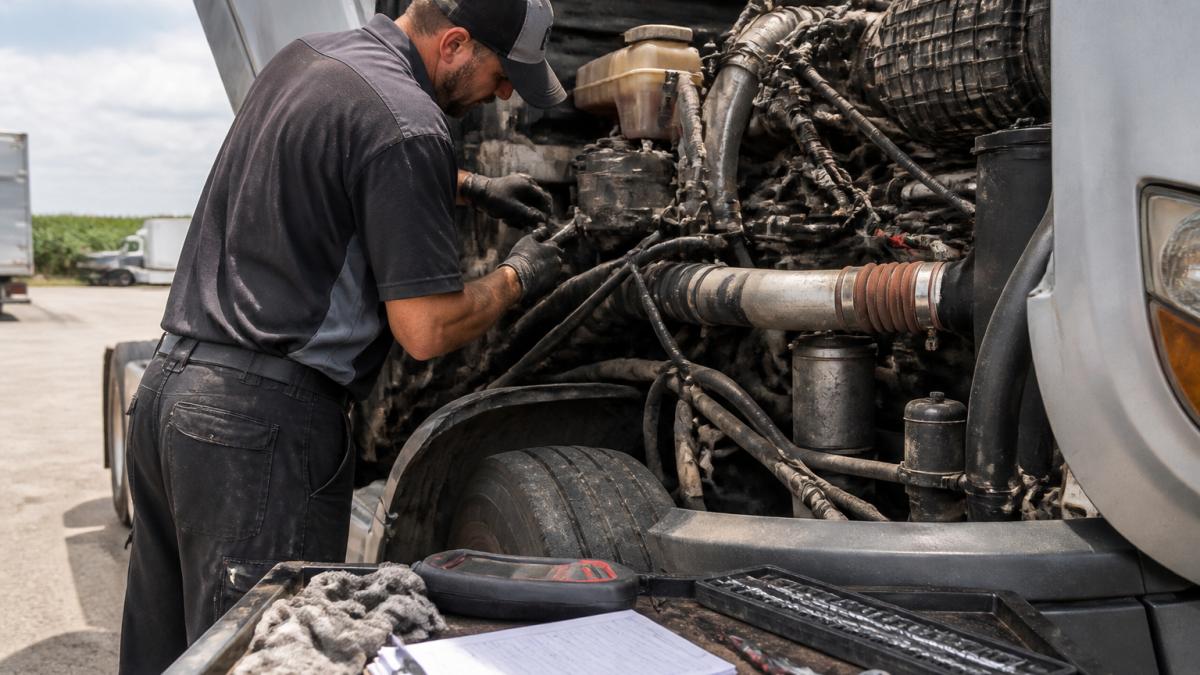
Pre-Trip Inspection Tasks
Pre-trip inspections are the first line of defense against failures, quick visual and functional checks performed before every trip that catch emerging problems before they become roadside emergencies.
Document pre-trip inspections in a log. Record the date, mileage, and any issues found. This log becomes crucial evidence if a warranty claim arises.
Many fleets use a pre-trip inspection form with checkboxes. The driver completes the form before departure, noting any issues.
Scheduled Service Intervals by Component
Engine and filter service occurs at intervals specified in your warranty.
Transmission service varies by transmission type. Some require fluid changes at specified intervals.
Electrical system checks include battery condition, alternator output, and starter function.
Suspension and steering inspection looks for worn bushings, loose bolts, and steering play.
Fleet-Wide Maintenance Tracking
For fleets with multiple trucks, centralized maintenance tracking prevents gaps and ensures compliance across all vehicles.
The tracking system should flag upcoming service intervals automatically.
Centralized tracking also identifies patterns. If one truck requires frequent repairs, the data shows it.
Most importantly, centralized tracking creates a comprehensive maintenance record.
Commercial Truck Warranty Maintenance Records: Documentation That Protects Your Coverage
Maintenance records are not optional, they’re your warranty protection. Without records, you cannot prove you maintained the truck. Without proof, the warranty company can deny any claim, regardless of the actual defect.
Records must be specific, dated, and traceable. “Oil changed” is not a record.
What Records Warranty Companies Require
Records must show the VIN (Vehicle Identification Number) of the truck.
CALL or TEXT NOW:712-827-0207 →
Receipts from the shop performing service are ideal. Receipts show what was purchased, what was installed, and the date of service.
Digital records are acceptable. Many fleet management systems capture service data electronically. The key requirement is that records must be retrievable and verifiable.
How to Document Service on the Road and at the Yard
Create a service log for each truck.
For roadside service, photograph the truck’s odometer before and after service. This documents mileage at service.
Keep receipts for all parts purchased.
Store records digitally and in hard copy. Scan receipts and work logs into a cloud-based system.
Dispute Prevention Through Proper Recordkeeping
Proper recordkeeping prevents disputes before they start. A warranty company reviewing comprehensive maintenance records is unlikely to deny a claim.
Conversely, incomplete or missing records invite scrutiny.
The most common dispute is over service intervals.
Detailed records also protect you if a warranty company wrongly denies a claim.
Common Maintenance Gaps That Void Warranty Coverage
Certain maintenance mistakes appear repeatedly in warranty disputes. Understanding these gaps helps you avoid them.
Delayed Service and Claim Denials
Delayed service is the most common maintenance gap. A service interval passes, and the truck continues operating.
Delayed service happens because of operational pressure. The truck is generating revenue, and taking it out of service for maintenance costs money.
The solution is strict adherence to intervals, even if it costs operational time.
Unauthorized Repairs and Parts Substitution
Using unauthorized parts or having repairs performed by uncertified technicians can void coverage. Your warranty contract specifies which parts are acceptable and who can perform service.
Some warranties require OEM parts.
Similarly, some warranties require dealership service.
Always verify what your warranty allows before authorizing service. Ask the technician whether the parts and service method comply with your warranty terms.
Operating Conditions That Exceed Warranty Terms
Your warranty contract specifies operating conditions. If you operate the truck outside those conditions, coverage may be voided.
A warranty might specify that the truck is used for “normal commercial service” with a maximum load weight and maximum operating temperature.
Many agricultural operations exceed standard operating conditions.
Review your warranty terms carefully. If your operation exceeds the specified conditions, discuss this with your warranty provider.
Preventative Maintenance as a Warranty Protection Strategy
Preventative maintenance isn’t just a warranty requirement, it’s a business strategy that protects your operation. Proactive service prevents catastrophic failures, reduces downtime, and preserves warranty coverage.
How Proactive Service Prevents Costly Failures
A failed turbocharger at roadside costs thousands in emergency repair and lost revenue.
This is the core of preventative maintenance commercial truck warranty strategy: small, scheduled expenses prevent large, unscheduled expenses.
Proactive service also extends component life. A transmission that receives fluid service every 100,000 miles lasts 500,000 miles or more.
For fleets, proactive maintenance reduces overall operating costs.
Building a Maintenance Plan That Satisfies Warranty Terms
Start with your warranty contract. Extract every maintenance requirement.
Add to this plan based on your operating conditions.
Schedule maintenance around your operational calendar.
Assign responsibility. Who will perform service?
Document the plan and share it with everyone involved.
Preventative maintenance for commercial truck warranties is not negotiable.
Your warranty contract defines your maintenance obligations.
Frequently Asked Questions
What are the recommended preventive maintenance intervals for commercial truck warranties?
Warranty-required intervals vary by manufacturer and warranty type, but typically include various fluid checks, filter replacements, and comprehensive inspections. Your warranty contract specifies exact intervals for your vehicle. Missing a single scheduled service can trigger warranty denial on related components. Check your manufacturer’s service schedule and maintain dated records of every service, including who performed it and what was inspected or replaced.
Does commercial truck warranty cover routine maintenance?
No. Commercial truck warranties cover manufacturing defects and component failures, not routine maintenance. Various routine maintenance tasks are the owner’s responsibility. However, warranty coverage depends on proof that you performed required maintenance on schedule. If a powertrain component fails and you cannot show maintenance records, the manufacturer can deny the claim. Routine maintenance is your cost; failure to do it voids your warranty protection.
What maintenance records should I keep for a commercial truck warranty claim?
Keep original invoices, service receipts, and work orders showing the date, mileage, service provider name, parts replaced, and technician signature. Digital records with photos of odometer readings and completed work strengthen claims. Store records by vehicle VIN and service date. If a component fails, provide the warranty company with your complete service history for that truck. Handwritten logs without supporting documentation are often rejected. Fleet managers should use maintenance software that auto-generates timestamped records tied to each truck’s VIN.
Can using aftermarket parts affect my commercial truck warranty?
Using aftermarket parts does not automatically void warranty coverage. However, if an aftermarket part failure causes damage to a warranted component, the manufacturer can deny the claim on the damaged part. OEM parts carry full warranty support; aftermarket parts typically do not. The safest approach is to use OEM parts for warranty-critical systems (engine, transmission, powertrain) and document your parts choices in service records. If you choose aftermarket, ensure your warranty terms explicitly permit it and keep proof of the part’s quality and installation.
What happens if I miss a scheduled maintenance interval?
A single missed interval does not automatically void your entire warranty, but it creates a claim dispute risk. If a component fails shortly after a missed service, the manufacturer will argue the failure resulted from neglected maintenance and deny your claim. For example, missing a maintenance interval and then experiencing engine bearing failure gives the warranty company grounds to refuse coverage. The safest practice is to perform every scheduled service on time and document it. If you miss a service, catch up immediately and keep records showing when you resumed the schedule.
How do I verify what maintenance my warranty actually requires?
Locate your warranty contract (usually in your truck’s documentation packet or online through the manufacturer’s portal using your VIN). The contract lists required maintenance tasks, intervals in miles or months, and which service provider types are acceptable (OEM dealership, certified technician, or any qualified shop). Contact the manufacturer’s customer service line with your VIN to request a maintenance schedule summary. Many manufacturers provide laminated maintenance cards or digital apps. Never assume; verify in writing before performing service to avoid coverage denial.
What maintenance responsibilities apply to mixed fleets with different warranty types?
Each truck’s warranty terms are independent based on its model year, manufacturer, and coverage type. A 2024 truck under full OEM warranty and a 2020 truck under aftermarket powertrain coverage require different maintenance schedules. Document each truck’s warranty separately and assign maintenance schedules by VIN, not by fleet-wide rule. Some trucks may require quarterly inspections while others need semi-annual service. Use fleet management software that tracks warranty expiration, required intervals, and service history by individual vehicle to prevent compliance gaps.