

Table of Contents
- The Verdict: Mobile Reefer Repair Reliability in 2026
- How Mobile Reefer Diagnostic Services Work Roadside
- On-Site Reefer Repair vs Shop Repair: An Honest Comparison
- Reefer Breakdown Prevention Tips That Actually Reduce Roadside Calls
- Vetting a Mobile Reefer Technician Before You Call
- DIY Troubleshooting Before You Call for Help
- Warranty, Parts, and Follow-Up: What Happens After the Roadside Fix
- Frequently Asked Questions
Last Updated: October 3, 2026
The Verdict: Mobile Reefer Repair Reliability in 2026
Is mobile reefer unit repair reliable? For most roadside refrigeration failures on the I-80 and I-29 corridors, the answer to is mobile reefer unit repair reliable is yes.
At Mudhollow Diesel Mechanics, we have run mobile diesel calls across western Iowa for over 15 years. Reliability depends less on the concept and more on who shows up: a properly equipped mobile service resolves most roadside reefer failures on the spot, while a guy with a pickup and a guess book does not.
How Mobile Reefer Diagnostic Services Work Roadside
That live data is the whole point. A fault code tells you what the unit thinks is wrong; live readings of suction pressure, discharge temperature, supply and return air temperatures, and compressor amp draw tell you what is actually happening. The gap between those two is where most misdiagnosed reefer failures live.
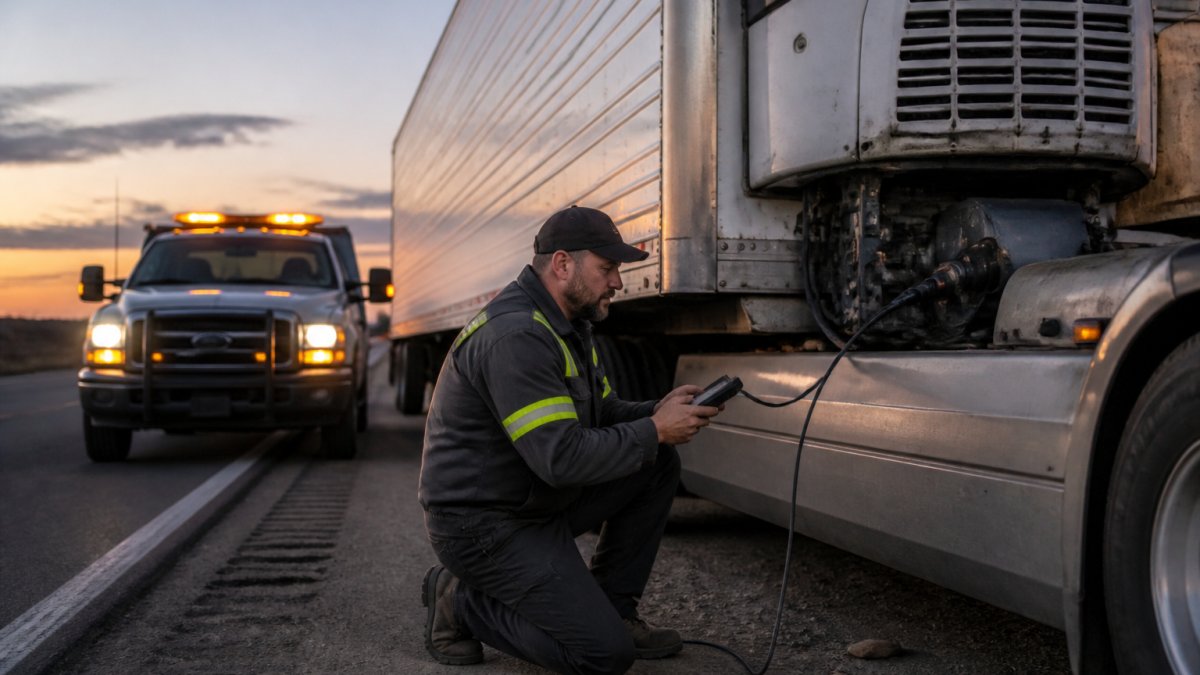
What Technicians Carry on the Truck
The other half of the equation is electrical. A large share of reefer breakdowns trace back to wiring, connectors, and control board faults that a code reader alone will not find. Thermo King’s service documentation treats electrical fault tracing as a core diagnostic skill for transport refrigeration, not an afterthought.
Matching Fault Codes to On-Site Repairs
Some codes clear and stay cleared after a genuine repair; others return because the underlying cause was never addressed. If a technician clears your codes and leaves without verifying the unit holds temperature under load, expect a repeat call.
On-Site Reefer Repair vs Shop Repair: An Honest Comparison
Here is the decision framework we use on every call.
The Three-Question Triage
Before you dial anyone, answer three questions:
Where Mobile Repair Genuinely Wins
The reason mobile wins here is not just speed, the trailer never stops being a trailer. The load stays on, the setpoint stays logged, and the customer never has to arrange a transfer or monitoring service. For high-value or temperature-sensitive freight, that continuity is worth more than the repair itself.
Where a Shop Is the Right Call
A good mobile technician will tell you this on the phone, before dispatching, if you describe the symptom accurately. If a mobile tech takes a job that clearly needs a shop, you are paying for a diagnosis a shop’s service writer would have given you for free.
The Hidden Cost Nobody Talks About
The honest trade-off: mobile is faster to first diagnosis and to a fix on component-level failures; a shop is faster to a fix on system-level failures once you are in the bay. The mistake is assuming either is always right.
Reefer Breakdown Prevention Tips That Actually Reduce Roadside Calls
Scheduled dry-land servicing at your yard is a cost-effective way to prevent breakdowns. We come to your terminal, run the checks on your schedule, and catch problems before they become roadside emergencies.
CALL or TEXT NOW:712-827-0207 →
Vetting a Mobile Reefer Technician Before You Call
Vetting a mobile reefer technician is not about trust, it is about verification. The questions below separate a technician who can actually fix your unit from one who will clear a code and send you down the road with the real fault still present. Ask them while parked safely, before anyone is dispatched.
The Vetting Checklist, With What a Good Answer Sounds Like
- “Are you insured, and can you provide a certificate of insurance?”
Commercial auto liability and general liability coverage are standard for legitimate mobile operations. A tech who cannot produce a COI on request is a risk you do not need to take on a loaded trailer.
Red Flags That Should End the Call
- No brand-specific diagnostic tooling, or refusal to name the platform
- No EPA Section 608 certification, or inability to state the certification type
- No written warranty offered before work begins
- Pressure to authorize work before a diagnosis is complete
- No physical business address or verifiable business identity
- A quote that is dramatically lower than every other mobile tech you have called, it usually means a parts-only fix with no diagnostic time built in
Why This Matters More for Reefer Than for General Roadside
EPA Section 608 certification requirements is worth reviewing so you know what to ask for. FMCSA roadside inspection guidance is worth reviewing so you understand what a roadside stop involves before you add a repair to it.
DIY Troubleshooting Before You Call for Help
One more thing: write down the code and the conditions when it appeared. That single detail cuts diagnostic time on-site and gets you back on the road faster.
Warranty, Parts, and Follow-Up: What Happens After the Roadside Fix
Follow-up matters more than most drivers expect. A repair that holds a week then fails usually points to misdiagnosis, not a bad part. A technician who stands behind the work will come back and make it right, the real test of whether mobile reefer repair is reliable for your operation.
Frequently Asked Questions
Is mobile reefer repair as effective as in-shop service?
For most roadside failures, yes. Mobile reefer repair handles the same diagnostics and common repairs a shop performs: fault code scans, belt and compressor checks, electrical troubleshooting, and refrigerant leak diagnosis. The difference is location, not capability. Repairs needing a lift, a full machine shop, or major component replacement usually go to a shop. For compressor failure, temperature fluctuations, and electrical issues caught early, on-site work resolves the problem without a tow.
What diagnostic tools do mobile reefer technicians carry?
Well-equipped mobile reefer diagnostic services bring laptop-based scan tools for major unit brands, multimeters, manifold gauge sets, leak detectors, and replacement parts like belts, filters, and sensors. That covers fault code analysis, electrical issues, cooling performance checks, and most regassing work. Ask what scan platforms a technician uses before booking. A truck with computer diagnostics and brand-specific software handles complex failures far better than a basic toolbox setup.
How can I verify the reliability of a mobile diesel mechanic?
Ask four questions: how many years the technicians have worked on transport refrigeration units, what scan tools they carry, whether parts are stocked on the truck, and what warranty covers the repair. A provider with 15+ years of experience and documented warranty terms is a safer bet than one who cannot describe their diagnostic process. Also confirm the service radius. A technician who regularly works your stretch of highway knows the common failure patterns on that route.
What are the most common causes of reefer unit failure on the road?
The repeat offenders are compressor failure, refrigerant leaks, electrical issues, worn belts, and clogged filters. Temperature fluctuations often trace back to low refrigerant or restricted air flow rather than a dead unit. Fault codes usually point to the specific circuit or sensor at fault. Regular belt inspection, service interval checks, and unit calibration during preventative maintenance catch most of these before they strand a loaded trailer.
Does mobile repair void my reefer unit’s manufacturer warranty?
Not automatically. Warranty coverage depends on whether the repair meets the manufacturer’s standards and whether quality parts are used. Ask the technician to document the work, parts numbers, and diagnostic readings. Reputable mobile providers supply that paperwork, which protects your claim if a covered component fails later. If your unit is still under a manufacturer plan, confirm the terms before authorizing any repair, on-site or in a shop.
Reefer breakdowns do not wait for business hours, and neither should your repair options. If you are sitting on the shoulder of I-80 or I-29 with a unit that will not hold temperature, Mudhollow Diesel Mechanics brings fully equipped mobile service, modern computer diagnostics, and 15-plus years of reefer and diesel experience directly to your trailer. Most of our customers avoid a tow entirely. Call or text 712-827-0207 and get your load moving again.