Table of Contents
- Emergency Diesel Repair vs Towing: The Quick Comparison
- Common Roadside Semi Truck Failures You’ll Face
- Heavy Duty Truck Mobile Diagnostics: What a Service Truck Can Find On-Site
- Emergency Roadside Repair vs Towing Cost Analysis
- Repair vs Tow: A Decision Matrix for Drivers
- Preventative Maintenance vs Emergency Breakdowns
- What Sets Mobile Repair Apart From Waiting on a Tow
- Frequently Asked Questions
Last Updated: September 17, 2026
Emergency Diesel Repair vs Towing: The Quick Comparison
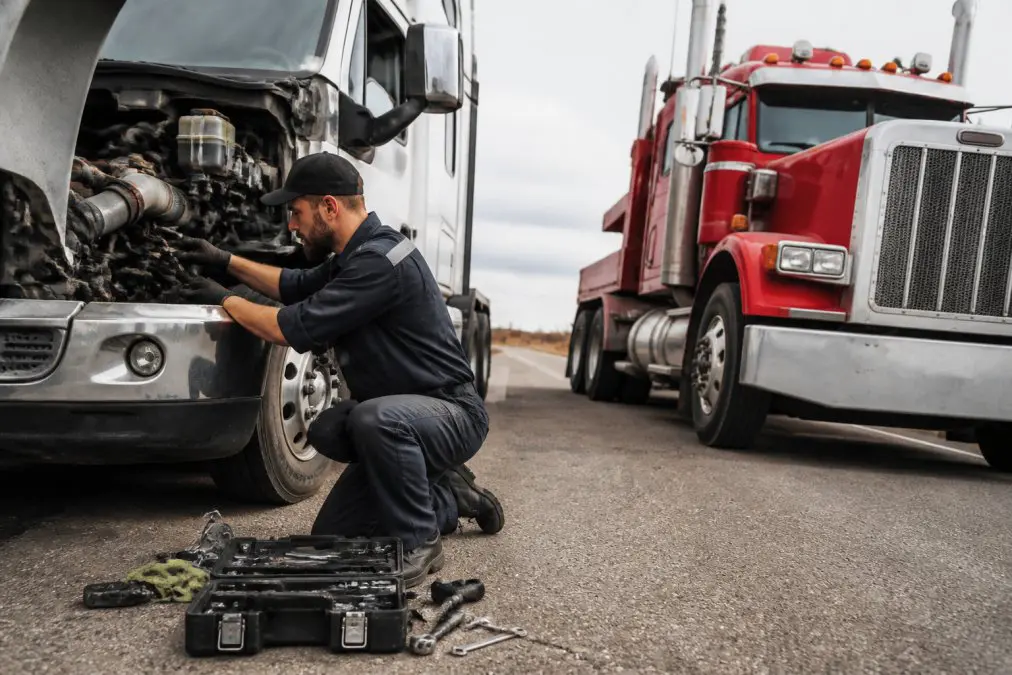
Emergency diesel repair vs towing comes down to one question: can the problem be fixed where the truck sits? If yes, on-site repair almost always wins. It skips the tow bill, the shop queue, and the days of lost revenue that follow. At Mudhollow Diesel Mechanics, our mobile units handle most roadside failures on the shoulder, at a rest stop, or in a yard, so the truck never leaves your control.
Emergency diesel repair is on-site mechanical service performed by a mobile technician at the breakdown location. Towing moves the vehicle to a shop, where it waits for a bay, a diagnosis, and a repair slot.
The difference matters most when the clock is running. A tow adds a step; a repair removes one.
| Factor | Emergency Diesel Repair | Towing to a Shop |
|---|---|---|
| Where work happens | Your location | Fixed shop bay |
| Tow cost | None | Added to the bill |
| Typical wait | Dispatch to arrival | Tow plus shop queue |
| Best for | Fixable roadside faults | Major structural or drivetrain failure |
| Vehicle control | Stays with you | Released to the tow operator |
Match the response to the failure. If a mobile technician can complete the repair on site, towing only adds cost and delay.
Common Roadside Semi Truck Failures You’ll Face
Most breakdowns trace back to a short list of repeat offenders. Knowing them helps you describe the problem clearly when you call for help.
- Cooling system failures. Radiator leaks, burst hoses, and failed water pumps are the classic roadside kill. A truck that overheats and keeps running turns a hose replacement into an engine rebuild.
- Turbocharger problems. Loss of boost, excessive smoke, or a whining turbo usually means the truck will not pull a load. Some turbo faults are repairable on site; others need parts ordered.
- Fuel and air restrictions. Clogged filters, gelled fuel in cold snaps, and air leaks cause hard starts and power loss. These are often quick fixes with the right parts on the service truck.
- Electrical gremlins. Faulty sensors, chafed wiring, and failing alternators trigger fault codes that confuse drivers and shops alike. This is where mobile diagnostics earns its keep.
- Brake and air system faults. Air leaks and stuck brake chambers are safety-critical. A mobile tech can often isolate the leak and restore air pressure on the spot.
A common mistake is guessing at the cause over the phone. The more precisely you describe the symptom, the faster the right technician arrives with the right parts.
Heavy Duty Truck Mobile Diagnostics: What a Service Truck Can Find On-Site
Modern mobile diagnostics do most of the detective work before a wrench comes out. A well-equipped service truck carries computer diagnostic tools that read fault codes, live data, and sensor behavior directly from the engine and aftertreatment systems.
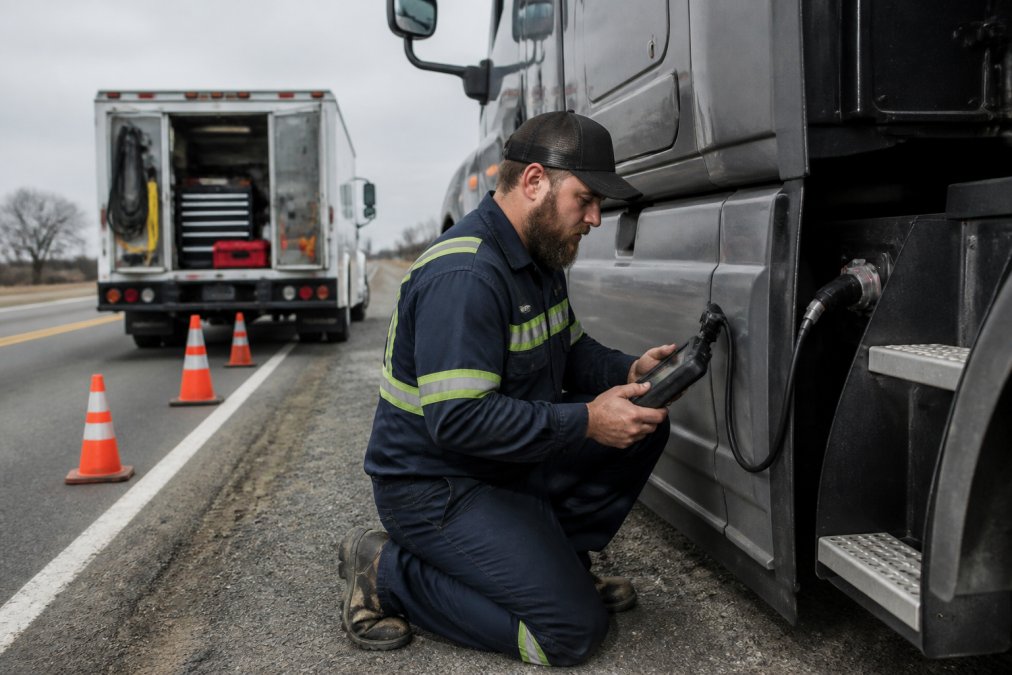
That matters for the breakdowns that stump everyone.
When you call, have your fault codes and the exact symptom ready. A technician who knows the code before arrival can load the right parts and cut the diagnostic time on site.
Emergency Roadside Repair vs Towing Cost Analysis
The cost question is simpler than it looks, because towing stacks charges while on-site repair collapses them into one visit. Most guides stop at “towing is expensive.” The useful version explains how each path accumulates cost, so you can estimate your own exposure before you call anyone.
How a tow bill actually accumulates
Heavy-duty towing is not a flat fee. It is a stack of line items that grow with distance, weight, and difficulty:
- Hook-up or recovery fee, a base charge just to attach and lift.
- Per-mile rate, billed from the tow origin, and long hauls multiply fast.
- Heavy-duty surcharge, loaded tractors and trailers sit in a higher weight class than a pickup.
- Winch or off-road recovery, added when the truck is stuck, in a ditch, or off the shoulder.
- Storage, daily charges once the truck lands at the yard and waits.
- Second tow or deadhead, moving the truck again if the first shop cannot take the job.
How an on-site repair accumulates cost
A mobile service call replaces the stack with a single dispatch. The technician arrives, diagnoses, and repairs in the same visit, so the cost structure is one call plus the parts and labor the job actually needs. There is no hook-up fee, no per-mile charge, and no storage clock running while the truck sits.
The line item that usually decides it
The largest cost in a breakdown is rarely the repair itself, it is the downtime. A truck in a tow queue or a shop bay is not earning, and that lost revenue typically dwarfs the difference between a mobile call and a shop invoice. For a fleet, the downtime line is the one to model first.
A practical way to frame the decision
Ask three questions in order:
- Can the fault be repaired where the truck sits? If yes, the tow line items disappear entirely.
- How far is the nearest capable shop? Distance drives the per-mile and deadhead charges.
- How long will the truck be down? Compare hours on site against days in a queue.
Exact figures vary by failure, parts, and distance, so no honest guide can quote a single number. The structural advantage does not vary: on-site repair removes the tow stack and the shop queue, and it keeps the truck in service instead of in line.
Towing adds cost in layers, hook-up, mileage, surcharge, storage, and downtime. On-site repair replaces that stack with one dispatch and keeps the truck earning.
Repair vs Tow: A Decision Matrix for Drivers
Use this matrix to decide fast when you are stranded. The right column explains why each call goes the way it does, because the reasoning is what lets you apply the matrix to a fault that is not listed.
| Situation | Recommended Action | Why |
|---|---|---|
| Overheating, coolant leak, or burst hose | Call for mobile repair | Cooling faults are usually repairable on site and get worse if driven |
| Turbo fault with loss of power | Call for mobile diagnostics | Some turbo faults are fixable on site; diagnostics confirm which |
| Electrical fault, warning lights, derate | Call for mobile diagnostics | Live data at the point of failure often reveals what a shop cannot reproduce |
| Major collision or structural damage | Towing and recovery | The vehicle cannot be made safe to work on |
| Blown engine or transmission failure | Towing to a shop | The repair exceeds what a service truck can complete on the shoulder |
| Air brake system failure | Mobile repair if isolatable; tow if not | Safety-critical, restore air pressure on site only if the leak can be isolated |
The three-question test
When the fault is not on the list, run it through three questions:
- Is the fault mechanical, electrical, or cooling-related? These are the categories mobile technicians resolve on site most often.
- Can the truck be made safe where it sits? If it is in a travel lane or cannot be secured, towing comes first regardless of the fault.
- Does the repair fit on a service truck? A hose, a sensor, a turbo, or a diagnostic fault usually does. A cracked block or a failed transmission does not.
The mistake that turns a repair into a tow
The most common error is driving a fault to reach a shop. A failed hose becomes a warped head; a derate becomes a full shutdown. Every mile driven on a known fault narrows the set of problems a mobile technician can fix on site.
Never keep driving on an overheating engine to reach a shop. A failed hose becomes a warped head, and a repair that fit on a service call turns into a tow plus an engine job.
Preventative Maintenance vs Emergency Breakdowns
A practical schedule to work from:
The gap between a scheduled service and a roadside emergency is usually one neglected item. Close it on your terms.
What Sets Mobile Repair Apart From Waiting on a Tow
The decision comes down to control. Towing hands your truck, your schedule, and your revenue to a queue you cannot see. On-site repair keeps all three with you.
Frequently Asked Questions
Is mobile diesel repair faster than waiting for a tow?
In most cases, yes. A mobile mechanic arrives with tools and diagnostics on the truck, so repairs start as soon as they reach you. Towing adds a second step: hauling your rig to a shop that may have a backlog. Many roadside issues, such as a faulty sensor, clogged filter, or minor electrical fault, get fixed on the spot in less time than a tow plus shop wait combined.
When is a tow truck absolutely necessary for a semi-truck?
A tow is unavoidable when the failure is structural or requires a lift, such as a seized engine, broken frame, or major transmission damage. If the truck cannot be made safe to move under its own power, or the repair needs parts and equipment that cannot travel, towing to a shop is the only option. A mobile technician can confirm this after an on-site diagnosis.
Can most roadside diesel issues be fixed on-site?
A significant share of breakdowns, including many common roadside semi truck failures like fuel delivery problems, sensor faults, and cooling system leaks, can be resolved on-site with the right mobile equipment. The key is accurate diagnosis first. A mobile scan identifies whether the fix is simple enough for the shoulder or whether recovery is the safer call.
What are the hidden costs of towing a heavy-duty vehicle?
Towing a semi-truck often involves more than the hook fee. Expect charges for mileage, heavy-duty equipment, after-hours dispatch, and possibly a second tow if the first shop cannot handle the repair. Add lost revenue from downtime and the risk of shop backlog. An emergency roadside repair vs towing cost analysis should factor in all these variables, not just the sticker price.
When a truck goes down, the fastest path back to the road is usually the one that never leaves it. Mudhollow Diesel Mechanics brings experienced technicians, computer diagnostics, and heavy-duty tools directly to your breakdown, so you skip the tow bill and the shop wait. Call or text 712-827-0207 to get a mobile unit dispatched, or schedule preventative servicing at your yard to keep the next breakdown from happening at all.