
Table of Contents
- The Verdict: Repair vs. Replace for Older RV AC Units
- When Repair Makes Sense
- When Replacement Wins
- RV AC Repair vs. Replacement Cost: A Real-World Breakdown
- Common Signs Your Older RV AC Needs Attention
- Parts Availability for Legacy RV AC Models
- Mobile RV Repair Benefits: Why On-Site Service Changes the Math
- Insurance and Warranty Implications for Older Units
- Mobile Technician Vetting Checklist
- Frequently Asked Questions
Last Updated: September 16, 2026
The Verdict: Repair vs. Replace for Older RV AC Units
Is mobile RV AC repair worth it for older models? On-site repair preserves the original system, avoids installation overhead, and gets you cooling again without a tow. This guide from Mudhollow Diesel Mechanics breaks down the decision the way we approach it on the roadside.
The math has shifted: replacement units cost more than they did a decade ago, and mobile technicians now carry diagnostic tools that once lived only in shops.
Below, we’ll show you how to evaluate your own unit, including the parts-availability problems that sink most older-model repairs.
Age alone doesn’t decide repair vs. replace. Compressor condition, refrigerant circuit integrity, and parts availability decide it.
The Three-Question Test
Before you authorize anything, run your unit through three questions in order. The first two are mechanical; the third is logistical, and it quietly ends most older-model repairs.
- Does the compressor start and draw normal amperage? A compressor that starts and pulls within its nameplate rating is repairable. One that trips the breaker, hums without starting, or draws well above spec is usually failed, and that changes the entire calculation.
- Does the refrigerant circuit hold pressure? A sealed system that still holds its charge has no leak. A system that has lost refrigerant has a leak somewhere in the circuit, and repairing that leak is a different job than swapping a capacitor.
- Does the failed part still exist for your model year? This is the question owners skip. A unit from a brand that still supports legacy hardware is a far better repair candidate than an orphaned model, even when both show identical symptoms.
If all three answers come back favorable, repair is almost always the better path.
How Unit Age Actually Factors In
Age matters, but not the way most owners assume. A 12-year-old unit with a healthy compressor and a supported parts chain is a better repair candidate than a 7-year-old unit with a failed compressor and a discontinued control board. Age is a proxy for wear, not a verdict.
The Parts-Availability Wildcard
Two identical-looking failures can have completely different outcomes depending on whether your model year still has a supported parts chain.
Ask your technician to check compressor amperage draw and confirm parts availability for your model year before quoting anything else. Those two data points change the entire repair-vs-replace calculation, regardless of what the thermostat is doing.
When Repair Makes Sense
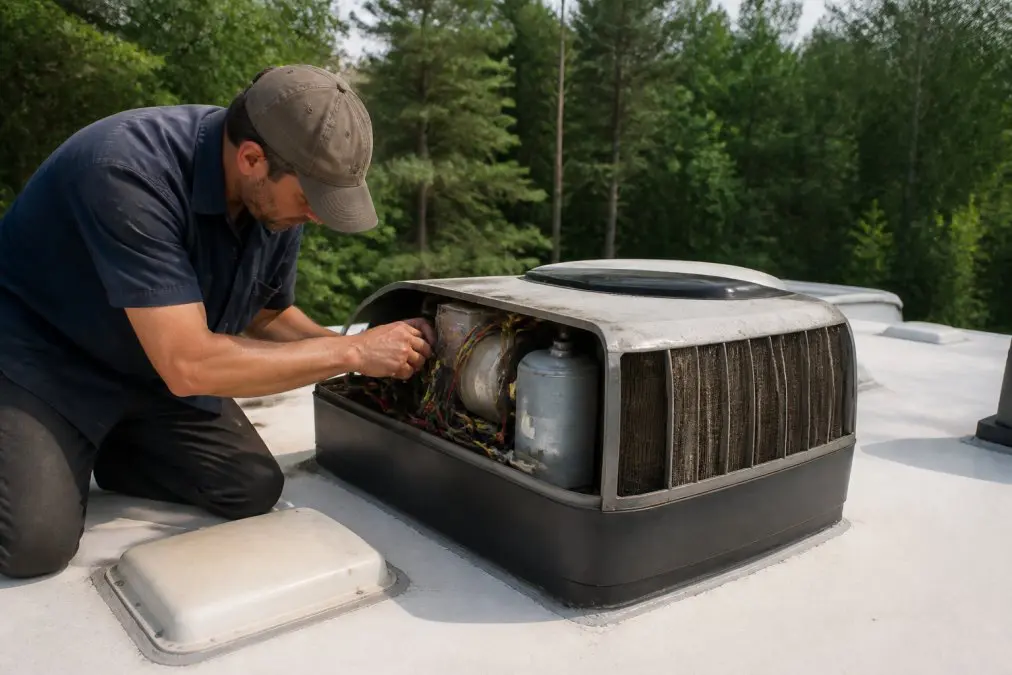
Repair wins when the failure is electrical or mechanical at the component level, not systemic. A failed capacitor, a seized condenser fan motor, or a control board that no longer reads the thermostat are all repairable on site, often in a single visit.
Three conditions point toward repair:
- The compressor still starts and draws normal amperage
- The refrigerant circuit holds pressure
- Replacement parts exist for your model year
Ask your technician to check compressor amperage draw before quoting anything else. A compressor pulling within spec changes the entire repair-vs-replace calculation, regardless of what the thermostat is doing.
When Replacement Wins
Replacement wins when the compressor has failed, when the refrigerant circuit has leaked into the sealed system, or when the unit is old enough that parts no longer exist. All three require opening a hermetically sealed system, which most mobile setups cannot do in the field.
RV AC Repair vs. Replacement Cost: A Real-World Breakdown
RV AC repair vs replacement cost comes down to labor scope, not parts alone. Repair labor is contained: diagnose, replace the failed component, verify the cooling cycle. Replacement labor includes removal, disposal, roof sealing, wiring harness adaptation, and thermostat compatibility checks. That difference in scope, not the sticker price, usually decides the math.
| Factor | Repair | Replacement |
|---|---|---|
| Parts scope | Single component | Full unit plus sealant |
| Labor scope | Contained, one visit | Multi-stage, longer |
| Roof work | None | Remove and reseal |
| Thermostat | Reuse existing | Often needs adapter |
| Disposal | Not applicable | Old unit removal |
| Parts sourcing | Usually in stock | Unit may be backordered |
What Drives Repair Costs Up
Access difficulty raises labor time more than any part. A rooftop unit mounted behind a solar panel array or roof rack takes longer to reach and reassemble. Hard-to-source legacy parts add a second variable, since a special-order component can stall the job.
Hidden Costs of Replacement
The purchase price is the visible number. What owners miss is the installation overhead: new roof sealant, possible wiring harness changes, and thermostat compatibility work when the new unit uses a different control protocol.
Skipping the thermostat compatibility check before ordering a replacement unit is the most common and most expensive mistake in this process. A mismatched control protocol can leave you with a new unit that won’t communicate with your existing system.
The Parts-Sourcing Variable Nobody Prices In
The cost of a repair isn’t just the part and the labor. It’s the part, the labor, and the risk that the part doesn’t exist.
The cheapest repair is the one where the part exists. Confirm parts availability before you compare repair and replacement numbers, or you’re comparing a real cost against a hypothetical one.
Common Signs Your Older RV AC Needs Attention
Early symptoms are cheap to fix. Late symptoms are not.
- Cooling output drops while the unit runs continuously
- The condenser fan spins slower than it should or stops intermittently
- The breaker trips when the compressor engages
- Ice forms on the evaporator coils
- The thermostat no longer holds the set temperature
- A hard start kit is masking a compressor that’s drawing too much current
Parts Availability for Legacy RV AC Models
Parts availability is the single biggest variable competitors gloss over. Two identical-looking failures can have completely different outcomes depending on whether your model year still has a supported parts chain.
Mobile RV Repair Benefits: Why On-Site Service Changes the Math
Mobile RV repair benefits compound when the alternative is a tow. Towing an RV is expensive, slow, and adds risk to the coach itself. On-site service removes that entire cost line and puts the repair where the vehicle already sits.
How Mobile Diagnostics Work
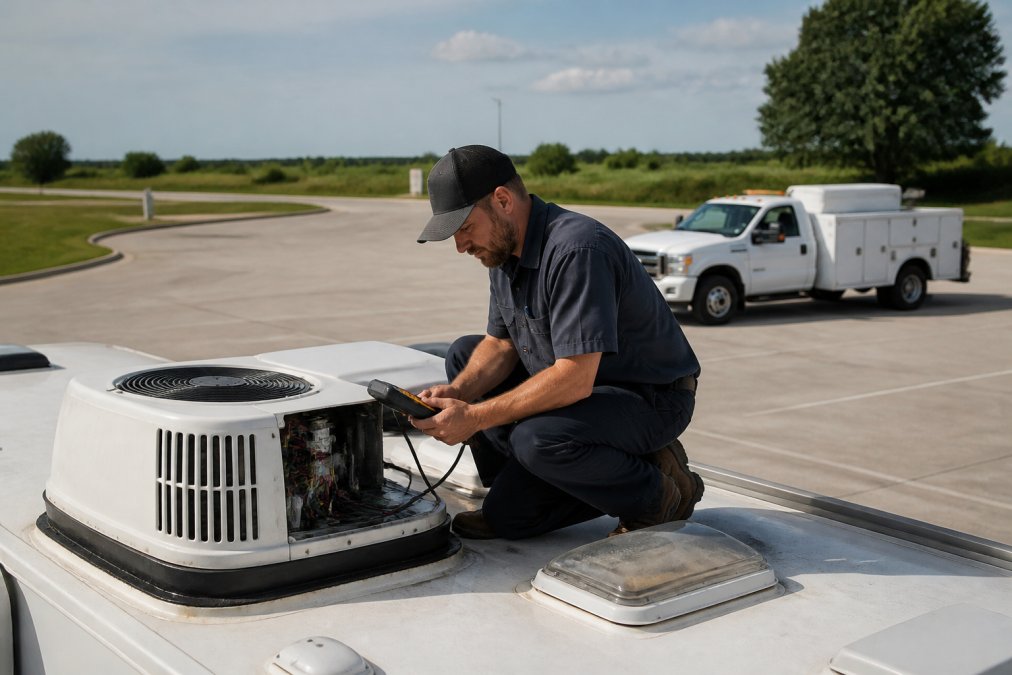
Mobile diagnostics work the same way shop diagnostics do, minus the bay. The technician connects to the system, reads compressor amperage, checks the control board, and verifies the cooling cycle under load, but the vehicle never moves.
A fault that disappears during a tow is a fault you’ll pay to diagnose twice. On-site diagnostics keep the failure in front of the technician.
Insurance and Warranty Implications for Older Units
Warranty coverage on older units is usually expired, which cuts both ways. You’re paying out of pocket, but you’re free to choose any qualified technician rather than being locked to a dealer network.
Mobile Technician Vetting Checklist
Vetting a mobile technician takes ten minutes and prevents most bad outcomes. Use this checklist before you authorize work:
- Ask for the technician’s experience with your specific RV system type
- Confirm the service truck carries computer diagnostics, not just hand tools
- Request a written estimate before work begins
- Ask what happens if the diagnosis reveals a part that needs ordering
- Confirm the warranty terms on the labor and any parts installed
- Verify the service area covers your breakdown location
- Ask whether the technician handles both diagnosis and repair in one visit
Frequently Asked Questions
Is it cost-effective to repair an RV AC unit over 10 years old?
It depends on the specific failure. If the compressor has failed or refrigerant is leaking from a sealed system, repair costs climb quickly and parts for legacy models may be hard to find. But if the issue is a capacitor, control board, or thermostat, repair often costs far less than a new unit. A mobile technician can diagnose the exact problem on-site and give you a clear repair vs. replace recommendation before you commit.
What is the average life expectancy of an RV air conditioner?
Most RV AC units last between 10 and 15 years with regular preventative maintenance. Units that run constantly in hot climates or skip filter cleaning and coil inspections tend to fail sooner. Once an older unit passes the 10-year mark, component failures become more frequent, and you should weigh each repair against the remaining service life before spending on another fix.
How does mobile RV repair compare to traditional shop service?
Mobile RV repair brings the technician, tools, and diagnostics to your location, whether that is a campground, rest stop, or roadside. You avoid the tow bill, the drop-off wait, and the shop queue. For AC diagnostics and many repairs, the work happens in the same visit. Shop service can make sense for major replacements requiring a lift or extended bay time, but mobile service handles the majority of AC failures on-site.
What are the most common signs that an RV AC needs replacement?
Watch for weak airflow, warm air from the vents, frequent breaker trips, unusual grinding or rattling from the condenser fan, and refrigerant leaks that keep returning after a recharge. If a technician finds compressor failure, a cracked evaporator coil, or a control board that is no longer manufactured for your model, replacement usually makes more sense than another repair.
Can older RV AC units be recharged or serviced on-site?
Some can, but many older units use hermetically sealed systems with no service ports, which means a standard refrigerant recharge is not possible without adding taps or replacing the unit. A mobile technician can check amperage draw, test the capacitor and control board, inspect the condenser fan, and tell you whether your unit is serviceable on-site or whether replacement is the better path.
Breakdowns on I-80 or I-29 don’t wait for business hours, and neither should your repair options. Mudhollow Diesel Mechanics brings fully equipped mobile service directly to your location, with modern computer diagnostics, 15+ years of technician experience, and a service model built to get you moving without a tow. Whether it’s a failed AC component, a radiator, or an electrical fault nobody else could trace, we diagnose and repair on site. Call or text 712-827-0207 and get back on the road.