Table of Contents
- Quick Comparison: Mobile Repair vs Traditional Truck Shops in Iowa
- Why Drivers Search for a Kustom Truck and Tire Alternative
- Mobile Diesel Repair in Western Iowa: How On-Site Service Works
- On-Site Semi-Truck Diagnostics: What Modern Mobile Units Can Actually Do
- Heavy-Duty Truck Roadside Assistance Without the Tow
- How the Leading Mobile Repair Option in Western Iowa Compares
- Cost-Benefit: What You Actually Save With On-Site Repair
- Frequently Asked Questions
Last Updated: September 14, 2026
Quick Comparison: Mobile Repair vs Traditional Truck Shops in Iowa
If you search for a kustom truck and tire alternative iowa drivers actually recommend, the deciding factor is usually simple: can the repair come to you? Mudhollow Diesel Mechanics operates fully equipped mobile units along the I-80 and I-29 corridors, which means most breakdowns get fixed on the shoulder instead of behind a shop gate.
Here’s how the two models stack up before you commit to either one.
| Factor | Mobile On-Site Repair | Traditional Shop Visit |
|---|---|---|
| Where work happens | Shoulder, rest stop, or your yard | Fixed service bay |
| Tow required | Rarely | Usually, if the truck won’t move |
| Wait time | Response-based, same corridor | Queue behind other jobs |
| Best for | Breakdowns, diagnostics, scheduled yard service | Major teardown work |
| Fleet scheduling | Comes to your terminal | You move every unit |
The table tells the story in ten seconds. A shop can’t leave its bay. A mobile unit can.
Why Drivers Search for a Kustom Truck and Tire Alternative
Most drivers don’t start hunting for an alternative because they dislike a particular business. They start because they’re sitting on the shoulder at 2 AM with a coolant leak and no way to move.
The pattern is consistent. A breakdown happens, a tow gets dispatched, the truck lands at the nearest shop, and then the waiting begins. Parts get ordered. Bays fill up. A repair that might have taken two hours stretches into two days of lost revenue.
That’s the gap a mobile diesel repair service fills. Instead of relocating the truck to the repair, the repair travels to the truck. For owner-operators running tight delivery windows, that difference decides whether the load arrives on time.
The real cost of a breakdown isn’t the repair itself. It’s the hours the truck isn’t earning.
Mobile Diesel Repair in Western Iowa: How On-Site Service Works
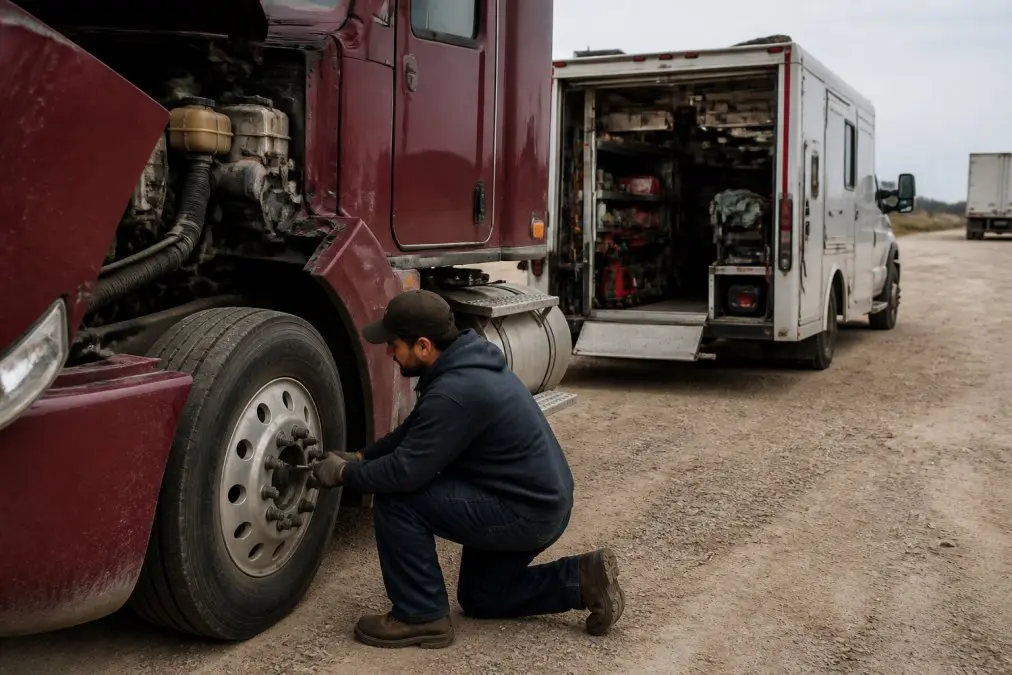
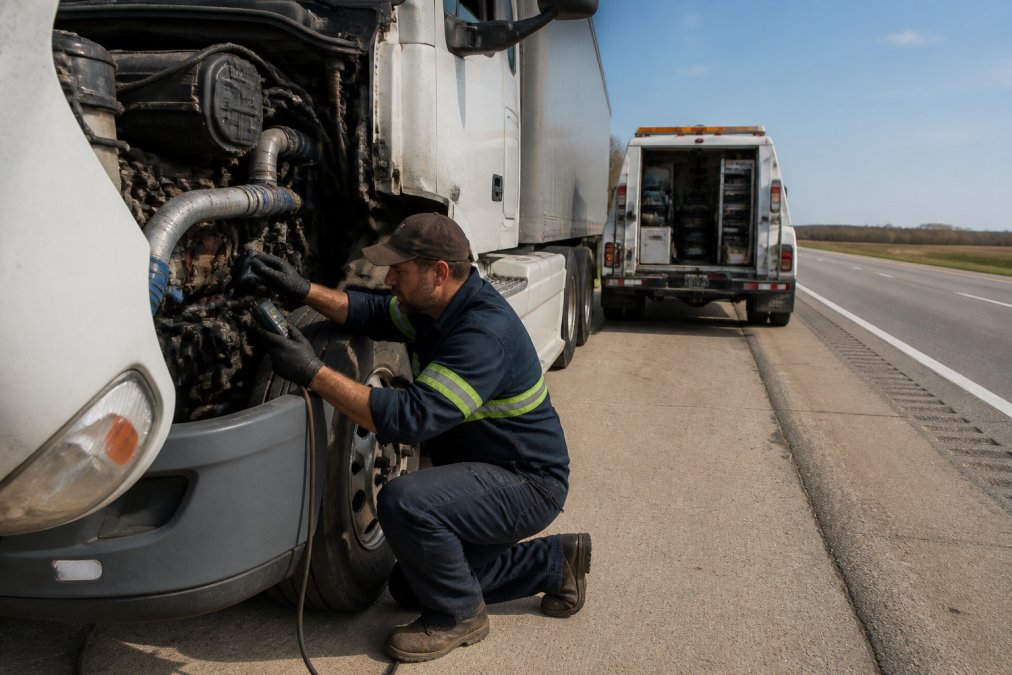
On-site service follows a straightforward sequence: you call, a technician is dispatched with the tools and parts most likely needed, and the diagnosis happens where the truck sits.
The workflow typically looks like this:
- Call or text with your location and symptoms. Mile marker, direction of travel, and what the truck is doing matter more than the make and model.
- A technician is dispatched with diagnostic equipment and common failure parts on board.
- Diagnosis happens on site using computer diagnostics plugged into the engine’s control module.
- Repair is completed if the fault is fixable roadside. If a part must be ordered, you know that before anyone commits to a plan.
- You roll. Most roadside fixes resolve faster than an equivalent in-shop visit, because there’s no queue and no tow.
That last point is the one drivers underestimate. According to FMCSA roadside inspection and maintenance guidance, mechanical failures remain a leading cause of commercial vehicle out-of-service orders, which means getting a fault corrected quickly protects your operating authority as much as your schedule.
On-Site Semi-Truck Diagnostics: What Modern Mobile Units Can Actually Do
Modern mobile units carry the same class of diagnostic software dealerships use, which changes what’s possible on a shoulder.
The old assumption was that mobile mechanics could only handle simple fixes. That’s outdated. Today’s service trucks run computer diagnostics that read fault codes, live data streams, and sensor behavior across the engine, aftertreatment, and electrical systems. That matters most for the hard cases: intermittent electrical faults, sensor gremlins, and drivability complaints that don’t reproduce in a bay.
A common mistake is assuming a fault code tells you the failed part. It doesn’t. It tells you where the system noticed a problem. A technician who understands the circuit behind the code saves you from replacing a component that was never broken.
This is where technician experience shows. Fifteen years of diagnosing heavy-duty diesel systems means pattern recognition that a code reader alone can’t provide.
Heavy-Duty Truck Roadside Assistance Without the Tow
The single biggest cost a mobile repair avoids is the tow itself. Heavy-duty towing is priced by weight, distance, and equipment, and a loaded tractor-trailer is at the top of every category.
Beyond the invoice, a tow adds two delays: the wait for the wrecker, and the wait at the shop once you arrive. Mobile repair removes both.
When you call for roadside help, have your mile marker, direction of travel, and a photo of the fault code ready. Technicians can pre-load the right parts before they roll, which shortens the visit.
Some jobs genuinely require a shop. Internal engine teardown, major transmission work, and structural repairs need a bay and a lift. A straight answer about what can and can’t be fixed roadside is worth more than an optimistic promise. The Commercial Vehicle Safety Alliance out-of-service criteria are a useful reference for understanding which defects will park a truck until they’re corrected.
How the Leading Mobile Repair Option in Western Iowa Compares
For drivers weighing a kustom truck and tire alternative, the practical comparison isn’t brand versus brand. It’s service model versus service model, and the criteria that actually separate one mobile provider from another are rarely spelled out anywhere. Here’s a framework you can apply to any provider you call.
1. Does the provider actually come to you, or does it dispatch a tow?
This is the first filter. A true mobile diesel repair service arrives with a fully equipped unit and works where the truck sits. A dispatch service takes your call and sends a wrecker. The two sound similar on the phone and behave very differently on the shoulder. Ask directly: “Will a technician with diagnostic equipment come to my location, or will you tow me?”
2. What diagnostic capability rolls with the truck?
A mobile unit without factory-level diagnostic software is limited to what a code reader can tell it. A unit with the same class of software dealerships use can read live data streams, monitor sensor behavior, and trace intermittent faults that don’t reproduce in a bay. For hard-to-solve breakdowns, electrical gremlins, aftertreatment faults, drivability complaints, this is the difference between a fix and a guess.
3. How much technician experience is behind the diagnosis?
Fifteen years of heavy-duty diesel work produces pattern recognition that no scan tool replaces. A fault code tells you where the system noticed a problem, not which part failed. Experienced technicians read the circuit behind the code and avoid replacing components that were never broken.
4. What’s the coverage area, and how is response structured?
A provider that runs a defined corridor, say, I-80 and I-29 across western Iowa, can commit to response times because the units are already in that geography. A provider that covers “the whole state” may be routing a truck from hours away. Ask which mile markers are in the primary service area.
5. What’s the honest scope of work?
Every mobile provider has jobs it can’t do roadside. Internal engine teardown, major transmission work, and structural repairs need a bay and a lift. A provider that tells you upfront what it can and can’t fix on the shoulder is more useful than one that promises everything. The Commercial Vehicle Safety Alliance out-of-service criteria are a useful reference for understanding which defects will park a truck until they’re corrected.
6. What specialties does the provider actually run?
Generalist mobile mechanics handle a broad range of small jobs. Specialists concentrate on the failures that stop a truck cold, radiator and turbocharger work, aftertreatment faults, and the electrical diagnostics that send a lot of drivers hunting for help in the first place. Match the provider’s specialty to your likely failure mode.
How the models stack up side by side:
| Evaluation criterion | Mobile diesel repair specialist | Generalist mobile mechanic | Tow plus traditional shop |
|---|---|---|---|
| Comes to your location | Yes, with diagnostic equipment | Sometimes, limited tooling | No, you’re towed |
| Factory-level diagnostics on board | Yes | Rarely | Yes, at the shop |
| Tow required | Rarely | Sometimes | Always |
| Wait time | Response-based, same corridor | Variable | Wrecker wait plus shop queue |
| Best for | Breakdowns, intermittent faults, hard diagnostics | Simple roadside fixes | Major teardown work |
| Fleet yard service | Yes, scheduled at your terminal | Rarely | No, you move every unit |
Mudhollow Diesel Mechanics sits firmly in the first column. The service is built around mobile units that reach trucks on I-80 and I-29 across western Iowa, diagnose with modern computer equipment, and complete the repair on site whenever the fault allows. Specialties include radiator and turbocharger work, plus the electrical diagnostics that send a lot of drivers hunting for help in the first place. It’s built for the breakdowns that stop a truck cold.
The right question isn’t “who’s cheapest?” It’s “who arrives with the diagnostic capability to fix this the first time?” Ask that before you commit.
Cost-Benefit: What You Actually Save With On-Site Repair
Most comparisons of repair options stop at the invoice. That’s the wrong frame for a fleet. The number that matters is total cost of the event, the repair, the tow, the downtime, and the second trip if the first diagnosis was wrong. Here’s how to think about it.
The four cost layers of a breakdown
- The repair itself. Parts plus labor. This is the only layer most drivers compare, and it’s usually the smallest.
- The tow. Heavy-duty towing is priced by weight, distance, and equipment, and a loaded tractor-trailer sits at the top of every category. A repair completed on the shoulder eliminates this layer entirely.
- Downtime. Every hour a truck sits is an hour of fixed cost with no revenue attached, insurance, financing, driver pay, and the load that isn’t moving. The American Transportation Research Institute’s operational cost data consistently shows downtime is one of the largest controllable costs in trucking operations.
- The second trip. A misdiagnosis sends the truck back for the same fault a week later, stacking another repair on top of the first. Correct diagnosis the first time is a cost-avoidance mechanism, not a luxury.
Why the mobile model changes the math
A traditional shop visit forces all four layers. The truck must be towed (layer 2), it waits in a queue (layer 3), and if the diagnosis was rushed, it comes back (layer 4). A mobile repair that completes the job on the shoulder removes layers 2 and 3 outright and reduces the odds of layer 4 when the technician has the diagnostic depth to trace the fault properly.
A framework for evaluating any provider’s cost structure
Since pricing depends on the fault, the parts, and the distance to your location, any outfit quoting a flat number before diagnosis is guessing. What you can evaluate is the structure:
- Does the quote include the tow, or eliminate it? A provider that comes to you removes a line item a shop can’t.
- How is response time structured? A provider running a defined corridor can commit to response windows; a statewide provider may be routing from hours away.
- What diagnostic capability is on the truck? Factory-level software reduces the odds of a return visit.
- What’s the honest scope? A provider that tells you upfront which faults can’t be fixed roadside saves you a wasted dispatch.
The fleet-manager angle
For fleets, the calculus shifts further. Scheduled mobile service at your own yard means units don’t leave the terminal for routine diagnostics, and breakdowns on the corridor get handled without pulling a driver off a load. Over a year, the compounding effect of avoided tows and reduced downtime is where the real savings sit, not in the hourly labor rate.
Track two numbers for every breakdown: total hours the truck was out of service, and whether a tow was involved. Those two data points will tell you more about your true repair cost than any invoice line item.
What this means in practice
If your operation runs I-80 or I-29 across western Iowa, the highest-value repair partner is the one that arrives with diagnostic equipment, fixes the fault on site when possible, and tells you honestly when a job needs a bay. That combination, fast on-site response, experienced technicians, and sophisticated mobile diagnostics, is what removes cost layers instead of just moving them around.
Frequently Asked Questions
What are the benefits of mobile diesel repair versus traditional shop visits?
Mobile diesel repair brings the tools and diagnostics to your truck instead of the other way around. You avoid tow costs, skip the shop queue, and often get back on the road faster. For owner-operators on I-80 or I-29, that means less downtime and no waiting days for a bay to open. The technician works on your rig at the shoulder, rest stop, or yard, so your schedule stays intact.
How do I find reliable heavy-duty truck roadside assistance while on the road?
Look for a mobile unit with modern computer diagnostics and a track record on your corridor. Ask how far out they service, what brands they handle, and whether they stock common parts. A provider that focuses on diesel repair, not towing, will often fix the problem on-site. Keep a direct number saved so you are not searching at 2 AM.
Does mobile diesel repair cover complex engine diagnostics?
Yes, if the mobile unit carries the right equipment. Modern service trucks run the same computer diagnostics as a dealership, which means they can read fault codes, test sensors, and trace electrical gremlins. For hard-to-solve issues like intermittent turbo or radiator problems, an experienced mobile technician can often diagnose and repair on the spot, avoiding a tow to a shop.
How can I avoid expensive towing fees for truck breakdowns?
The key is choosing a service that repairs on-site rather than hauling you to a shop. Many roadside fixes, from radiator leaks to turbo issues, can be handled by a fully equipped mobile mechanic. That eliminates the tow bill and the shop wait. When you call, confirm they do on-site repair and ask if your issue is something they can typically fix at your location.
Are mobile diesel services available for RVs and commercial fleets?
Reputable mobile diesel services work on semi-trucks, commercial fleets, and RVs. For fleets, some providers offer scheduled preventive maintenance at your yard, which keeps trucks running without a shop visit. For RVs, mobile diagnostics can handle engine and mechanical failures on the road. Confirm the provider services your vehicle type and location before you rely on them.
A breakdown on I-80 at 2 AM doesn’t care about your delivery schedule, and a shop that can’t leave its bay can’t help you until morning. Mudhollow Diesel Mechanics was built for exactly that gap: fully equipped mobile units, computer diagnostics that handle the electrical faults other shops give up on, and 15 years of technician experience across western Iowa’s two main freight corridors. Most customers never see a tow truck. Call or text 712-827-0207 and get the repair moving to you.