Table of Contents
- Why a Towing Alternative for Trucks Beats Waiting for a Tow
- Mobile Diesel Repair vs Towing: What Actually Gets You Moving
- Common Roadside Semi Truck Failures That Never Need a Tow
- Emergency Roadside Diesel Diagnostics: Finding the Fault on the Shoulder
- What to Look For in a Towing Alternative for Trucks
- Self-Recovery Options: Heavy-Duty Trucks as a Backup
- When Towing Is Actually the Right Call
- Frequently Asked Questions
Last Updated: September 12, 2026
Why a Towing Alternative for Trucks Beats Waiting for a Tow
A Diversified Towing alternative for trucks is any on-site service that fixes the vehicle where it sits instead of hauling it to a shop. For owner-operators on I-80 and I-29, that difference decides whether you lose two hours or two days. At Mudhollow Diesel Mechanics, our mobile units carry the same diagnostic computers and heavy-duty tools a dealer bay uses, so most breakdowns get resolved on the shoulder. A tow moves the problem, a repair ends it.
Here is the part most drivers learn the hard way. A tow only relocates your truck to a queue (fmcsa.dot.gov). It does not diagnose anything, it does not order parts, and it does not put you back under load. You still wait, just in a different parking lot.
That is why a towing alternative changes the outcome, not just the invoice.
FMCSA roadside inspection and out-of-service guidance
Mobile Diesel Repair vs Towing: What Actually Gets You Moving
Mobile diesel repair resolves a mechanical fault on site, while towing transfers the vehicle to a fixed shop for that same work later. The distinction matters most when the failure is one a technician can reach, diagnose, and correct from a service truck.
Time Off the Road: Side-of-Highway Repair vs the Tow-to-Shop Cycle
The tow-to-shop cycle stacks delays. You wait for a wrecker, ride to a shop, join the service queue, wait on diagnosis, then wait on parts. A roadside repair collapses that sequence into one visit. Our technicians resolve most calls without a hook ever touching the truck.
A common pattern on I-80 and I-29: a derate or cooling fault that a mobile unit clears in a single visit would otherwise consume the better part of a day across dispatch, transport, intake, and diagnosis before a wrench ever turns. That is the difference between losing an afternoon and losing a load.
How the Two Options Compare on Cost and Control
Cost control favors on-site work because you avoid stacking a recovery fee on top of the repair you still need. You also keep your load, your trailer, and your schedule under your own control.
| Factor | Mobile On-Site Repair | Tow-to-Shop |
|---|---|---|
| Who diagnoses | Technician at your location | Shop after you arrive |
| Load and trailer | Stay with you | Often separated |
| Time to first fix attempt | Same visit | After queue and intake |
| Cost structure | One service call | Recovery fee plus shop labor |
| Parts delay risk | Identified immediately | Discovered after intake |
| Load status | Stays under your control | Detention and rescheduling risk |
How Heavy-Duty Towing Is Actually Billed
Most towing providers do not publish rates, which makes the comparison hard to run in advance. The billing model itself is the useful part to understand, because it is what drives the final invoice up or down.
- Hook-up or recovery fee. A flat charge to attach and begin the recovery. This is charged whether the truck moves one mile or fifty.
- Mileage rate. Charged per mile from the hook-up point to the destination. This is where a long haul to the nearest capable shop compounds quickly.
- Heavy-duty surcharge. Wreckers rated for loaded tractor-trailers carry a higher base than light-duty units, and the rate reflects the equipment class, not the distance.
- Additional equipment. A second wrecker, a rotator, or a trailer for the load adds line items that are not part of the base quote.
- Storage and detention. Once the truck reaches the yard, daily storage and shop queue time can accrue before any repair begins.
A mobile repair call is structured differently: one service call covers the diagnosis and the on-site work, and the parts needed are identified during that same visit rather than after intake.
When you call any provider, ask how the quote is built: is the hook-up fee separate from mileage, and is there a storage charge if the repair cannot start the same day? The answer tells you more than the headline rate.
What Keeps You Under Load
The control question is separate from the cost question. When a truck is towed, the trailer and load are often separated from the tractor, which means a second decision about what happens to the freight. On-site repair keeps the tractor, trailer, and load together, so a mechanical fix does not become a logistics problem. For an owner-operator running a tight delivery window, that is frequently worth more than the invoice difference.
Common Roadside Semi Truck Failures That Never Need a Tow
Most common roadside semi truck failures are repairable in place because the failed component is accessible from outside the frame. Cooling system faults, charge-air leaks, and sensor-driven derates top the list. A tow is rarely the technical answer; it is usually just the default one.
Radiator and Cooling Failures
Coolant loss from a split hose, a failed clamp, or a cracked tank strands trucks daily (the CDC). These are reachable, and a technician can often restore the system on the shoulder. Ignoring a slow leak can lead to more serious issues, so address it the first time the low-coolant light appears.
Turbocharger and Aftertreatment Problems
Turbo and aftertreatment faults often trigger a derate rather than a hard stop. Modern diagnostics read the fault code, verify boost pressure or sensor behavior, and confirm whether the truck can run. Many of these end with a repair or a cleared fault, not a hook.
Emergency Roadside Diesel Diagnostics: Finding the Fault on the Shoulder
Emergency roadside diesel diagnostics is the process of connecting factory-level scan tools to the truck’s ECM on site to read active and stored fault codes. It is the single biggest reason a mobile call succeeds where a tow would only relocate the problem.
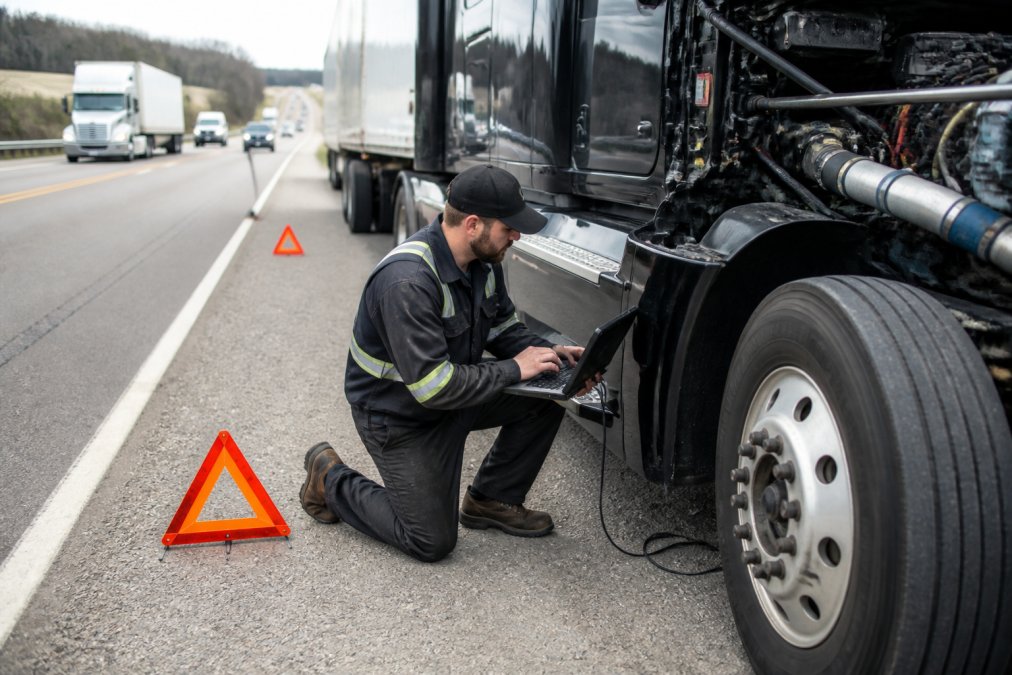
Electrical gremlins are a classic case. Intermittent faults can trace to a chafed harness or a corroded ground, and those show up when you read live data under load. Our service trucks carry computer diagnostics built for exactly this work.
Before the technician arrives, note the exact fault code, the conditions when it appeared, and whether the derate is active or intermittent. That history cuts diagnostic time significantly.
What to Look For in a Towing Alternative for Trucks
The right towing alternative for trucks is a mobile service with real diagnostic capability, not just a jump pack and a wrench. Ask what equipment arrives, who performs the work, and how far the provider will travel.
- Factory-level scan tools, not generic code readers
- On-board parts and fittings for common cooling and charge-air failures
- A stated service radius and realistic arrival window
- Technicians with heavy-duty diesel experience, not general automotive
- A clear answer on what happens if a part must be ordered
The most common mistake is calling a general roadside provider for a diesel fault. Without factory diagnostics they will default to a tow, and you pay the recovery fee anyway.
Self-Recovery Options: Heavy-Duty Trucks as a Backup
A one-ton pickup can handle some light recovery and equipment hauling, which is why fleets keep one on standby. That capability covers a yard move or a light trailer, not a loaded tractor-trailer on a live interstate lane.
Matching the Truck to the Job
The mistake is treating “heavy-duty pickup” and “heavy-duty recovery” as the same category. They are not. The relevant question is what class of vehicle the recovery equipment is rated to move, and that rating is set by the wrecker or tow unit, not by the pickup’s marketing badge.
A rough way to think about it:
- Light-duty recovery. Pickup-based units for passenger vehicles and light trailers. A one-ton dually with a gooseneck or fifth-wheel setup fits here for planned moves.
- Medium-duty recovery. Purpose-built wreckers for box trucks and smaller commercial vehicles. A pickup is not in this class.
- Heavy-duty recovery. Wreckers and rotators rated for loaded tractor-trailers and buses. This is a different equipment class entirely, and it is what a stranded semi actually needs.
A one-ton pickup pulling a light trailer in a yard is a reasonable use of self-recovery. The same pickup attempting to move a loaded tractor-trailer is a mismatch that no amount of towing capacity on the spec sheet resolves.
Why Self-Recovery Has a Hard Ceiling
Self-recovery has a hard ceiling. It cannot fix a derate, and it puts an untrained driver next to traffic. A mechanical or electrical fault does not care how much the recovery vehicle can pull, the truck still will not run, and pulling it does not diagnose anything.
There is also a compliance dimension. Roadside work on a live interstate lane falls under the same safety expectations that apply to any commercial recovery, and an untrained driver improvising a hook-up next to moving traffic is a liability exposure, not a solution. Treat self-recovery as a backup for planned moves, not an emergency plan.
Do not confuse towing capacity with recovery capability. A pickup rated to pull a heavy trailer is not rated to recover a loaded tractor-trailer, and treating the two as interchangeable is how equipment gets damaged and people get hurt.
When a Mobile Technician Beats Self-Recovery
For a mechanical or electrical fault, the faster path is a mobile diesel technician who can diagnose on site and repair in place. That keeps the load moving without involving a second vehicle, a hook-up, or a trip to a yard. Self-recovery moves a broken truck; on-site repair ends the breakdown.
When Towing Is Actually the Right Call
Towing is the correct choice when the failure is structural, when the truck cannot be made safe in place, or when the repair requires a lift. Accident recovery, frame damage, and major driveline failures fall into that category. If a technician on scene determines the fault needs a shop, that is a professional judgment, not a default.
For everything else, on-site repair keeps the load moving and the schedule intact.
Match the response to the failure. Mechanical and electrical faults usually favor on-site repair; structural damage and lift-only jobs favor a tow.
Frequently Asked Questions
When should you choose mobile diesel repair instead of a tow?
Choose mobile repair when the failure is something a technician can reach and fix on the spot, such as a radiator leak, a failed sensor, a turbocharger issue, or an electrical fault. A fully equipped service truck carries diagnostics and heavy-duty tools, so most roadside breakdowns get resolved without a tow. If the truck needs a shop lift, major teardown, or parts that must be ordered, towing becomes the practical option.
What are the common roadside semi truck failures that can be fixed on-site?
Cooling system leaks, burst radiator hoses, turbocharger faults, clogged aftertreatment components, sensor failures, wiring and electrical gremlins, and fuel delivery issues are the failures technicians handle most often at the roadside. These problems usually trace back to a specific component that a mobile diagnostic scan can pinpoint. Once identified, many are repaired with parts carried on the service truck, letting the driver continue without a tow.
How does on-site semi-truck repair compare to traditional towing?
Towing moves the truck but does not fix it. The driver still waits for a hook, rides to a shop, and joins the repair queue behind other vehicles. Mobile repair skips that entire cycle by bringing the tools and diagnostics to the breakdown location. The truck often returns to service the same day instead of sitting in a yard, which matters most for owner-operators and fleets running tight delivery schedules.
Is mobile diesel repair a viable alternative to heavy-duty towing?
For many breakdowns, yes. A mobile unit with computer diagnostics can read fault codes, test components, and complete repairs on the shoulder, at a rest stop, or in a terminal yard. The main limits are geography and the nature of the failure. A reputable provider will tell you upfront whether the problem can be solved on-site or whether the truck genuinely needs a shop and a tow.
How much time can mobile diesel mechanics save compared to shop wait times?
The savings come from removing two delays: the tow itself and the shop queue. Roadside repairs often finish in a fraction of the time a tow-and-wait cycle takes, since the technician starts diagnosing the moment they arrive. For fleets, that difference can mean the truck makes its next load instead of missing a day or more of revenue while it sits waiting for a bay to open.
A breakdown on I-80 or I-29 is a scheduling problem first and a mechanical one second. Mudhollow Diesel Mechanics brings fully equipped mobile service, computer diagnostics, and 15+ years of heavy-duty experience directly to your shoulder, rest stop, or loading dock, so most customers avoid a tow entirely. We also handle scheduled dry-land servicing at your yard to head off the failures that strand you later. Call or text 712-827-0207 and get your truck moving again.