

Table of Contents
- Quick Comparison: Top Mobile Diesel Repair Tools for Emergencies
- 1. Snap-on Professional Diagnostic Scanner: Best for Complex Faults
- 2. Noco Boost Plus GB40 Jump Starter: Best for Dead Batteries
- 3. Tekton 1/2-Inch Drive Impact Socket Set: Best for High-Torque Repairs
- 4. Gearwrench 12-Point Combination Wrench Set: Best for Tight Spaces
- 5. Sunex Tools 3/8-Inch Drive Master Impact Socket Set: Best for Versatility
- Common Roadside Semi Truck Failures These Tools Address
- When to Call a Mobile Diesel Mechanic Instead of DIY
- Frequently Asked Questions
Last Updated: September 30, 2026
Quick Comparison: Top Mobile Diesel Repair Tools for Emergencies
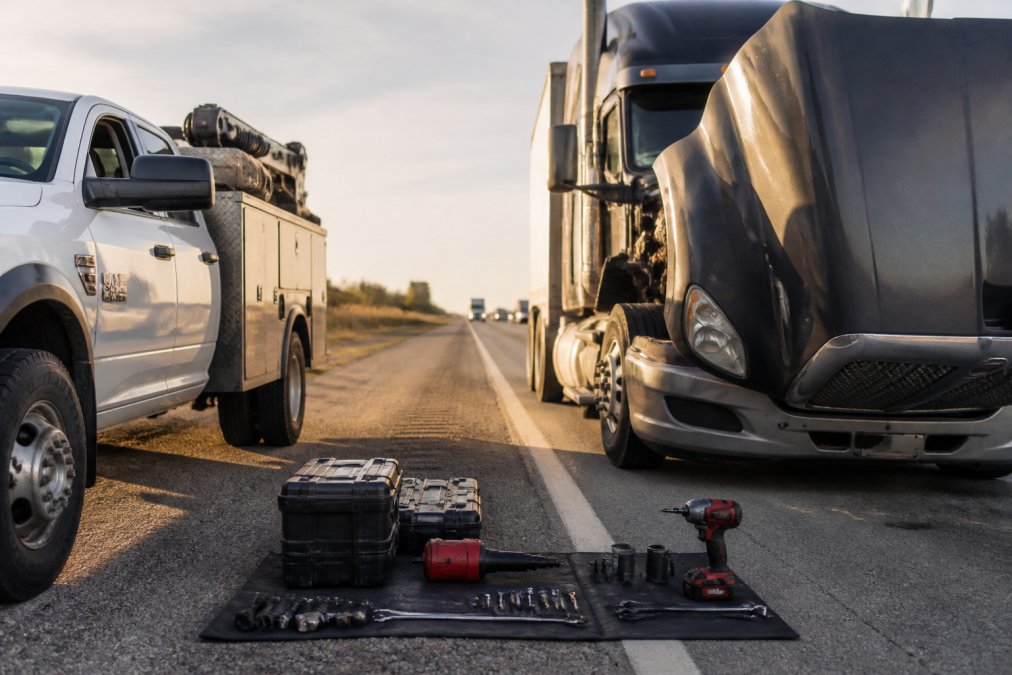
Choosing the right mobile diesel repair tools for emergencies often decides whether a rig rolls again in an hour or sits on the shoulder until a tow truck arrives. At Mudhollow Diesel Mechanics, we’ve spent 15+ years working breakdowns along I-80 and I-29, and the tools below are the ones our technicians actually trust when a semi-truck quits at mile marker 40.
This guide breaks down five essentials: a heavy duty diesel diagnostic scanner, a lithium jump starter, two impact socket sets, and a combination wrench set. Each one solves a specific roadside problem.
| Tool | Best For | Key Feature | Approx. Price |
|---|---|---|---|
| Snap-on Professional Diagnostic Scanner | Complex faults | Bi-directional testing | Contact for pricing |
| Noco Boost Plus GB40 | Dead batteries | 1,000-amp peak | $99.95 |
| Tekton 1/2-Inch Impact Socket Set | High-torque repairs | 6-point design | $60.00 |
| Gearwrench Combination Wrench Set | Tight spaces | Surface Drive tech | $85.00 |
| Sunex 3/8-Inch Master Impact Set | Versatility | Shallow + deep sockets | $120.00 |
1. Snap-on Professional Diagnostic Scanner: Best for Complex Faults
A heavy duty diesel diagnostic scanner is the one tool on this list that separates a roadside guess from a roadside fix. On a modern Class 8 truck, the engine control module, aftertreatment control module, and transmission controller all live on separate networks, and a generic OBDII reader that works fine on a pickup often cannot open a single one of them.
Why Generic OBDII Readers Fall Short on Diesel
Most consumer scan tools speak only the legislated OBDII protocol and read a narrow set of emissions-related codes from the engine controller. A Class 8 diesel spreads its data across manufacturer-specific networks, J1939 and J1708 on the chassis side, plus proprietary diagnostic links for the aftertreatment and transmission modules. Reaching those requires the right adapter and the right software license, which is exactly what a professional diesel platform provides.
A heavy duty diesel diagnostic scanner does more than pull codes.
What to Look For in a Diesel Scanner
- Coverage of heavy-duty protocols, not just light-duty OBDII. If the tool can’t talk J1939, it can’t help a semi.
- Bi-directional controls for injector cutout, fan engagement, and regeneration cycles.
- Live data graphing so you can watch a value move under load instead of staring at a frozen number.
- Update path. Software and coverage subscriptions are a recurring cost, and a tool that stops updating stops covering new model years.
The trade-off is real: a professional-grade platform is a high initial investment, and software updates cost extra. For fleets and serious owner-operators, that cost pays for itself the first time it saves a tow.
If your truck is derated, throwing codes you can’t read, or losing power under load, the scanner is the tool that matters. Everything else on this list is hardware; this is the one that tells you which hardware to touch.
SAE J1939 heavy-duty vehicle network standard overview
2. Noco Boost Plus GB40 Jump Starter: Best for Dead Batteries
A dead battery is the most common reason a diesel won’t crank, and the Noco Boost Plus GB40 solves it without waiting on another driver to show up with cables.
3. Tekton 1/2-Inch Drive Impact Socket Set: Best for High-Torque Repairs
Keep a dedicated 1/2-inch impact set in the truck and leave the chrome set in the shop. Chrome sockets shatter under impact wrench torque, and flying shrapnel near a fuel system is a bad day.
The set carries a lifetime replacement warranty. The downside is weight; it’s heavy to haul, so it earns its place only if you’re doing real mechanical work.
4. Gearwrench 12-Point Combination Wrench Set: Best for Tight Spaces
Reaching fasteners buried behind turbochargers and exhaust manifolds is the hardest part of roadside work, and the Gearwrench 12-Point Combination Wrench Set is designed for exactly that.
5. Sunex Tools 3/8-Inch Drive Master Impact Socket Set: Best for Versatility
Don’t trust worn case latches to hold a master set together in a bouncing truck cab. If the case pops open, you’ll be crawling the floorboard for a 10mm at the worst possible moment.
The wide size range makes it a strong companion to the Tekton 1/2-inch set. The case latches are the weak point, so check them before every trip.
CALL or TEXT NOW:712-827-0207 →
Common Roadside Semi Truck Failures These Tools Address
Understanding common roadside semi truck failures tells you which tools earn their space in the truck, because breakdowns cluster around a handful of systems, and because cab space and payload are finite, every tool you add has to justify its weight.
The Failures That Strand a Rig
- Dead batteries and charging faults. The most common no-crank call. A lithium jump starter gets you cranking; a scanner tells you whether the alternator or a parasitic draw killed the battery in the first place.
- Fuel delivery problems. Gelled fuel, a clogged filter, or an injector fault. A scanner reads rail pressure and injector codes; a wrench set gets you to the filter housing.
- Loose or seized fasteners. High-torque suspension and driveline hardware needs impact-rated sockets, not chrome.
- Sensor and aftertreatment faults. A derate from a failed sensor or a plugged diesel particulate filter is diagnostic territory, codes and live data, not guesswork.
- Coolant and turbo issues. Hose clamps, charge-air boots, and turbo housings are reachable with hand tools, which is why wrenches and sockets stay in the kit.
Cold Weather Changes the Kit
Diesel is far less forgiving of cold than gasoline. Two failures dominate winter breakdowns: fuel gelling and weak batteries. A diesel fuel system can gel as temperatures drop, and a battery that cranks fine at 60°F can fail to turn the engine at 0°F because cold thickens the oil and cuts available cranking amps.
Minimalist vs. Comprehensive: What Fits in a Truck
Space and weight are the real constraints, so build the kit in tiers rather than hauling everything.
- Minimalist (get-home) kit: jump starter, one impact socket set, a combination wrench set, anti-gel additive, spare fuel filter, gloves, and a headlamp. This covers the failures a driver can realistically fix on a shoulder.
- Comprehensive (diagnostic) kit: add a heavy-duty diesel scanner, a second socket set in the other drive size, and a multimeter. This is the tier that turns a tow into a repair.
Roadside Safety and Compliance
Working on a highway shoulder is its own hazard, and federal rules govern how you mark a stopped commercial vehicle. Under the Federal Motor Carrier Safety Administration’s roadside emergency requirements, a stopped truck generally needs warning devices, reflective triangles placed behind the vehicle, and drivers working near traffic should wear high-visibility gear. Set the triangles first, then the tools. No repair is worth standing in a live lane.
Never attempt a roadside repair in a live traffic lane or on a blind curve. Set warning devices, move behind the barrier if one exists, and call for help if the position isn’t safe.
FMCSA roadside emergency warning device requirements
When to Call a Mobile Diesel Mechanic Instead of DIY
Call a mobile diesel mechanic when a fault needs computer diagnostics, when the repair requires a tow to reach safely, or when you’re working in traffic with no safe shoulder. A qualified technician arrives with the scanner and tools to fix it on the spot, and 99% of our customers avoid a tow entirely.
Frequently Asked Questions
What tools should every heavy-duty diesel driver carry for emergencies?
At minimum, carry a heavy duty diesel diagnostic scanner to read fault codes, a 1,000-amp lithium jump starter like the Noco Boost Plus GB40, a 1/2-inch drive impact socket set for high-torque fasteners, a 12-point combination wrench set for tight engine bays, and a 3/8-inch drive master socket set for versatility. These tools can help you address common roadside semi truck failures and potentially avoid a costly tow.
Can mobile diesel diagnostics fix a truck on the side of the road?
Yes, in many cases. A heavy duty diesel diagnostic scanner lets a mobile technician read fault codes, stream live data, and run bi-directional tests to pinpoint issues like faulty injectors, sensor failures, or emission problems. Mudhollow Diesel Mechanics uses modern service trucks with computer diagnostics to perform these tests on-site. Most roadside fixes are resolved faster than in-shop repairs, and 99% of customers avoid a tow entirely.
What are the most common roadside semi-truck failures?
The most frequent roadside semi truck failures include dead batteries, alternator faults, coolant leaks, turbocharger issues, radiator problems, and electrical gremlins that trigger fault codes. Fuel system clogs and sensor failures are also common. Carrying a jump starter, diagnostic scanner, and basic hand tools helps you address some of these on your own. For complex issues like turbo or electrical faults, a mobile diesel mechanic with advanced diagnostics is often the fastest path back on the road.
How do I know if a roadside diesel repair is possible without a tow?
If the issue is a dead battery, loose hose clamp, blown fuse, or a fault code you can clear with a scanner, a roadside fix is often possible. If you hear grinding, see heavy fluid loss, or the engine won’t crank after a jump, you likely need a mobile diesel mechanic. Mudhollow Diesel Mechanics brings fully equipped service trucks to your location, and most repairs are completed on-site. Call or text 712-827-0207 to describe the symptoms and get a quick assessment.
What diagnostic software is best for heavy-duty diesel engines?
Professional-grade platforms like Snap-on diagnostic scanners are widely used for heavy-duty diesel engines because they offer full-system fault code reading, bi-directional control, and live data streaming. These features let technicians test injectors, fans, and other components in real time. For owner-operators, a basic OBDII scanner can read generic codes, but complex engine and emission failures usually require the deeper coverage of a professional heavy duty diesel diagnostic scanner.