

Table of Contents
- What Is Off-Hours Fleet Service?
- Mobile Diesel Repair Benefits for Your Fleet
- Emergency Roadside Diesel Diagnostics After Hours
- Commercial Fleet Downtime Reduction Through Scheduling
- Key Management and Communication Workflows for Night Service
- Preventative Maintenance and Hours of Service Compliance
- Frequently Asked Questions
Last Updated: October 2, 2026
What Is Off-Hours Fleet Service?
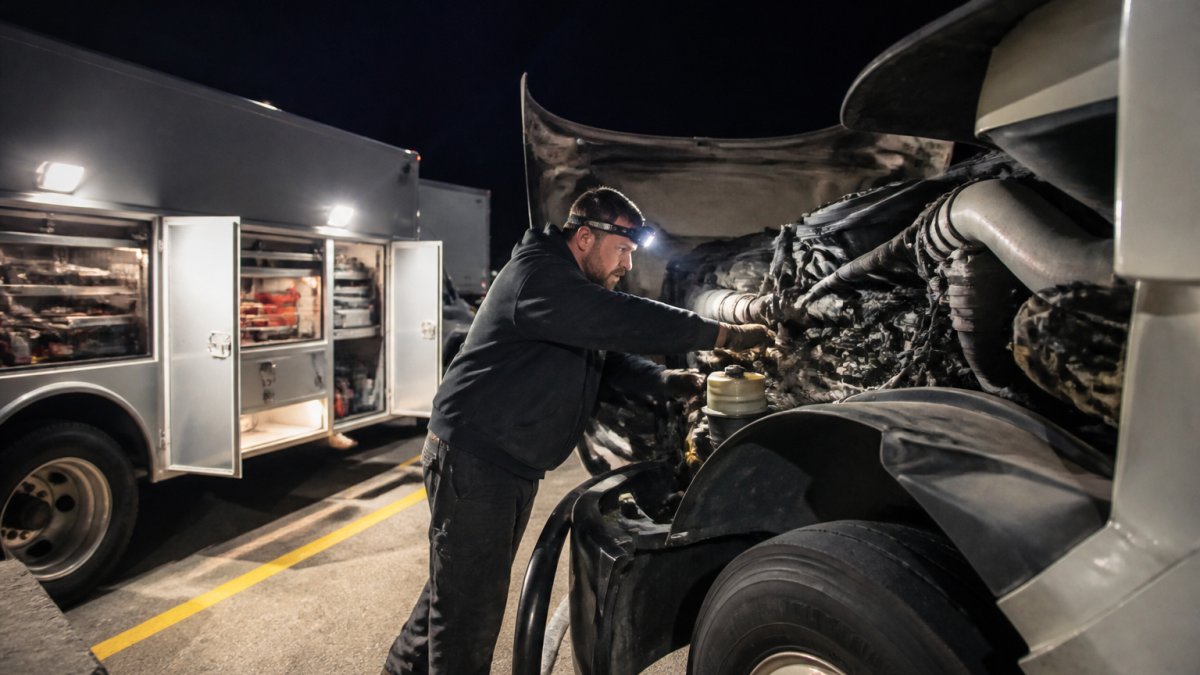
Off-hours fleet service is scheduled or emergency mechanical repair performed outside standard shop hours, typically between 6 p.m. and 6 a.m., so commercial vehicles get serviced while they sit idle instead of during revenue hours. For fleets on the I-80 and I-29 corridors, that means a mobile diesel mechanic comes to your yard, terminal, or roadside location at night, handles diagnostics and repairs on the spot, and has the truck ready before morning dispatch.
Most fleet managers still treat “after-hours” as emergency-only. It isn’t. Off-hours fleet service is a scheduling strategy first and an emergency response second.
How It Differs From Standard Shop Maintenance
Standard shop maintenance means surrendering the vehicle to a fixed location during business hours, so the truck earns nothing while it waits.
The practical differences stack up fast:
- Location: Mobile service at your yard versus dropping the truck at a shop
- Timing: Overnight or early morning versus mid-day
- Downtime cost: Vehicle stays in your operational control versus sitting in a queue
- Tow exposure: None for most repairs versus a tow bill before work even starts
A common mistake is treating mobile repair as lesser shop work. In practice, a fully equipped service truck with computer diagnostics handles the same radiator, turbocharger, and electrical work a bay would.
Mobile Diesel Repair Benefits for Your Fleet
The core benefit of mobile diesel repair is straightforward: the repair comes to the asset, so the asset never leaves your control. That removes two of the biggest hidden costs in maintenance, towing and shop wait time.
Avoiding Towing Costs and Shop Wait Times
A tow is pure loss: you pay to move a truck that isn’t earning, then still owe for the repair. Mobile service eliminates that bill for most roadside fixes, and removes the cost most managers underestimate, days spent waiting in a shop queue.
The wait is often longer than the repair: a truck can sit for days waiting on bay availability for a job that takes hours.
When you book off-hours service, ask the dispatcher what diagnostics the truck carries. A mobile unit with full computer diagnostics can read fault codes on the spot instead of guessing, which is the difference between a one-visit fix and a parts-ordering loop.
Emergency Roadside Diesel Diagnostics After Hours
Emergency roadside diesel diagnostics after hours separates a real mobile repair operation from a tow-and-hope service. When a truck throws a fault code at 2 a.m. on the shoulder, the question isn’t whether someone can drag it to a shop, it’s whether someone can read the fault, confirm the cause, and fix it where it sits.
Modern service trucks carry the same diagnostic platforms dealerships use, which matters for the intermittent faults, sensor failures, and module communication errors that stump general mechanics. Those often only show up under live data, not a static scan, and a technician pulling live readings at the roadside solves problems a basic code reader never will.
The payoff is repair turnaround: a truck diagnosed and repaired on the shoulder at night is back in service by morning.
Commercial Fleet Downtime Reduction Through Scheduling
Commercial fleet downtime reduction starts with treating maintenance as a calendar problem, not a crisis. Every hour a truck spends in a shop during the workday is lost fleet use; move that work into the off-hours window and the same repair costs nothing in lost revenue.
The scheduling logic is simple once you see it laid out:
| Service Approach | When Work Happens | Vehicle Availability Impact | Tow Exposure |
|---|---|---|---|
| Standard shop visit | Business hours | Truck out of service all day | Often required |
| Dealer appointment | Business hours, queued | Truck out for days | Often required |
| Off-hours mobile service | Overnight at your yard | Truck ready by morning dispatch | Avoided for most repairs |
| Emergency roadside call | Anytime, on-site | Truck repaired where it sits | Avoided for most repairs |
Cost-Benefit Analysis: Off-Hours vs. Standard Hours
Here is the framework fleet managers actually need, built on one metric: cost per available truck-day.
The formula is straightforward:
- Revenue per truck-day. Take the truck’s average daily gross revenue; use your own numbers from the last quarter.
- Lost days per service event. A standard shop visit during business hours usually costs a full operating day, sometimes more if the truck queues for a bay.
- Tow exposure. Add the tow bill plus the downtime the tow consumes.
- Repair bill. The only line roughly comparable between the two approaches, and the one most managers fixate on.
Stop comparing hourly labor rates. Compare cost per available truck-day. The approach that protects the operating day almost always wins, even when its repair bill is higher.
When Standard Hours Still Makes Sense
Off-hours service is not right for every job. A few situations still favor a daytime shop visit:
- Major overhaul or engine replacement that requires a bay, a lift, and days of dedicated work
- Warranty work that must be performed by a franchised dealer to stay covered
- Body and collision repair that needs a paint booth and frame equipment
For everything else, the question is whether the truck can be worked on while it sits idle. If it can, off-hours mobile service protects the operating day.
Key Management and Communication Workflows for Night Service
Off-hours fleet service only works if the night shift can reach the vehicle. The logistics that trip up most fleets aren’t mechanical but operational: who holds the keys, who authorizes the work, and how the technician and driver stay in contact. This is where off-hours programs quietly fail.
Key Management: Security Without the Bottleneck
The goal is to get the technician into the vehicle without leaving the asset exposed. Two patterns work in practice:
CALL or TEXT NOW:712-827-0207 →
Pattern 1: On-site lockbox. Mount a key lockbox at the yard where the service provider can reach it without entering a building. Use a mechanical combination box or a smart lockbox that issues a one-time code per visit, change the code after each service window, label the box by yard, and keep a written access log.
Pattern 2: Key handoff at the gate. A designated night contact meets the technician at the gate, hands over the key, and stays reachable until the work is done. This suits smaller yards where a lockbox is impractical, but depends on that person being awake and available.
Whichever pattern you choose, follow these rules:
- Designate a primary key custodian for each yard and a backup who answers at night
- Never leave keys in an unlocked cab or a manager’s desk drawer
- Keep a written access log with names, times, and which vehicle was serviced
- Give the service provider a single point of contact with authority to approve work
- Confirm the vehicle’s parking location and gate code in advance
- Recover or re-secure the key immediately after the service window closes
Communication Workflows: Bridging the Night Gap
The communication workflow matters as much as the keys. A technician who finds a second problem at 1 a.m. needs a decision-maker reachable in minutes, not a voicemail box. Naming one night contact with approval authority avoids the stall that costs the morning dispatch.
A workflow that holds up under pressure looks like this:
- Pre-service brief. Before the service window, the fleet manager sends the technician the vehicle ID, the reported symptom, the parking location, and the approval contact’s name and number.
- Arrival confirmation. The technician texts or calls the night contact on arrival so the fleet knows the work has started.
- Findings report. If the diagnosis differs from the reported symptom, the technician sends a short summary with the recommended repair and any added cost before starting the extra work.
- Approval gate. The night contact approves or declines added work. Set a clear dollar threshold above which approval is required, and a lower threshold below which the technician can proceed without a call.
- Completion report. The technician sends a written summary with parts used, work performed, and any follow-up recommended. This becomes the maintenance record.
Set the approval threshold in advance and put it in writing. A technician who has to wake a manager for every minor part wastes the night window. A technician who replaces a turbocharger without approval creates a billing dispute. The threshold solves both problems.
What to Put in the Night Contact’s Hands
The night contact needs three things: authority to approve work up to a set limit, the vehicle’s service history, and a direct line to the technician. Without the first, the technician stalls; without the second, a repair may be repeated; without the third, the fleet guesses about status until morning.
Fleets that run off-hours service well treat the night contact role as a real assignment. Name the person, document the authority, and review the workflow after the first few service windows.
Preventative Maintenance and Hours of Service Compliance
Preventative maintenance and Hours of Service compliance are separate obligations, and conflating them is a common fleet management error. Hours of Service rules govern how long a driver may operate; preventative maintenance governs equipment condition. Off-hours fleet service addresses the second so it never becomes a violation of the first.
The U.S. Department of Transportation’s Federal Motor Carrier Safety Administration Hours of Service rules sets the operating limits drivers must follow, including the 11-hour driving limit and the 14-hour on-duty window. A truck that breaks down mid-route can push a driver toward those limits while waiting for a tow. Keeping equipment sound through scheduled maintenance removes one of the most avoidable causes of a compliance scramble.
Sleeper Berth Regulations and Driver Logs
Sleeper berth regulations allow a driver to split required rest time in the berth, and driver logs must reflect that time accurately.
This is where off-hours service protects more than the truck. A repair completed at the yard overnight means the driver starts the next shift rested and legal, with a clean log.
Do not treat a roadside repair as a substitute for scheduled maintenance. Repeated emergency fixes on the same truck usually signal a maintenance scheduling gap, and that gap eventually produces an out-of-service violation that costs far more than the service would have.
Fleet management software can help here. Platforms like Fleetio fleet maintenance tracking and Motive compliance and diagnostic tools automate service interval alerts and HOS monitoring, so the schedule runs itself instead of depending on memory.
A breakdown never waits for business hours, and neither should your maintenance plan.
Frequently Asked Questions
How does off-hours fleet service differ from standard shop maintenance?
Off-hours fleet service brings the repair to your vehicle during nights, weekends, or other non-operating hours. Instead of dropping a truck at a shop and waiting in line, a mobile technician arrives at your yard, terminal, or roadside location. This keeps the vehicle in service during peak operating hours and reduces unplanned downtime. It also avoids the tow truck costs and multi-day shop delays that come with standard in-shop maintenance.
Why is 24/7 mobile repair critical for commercial fleet uptime?
A truck that breaks down on I-80 at 2 AM can sit for hours waiting for a shop to open. Mobile repair eliminates that wait. Technicians with advanced diagnostics and heavy-duty tools arrive on-site, diagnose the issue, and often complete the repair without a tow. For fleets, this means the vehicle is back on the road faster, protecting delivery schedules and reducing the ripple effect of one breakdown on the entire operation.
What types of diesel engine repairs can be performed on-site after hours?
Mobile diesel mechanics handle radiator leaks, turbocharger failures, electrical diagnostics, fuel system issues, and many other roadside repairs. With modern service trucks equipped with computer diagnostics, technicians can troubleshoot complex problems that might otherwise require a dealership. Most repairs are completed on the shoulder, at a rest stop, or in your yard. If a part needs ordering, the technician can often source it quickly to minimize the wait.
How does off-hours service help avoid expensive towing costs?
Towing a semi-truck can cost hundreds or thousands of dollars depending on distance and time of day. Off-hours mobile repair brings the mechanic to you, so the truck never leaves your possession. This eliminates the tow bill entirely and avoids the risk of damage during transport. For fleet managers, the savings on towing alone often justify the switch to mobile service, especially for after-hours breakdowns.
What are the benefits of scheduling mobile diagnostics during downtime?
Scheduling diagnostics during off-hours lets you catch small issues before they become roadside emergencies. A technician can run computer diagnostics, inspect components, and perform preventative maintenance while the truck is parked. This proactive approach reduces unplanned downtime, extends service intervals, and keeps your fleet compliant with safety inspections. It also means your drivers start their shifts with vehicles that are ready to go.
How do you handle key management for off-hours fleet service?
Key management is a common concern for night service. Many fleets use a secure lockbox or key drop system at the yard. Others designate a point of contact who can meet the technician. Some mobile providers coordinate directly with the driver if they are present. The goal is to make the vehicle accessible without requiring a manager to be on-site at 3 AM. Clear communication before the service call prevents delays.